Table tennis fundamentals
The table tennis fundamentals are the technical base of the game: the grip (how to hold the paddle), the ready position, the serve, the strokes (forehand and backhand, such as the push, block, loop and smash), footwork and spin. Coaches group them differently, which is why some lists name 3, 4 or more fundamental skills.
In this article
Fundamentals are the basic movements and positions every player has to master before thinking about tactics. In table tennis there are not many of them, but each one has details that make a big difference. They are also a common topic for PE classes, coaching courses and school assignments.
Here is a summary of the table tennis fundamentals, what each one means and the order to learn them.
What are the table tennis fundamentals?
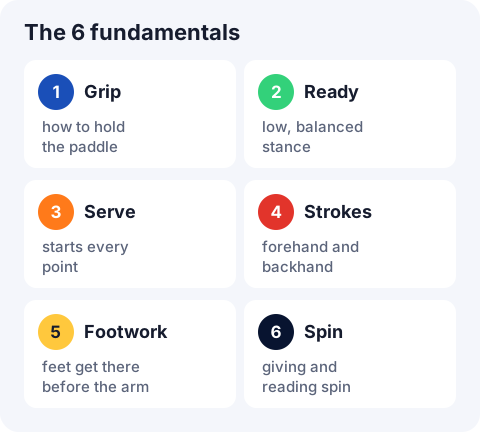
| Fundamental | What it is | Why it matters |
|---|---|---|
| 1. Grip | How you hold the paddle | The base of every stroke |
| 2. Ready position | Your stance between shots | Lets you react quickly in any direction |
| 3. Serve | The shot that starts the point | Lets you control how the rally begins |
| 4. Strokes | Forehand and backhand, in several versions | Returning, attacking and defending |
| 5. Footwork | How you move your feet | Getting into the right position to hit |
| 6. Spin | The rotation of the ball | Controlling and deceiving; reading your opponent |
Why do some lists have 3 or 4 fundamental skills?
Because every coach or textbook groups them differently. A list of 3 usually covers grip, serve and strokes. A list of 4 usually adds footwork or splits forehand and backhand. They all describe the same things; the list above just breaks them down in more detail.
1. Grip
How you hold the paddle. There are two main grips:
- Shakehand: like shaking hands. The most common grip in the world and the best choice for beginners.
- Penhold: like holding a pen, common among Asian players.
The most common mistake is squeezing too hard. Keep the hand firm but relaxed. Details in table tennis grip and shakehand vs penhold.
2. Ready position
Between shots, a player stands:
- about one step from the table;
- with feet a bit wider than shoulder width;
- knees bent and weight on the balls of the feet;
- paddle in front of the body, around table height.
This stance lets you move quickly to your forehand or backhand.
3. Serve
The only shot you play without depending on your opponent. The ball starts on an open palm, rises at least 16 cm (6 in), and must bounce first on your side and then on your opponent's side. A good serve has spin and lands short or long on purpose. See table tennis serve rules and how to serve.
4. Strokes: forehand and backhand
Every stroke is either a forehand (on your paddle-hand side) or a backhand (on the other side). The basic table tennis strokes:
| Stroke | When to use it |
|---|---|
| Drive (counter-hit) | Rallies without much spin, to build consistency |
| Push | Returning short backspin balls while keeping them low |
| Block | Returning attacks using your opponent's pace |
| Loop (topspin) | Attacking with forward spin, the key shot of modern table tennis |
| Smash | Putting away high balls |
| Flick | Attacking short balls over the table |
Each stroke has its own guide: forehand, backhand, push and forehand loop.
5. Footwork
Many beginners try to reach the ball with just their arm. The right way is to move your feet first and hit with your body in position. The most common movements are short side steps and a crossover step for wide balls. Drills in table tennis footwork.
6. Spin
Spin is the rotation of the ball. The three basic types:
- topspin: the ball rotates forward, dips and kicks forward off the bounce;
- backspin: it rotates backward, floats and checks up on the bounce;
- sidespin: it rotates sideways and curves.
Being able to create and read spin is what separates table tennis from basement ping pong. Read spin in table tennis.
The order to learn them
- Grip and ready position.
- Basic forehand and backhand, until you can keep a rally going.
- A simple serve, then a backspin serve.
- The push, to return backspin balls.
- Side-to-side footwork combined with forehand and backhand.
- The forehand loop and the block.
- Reading spin, varied serves and advanced strokes.
A weekly plan that follows this order is in the beginner training plan.
Technical vs tactical fundamentals
The fundamentals above are technical: the "how". There is also the tactical side, the "what": where to place the ball, when to attack, how to vary your serve. Tactics only work once your technique is reasonable, which is why the fundamentals come first. When you get there, see tips to win more points.
Frequently asked questions
What are the fundamentals of table tennis?
Grip, ready position, serve, forehand and backhand strokes, footwork and spin.
What are the 4 basic skills in table tennis?
A common breakdown is grip, serve, strokes (forehand and backhand) and footwork. Some lists swap footwork for spin.
What is the most important table tennis fundamental?
The grip, because every stroke depends on it. At a high level, the serve and the loop decide the most points.
What are the basic strokes in table tennis?
The drive, push, block, loop, smash and flick, each played on the forehand or backhand side.