How to hit a table tennis backhand, step by step
To hit a backhand, face the table with your feet parallel and your knees bent, keep your elbow slightly in front of your body, bring the paddle back near your stomach and hit the ball in front of you at the top of the bounce, with a short forward stroke that finishes pointing at your target.
In this article
The backhand is the stroke you hit on the opposite side from your playing arm: for a right-hander, balls on the left and balls coming at the middle of the body. In modern table tennis it matters as much as the forehand, because it is fast, compact and used constantly in rallies close to the table.
This guide walks through the basic backhand (backhand drive) step by step. It is the base for the block and the backhand loop.
Stance
- Feet: parallel to the end line, a little wider than your shoulders. Unlike the forehand, there is no need to drop a foot back.
- Knees: bent, weight on the balls of your feet.
- Elbow: slightly in front of your body, not tucked against it. It is the hinge of the stroke.
- Paddle: in front of you, at about stomach height.
- Distance: close to the table, about an arm's length from the end line.
The backhand stroke, step by step
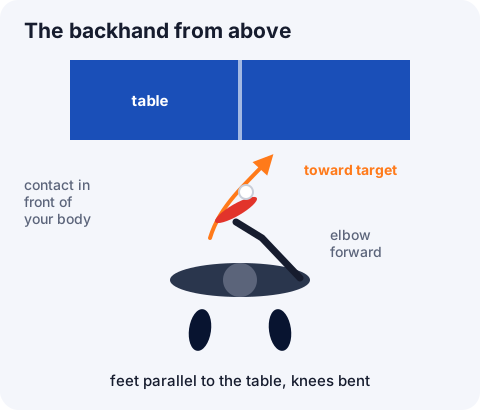
- Backswing: bring the paddle back near your stomach, a little left of center (for right-handers). The wrist bends back slightly.
- Angle: keep the paddle face slightly closed, tilted toward the table.
- Contact: extend your forearm forward and hit the ball in front of your body, at the top of the bounce or just before.
- Touch: the paddle meets the back and a bit of the top of the ball, moving forward and slightly upward.
- Follow-through: finish with your arm almost straight and the paddle pointing at the target, at shoulder height or a bit lower.
- Recover: get straight back to the ready position.
What moves on a backhand
The backhand is a forearm stroke. The elbow stays nearly still, like a hinge, and the forearm swings forward. The wrist helps at the end, especially to add spin. Your body turns much less than on the forehand.
Contact point and timing
Timing matters even more on the backhand, because the stroke is short. Hit the ball in front of your body, in the center or slightly to the left. If the ball drifts wide, move your feet to get behind it instead of reaching with your arm.
Ideally, take the ball at the top of the bounce or slightly before. That way you use the ball's own pace and do not need much force.
Penhold backhand
Penhold players can hit the backhand two ways: with the same side of the paddle as the forehand (traditional backhand) or with the other side (reverse backhand). The stroke shape is similar, but the wrist angle changes. The details are in our penhold grip guide.
Common backhand mistakes
- Elbow stuck to your stomach. With no room, the arm cannot extend. Keep the elbow a little forward.
- Hitting beside your body. Move your feet so the ball is in front of you.
- An open paddle. The ball sails high. Close the face a little.
- Too long a stroke. The backhand is short and quick. A big swing makes you late for the next ball.
- A raised shoulder. Relaxed, low shoulders make the stroke smoother.
- Straight legs. Bent knees help you adjust to the ball's height.
Simple drill: crosscourt backhand
- With a partner, both hit backhands crosscourt (each player's left side, for right-handers), slowly and without spin.
- Count your rally. The first goal is 20 in a row without a miss.
- Then one player hits backhands while the other hits forehands down the line.
- Finally, alternate: one ball to the backhand and one to the middle, to practice adjusting your feet.
This drill plus the forehand one covers the foundation of the whole game. See also our forehand guide.
Frequently asked questions
What is a backhand in table tennis?
It is the stroke hit on the opposite side from your playing arm, with the paddle in front of your body. For a right-hander, it is the ball on the left.
How do you hit a backhand in ping pong?
Feet parallel to the table, elbow forward, paddle near your stomach and a short forward forearm stroke, hitting the ball in front of your body.
Why does my backhand go into the net?
The paddle may be too closed for that ball, or you are hitting the ball after it has dropped too far. Take it earlier and adjust the angle to the incoming spin.
Is the backhand harder than the forehand?
It feels that way for many beginners, but the backhand is a smaller motion and often becomes consistent quickly with practice.