Table tennis (ping pong) serve rules, explained
In singles, the serve does not have to go diagonal: it can land anywhere on your opponent's side. Only in doubles must it go from your right half to their right half. In every case the ball has to bounce once on each side.
In this article
The serve is the only moment in a rally when you have full control of the ball, which is why it has so many rules. They all exist for one reason: your opponent has to be able to see what you are doing. Below are the official ITTF rules, plus the questions that come up most in casual games.
Does the serve have to go diagonal?
It depends on the game:
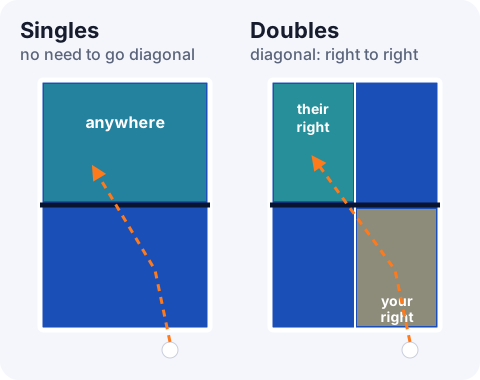
| Game | Must it go diagonal? | Where the ball may land |
|---|---|---|
| Singles | No | Anywhere on the opponent's side |
| Doubles | Yes | From your right half to the opponent's right half |
The confusion comes from tennis and from house rules. Under the official singles rules, the white center line means nothing: it only exists for doubles serves. In doubles, a serve that lands on the center line counts as in.
A legal serve, step by step
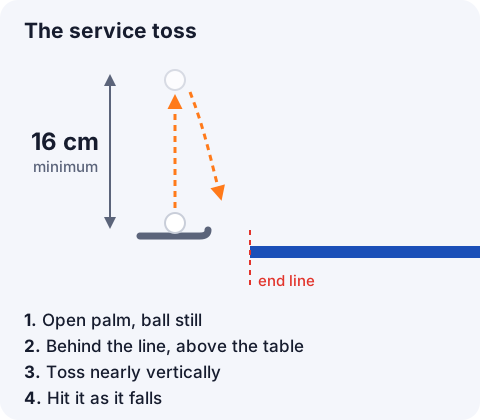
- Start with the ball resting still on the open, flat palm of your free hand, without gripping it with your fingers.
- Keep the ball behind the end line and above the level of the playing surface.
- Toss the ball nearly vertically upward, without spin, at least 16 cm (about 6 inches).
- Strike the ball only as it is falling.
- Make the ball bounce first on your side, then pass over or around the net and bounce on your opponent's side.
The 16 cm toss
The 16 cm are measured from the moment the ball leaves your hand. That is a little more than the height of the net (15.25 cm), so a good reference is to toss the ball clearly above net height. In tournaments, serves with a toss that is too low are among the most common faults umpires call.
You cannot hide the ball
From the toss until contact, the receiver must be able to see the ball. You cannot hide it with your body, head, clothing or free arm. That is why, after the toss, your free arm has to move out of the space between the ball and the net. This is the part of the rule that advanced players have to watch most, because hiding the contact would also hide the spin.
How many serves each player gets
Each player serves 2 points in a row, then the serve passes to the opponent. At 10-10, the serve alternates every point until the game ends. In each new game, the player who received first in the previous game serves first.
Before the match, a draw decides who chooses between serving, receiving or picking an end.
Serve hits the net: let or point?
- The serve touches the net and lands correctly on the opponent's side: it is a let and the serve is replayed, with no limit.
- The serve touches the net and lands out or on the wrong half: point to the receiver.
- The serve touches the net and then hits the receiver or their racket before bouncing: let.
There is no "second serve" like in tennis. A faulty serve is a lost point.
Common serve faults
- Tossing the ball from over the table, with your hand above the playing surface.
- Tossing too low, or adding spin with your fingers during the toss.
- Hitting the ball while it is still rising.
- Hiding contact with your free arm or shoulder.
- In doubles, serving straight instead of diagonally.
Is a spin serve allowed?
Yes. What you cannot do is spin the ball during the toss. At contact you can use any spin: backspin, topspin, sidespin or combinations. Spin is exactly what makes the serve a weapon. To understand each one, read spin in table tennis.
Frequently asked questions
Does a ping pong serve have to go diagonal?
In singles, no. The serve can land anywhere on the opponent's side. Only in doubles must it go diagonally, from your right half to their right half.
How high do you have to toss the ball when serving?
At least 16 cm (about 6 inches) after it leaves your hand, nearly vertically and without spin.
How many serves does each player get?
Two in a row. At 10-10, the serve alternates every point.
What happens if the serve hits the net?
If the ball then lands on the correct side, it is a let and the serve is replayed. If it lands out, the receiver wins the point.
Can you serve with the ball over the table?
The ball must be above the level of the table, but behind the end line, never over the playing surface.