Table tennis footwork: how to move and drills to practice
Table tennis footwork uses short, quick steps from a ready position with bent knees and weight on the balls of your feet. The side shuffle (lead with the outside foot) covers most balls, the crossover step handles very wide balls, and the pivot lets you use your forehand from the backhand corner.
In this article
Plenty of people think table tennis is all arm. It is not. Most beginner errors come from arriving late or badly placed for the ball, and that is a footwork problem. Good footwork means you always hit in front of your body, at the right height and in balance.
The table is small, so the steps are small too: short, quick and constant.
Ready position
All movement starts from the ready position:
- Feet a little wider than your shoulders. For right-handers, the right foot is slightly back.
- Knees bent, as if about to sit on a high stool.
- Weight on the balls of your feet, never on your heels.
- Upper body leaning forward, paddle in front of you.
- Position at the table: for right-handers, slightly toward the backhand side (left), so the forehand covers more table.
Between shots, always come back to this position. That recovery is half of good footwork.
The main footwork patterns
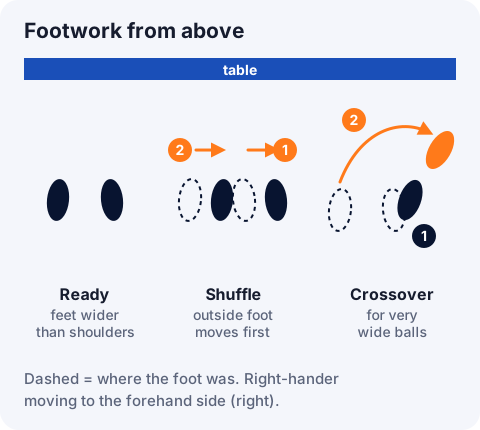
| Step | How | When |
|---|---|---|
| Side shuffle | The foot on the side you are moving to goes first; the other follows. Feet never cross | Most balls, short and medium distances |
| Single step | Only one foot moves; the other is the anchor | Balls close to the body, quick adjustments |
| Crossover step | One foot crosses in front of the other to cover more ground | Very wide balls, mostly to the forehand |
| Pivot | You turn your body in the backhand corner to hit a forehand | Attacking a ball on your backhand side with the forehand |
| In and out | One foot steps under the table and back | Short balls: pushes, flicks, short serves |
How to do the side shuffle
- Start in the ready position, knees bent.
- Push off the inside foot and move the foot on the side the ball is going to first.
- Bring the other foot right after, keeping the same distance between your feet.
- Keep your body at the same height, without bobbing up and down.
- Hit the ball in balance and shuffle back to the center the same way.
The forehand pivot
The pivot is how you attack with your forehand a ball that comes to your backhand. For right-handers: step left with the left foot and turn your body, bringing your right foot back. Now you are side-on and the forehand has room. It is a big move, so use it when you have time and the ball is attackable. After pivoting, your forehand corner is open, so recover fast.
Common footwork mistakes
- Straight legs. Without bent knees, you cannot push off.
- Weight on your heels. Your first step is slow.
- Crossing your feet when you do not need to. For nearby balls, the shuffle is faster and more balanced.
- Reaching with your arm instead of moving. The shot loses power and accuracy.
- Not returning to the center. After hitting from a corner, you get stuck there.
- Hopping. Keep steps low to the ground. Jumping costs balance.
Table tennis footwork drills
- Shadow footwork: at the table, shuffle from corner to corner while making the stroke motion, for 30 seconds. Rest and repeat 5 times.
- Two-point forehand: your partner sends one ball to your backhand corner and one to the middle, alternating. Hit forehands on both, moving your feet.
- Wide two-point: one ball to the forehand corner and one to the middle, always forehand.
- Falkenberg drill: a backhand from the backhand corner, a forehand from the backhand corner (with a pivot), then a forehand from the forehand corner. Repeat the pattern.
- Random: your partner places balls anywhere without warning. React and come back to center.
All of these also work with multiball and robots. When the drills get intense, do a proper warm-up first. To fit them into a routine, see our beginner training plan.
Frequently asked questions
What is the ready position in table tennis?
Feet a little wider than your shoulders, knees bent, weight on the balls of your feet, upper body leaning forward and paddle in front of you.
How can I improve my table tennis footwork?
Practice short side shuffles with shadow drills, do two-point drills and always return to the center after each shot.
When should I use a crossover step?
For very wide balls, mostly in the forehand corner, when a shuffle cannot cover the distance.
What is the Falkenberg drill?
A classic footwork drill: backhand from the backhand corner, forehand from the backhand corner with a pivot, then forehand from the forehand corner, in a loop.
Can I practice footwork at home?
Yes. Shadow footwork without a ball, with or without a paddle, trains the patterns and the leg strength you need.