The push in table tennis: technique, step by step
The push is a short stroke where you slide an open paddle under the ball, moving forward and slightly down, to return it low with backspin. It is used mostly against short backspin balls near the net, so you do not give your opponent an easy ball to attack.
In this article
The push is the stroke you see most at the start of points. When your opponent serves short with backspin, the safest answer is often another push: a low ball with backspin that is hard to attack.
Do not confuse the push with the chop, the defensive backspin stroke played far from the table. The push is short and played close to the table. (In Brazil, the push is called corte, which is easy to mix up with cortada, their word for the smash.)
When to push
- Against short backspin serves you cannot attack.
- Against other short pushes, in a push rally.
- To change the pace, sending a slow low ball before you attack.
Against topspin, pushing does not work well: the ball pops up and goes long. Learning to read spin comes first.
Stance
- Close to the table. The push is played over the table or just behind the end line.
- Step in. Against short balls, put your playing-side foot (the right, for right-handers) under the table near the ball.
- Stay low. Bend your knees and waist to reach the ball's height without stretching your arm.
The push, step by step
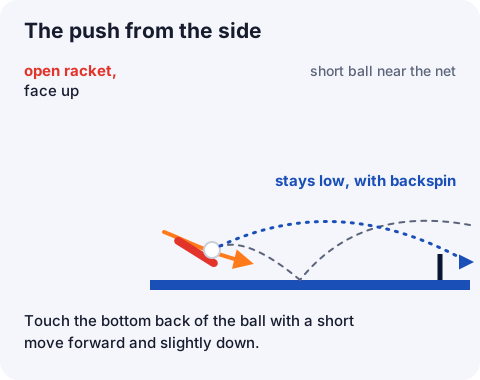
- Move to the ball with your inside foot stepping in and your body low.
- Open the paddle so the face points up. The more backspin on the ball, the more open the paddle.
- Keep the backswing short: bring the paddle back only a little, slightly above ball height.
- Contact: touch the bottom back of the ball at the top of the bounce or just after, moving forward and slightly down.
- Brush the ball to add spin instead of shoving it. The stroke is short.
- Finish with the paddle pointing at the target and get back to ready.
Short push vs long push
| Short push | Long push | |
|---|---|---|
| Goal | Ball bounces twice on the opponent's side | Ball goes deep to the end line |
| Contact | Very early, right after the bounce | At the top of the bounce |
| Stroke | Very short, almost just a touch | A bit longer, more forward |
| Risk | Can float high if the angle is off | Gives the opponent a chance to loop |
A fast, long push to a corner or to the elbow is also a good weapon, because it rushes your opponent.
Forehand push and backhand push
The backhand push is the most common, since it is natural and covers much of the table. The motion comes from the elbow, with the paddle in front of your body.
The forehand push needs more footwork, especially on short balls to the forehand. Step in with the right foot and keep the paddle open.
Common push mistakes
- A square paddle. Against backspin, the ball goes into the net. Open the face.
- Too long a stroke. The ball floats high and long. Keep it short.
- Hitting late. If the ball drops too far, it is hard to keep low. Take it at the top of the bounce.
- Reaching with your arm. Bring your body to the ball with your inside foot.
- Pushing without brushing. A push without spin is easy to attack.
- Pushing everything. If you only push, your opponent always attacks first. Use the push to set up your own attack.
Simple drill: push rally
- With a partner, push backhand to backhand crosscourt, slowly, for 3 minutes.
- Then aim short: the ball should bounce twice on the other side.
- Next, mix short and long without warning.
- Finish with a game: whoever pushes high or too long loses the point.
Frequently asked questions
What is a push in table tennis?
It is a stroke where an open paddle slides under the ball, returning it low with backspin. It is mostly used against short backspin balls.
What is the difference between a push and a chop?
Both create backspin, but the push is a short stroke played close to the table, while the chop is a longer defensive stroke played away from it.
How do you return a heavy backspin ball?
Open your paddle and push back under the ball, or loop it with a clearly upward swing.
Why does my push float high?
The paddle is too open, the stroke too long, or you are hitting after the ball has dropped. Use a shorter, earlier touch.