The forehand loop in table tennis: technique, step by step
The forehand loop is a forehand where the paddle brushes the ball from low to high, putting heavy topspin on it. Against backspin the swing goes more upward with a nearly square paddle; against topspin it goes more forward with a more closed paddle. Either way, power comes from your legs and waist and the paddle speeds up through contact.
In this article
The forehand loop (or forehand topspin) is the most important attacking stroke in modern table tennis. Instead of hitting through the ball like a basic forehand drive, you brush it from low to high so it spins hard forward. That spin makes the ball dip, so it lands on the table even when you hit hard.
Before learning to loop, make sure your basic forehand is solid. To understand the physics of the spin, see what is topspin.
Forehand loop vs drive
| Forehand drive | Forehand loop | |
|---|---|---|
| Contact | Fuller, through the ball | Thin, brushing the ball |
| Swing | Forward | Low to high and forward |
| Spin | Little | Lots |
| Used for | Rallies, no-spin balls | Attacking backspin, counter-looping, finishing |
Stance and backswing
- Feet: wider than your shoulders, the right foot (for right-handers) further back than on the drive.
- Knees: well bent. The loop starts in your legs.
- Backswing: turn your waist back and drop the paddle. The more backspin on the ball, the lower the paddle starts.
- Arm: relaxed, elbow away from your body. A stiff arm cannot accelerate.
The forehand loop, step by step
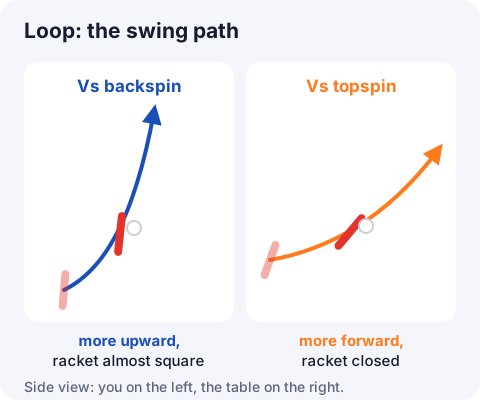
- Read the ball: is it coming with backspin or topspin? That decides the swing path.
- Load: turn your waist back, bend your back leg and bring the paddle below the height of the ball.
- Push off the floor: start the stroke with your legs, rotating your waist forward. The arm follows.
- Contact: hit the ball in front of your body with a thin contact, brushing the back of the ball (against backspin) or the back and top (against topspin).
- Accelerate: the paddle should be gaining speed at contact, with the forearm snapping closed.
- Finish: end with the paddle high, near or above your forehead, and get back to ready quickly.
Forehand loop against backspin
Against a backspin ball, the spin pulls the ball down off your paddle. So:
- The swing goes more upward than forward.
- The paddle stays almost square, only slightly closed.
- Take the ball at the top of the bounce or just after, as it starts to drop. That gives you more time and margin.
- Use plenty of leg drive: you are lifting the ball.
This is the classic stroke for attacking a long backspin serve or your opponent's push.
Forehand loop against topspin
Against a ball that already has topspin, the spin makes it jump up off your paddle. So:
- The swing goes more forward.
- The paddle is more closed, tilted toward the table.
- Take the ball earlier, at the top of the bounce, contacting the back and top.
- The stroke can be shorter, since the ball already brings pace.
When both players trade loops, this is called counter-looping.
Common forehand loop mistakes
- All arm. Without legs and waist, spin and speed stay weak.
- Too full a contact. Hitting through the ball sends it flat and long. Brush it.
- One swing for everything. Against backspin go up; against topspin go forward.
- A stiff arm. Tension kills acceleration. Stay loose and speed up only at contact.
- Hitting behind your body. If the ball gets past you, move your feet earlier.
- Admiring your shot. After contact, recover. The point is not over.
Drills to practice
- Multiball against backspin. A partner or coach feeds backspin balls one after another to your forehand. Just loop, without worrying about speed. Here is how multiball training works.
- Push then loop. Your partner pushes, you open with a loop, they block, and you start over. It is the basic drill for opening a point.
- Continuous looping. You loop crosscourt while your partner blocks. Start slow and count balls in a row.
Frequently asked questions
How do you hit a forehand loop in table tennis?
Brush the ball from low to high with the paddle accelerating at contact, driving from your legs and waist. The contact is thin, grazing the back or top of the ball.
What is the difference between a forehand loop and a drive?
A drive hits more through the ball with little spin. A loop uses a low-to-high swing to put heavy topspin on it.
How do you loop against backspin?
Start with the paddle low and nearly square, swing clearly upward and take the ball at the top of the bounce or just after, using lots of leg drive.
Why does my forehand loop go into the net?
Against backspin, you are usually not lifting enough or your paddle is too closed. Open the angle slightly and swing more upward.
Do I need a special paddle to loop?
It does not need to be expensive, but the rubber needs grip. Very hard, slick rubbers barely spin the ball.