How to serve in table tennis: a step-by-step guide for beginners
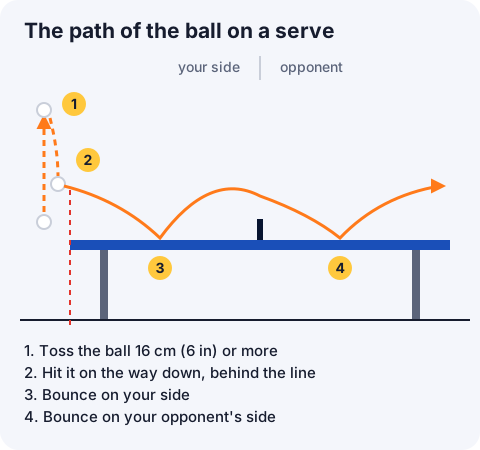
To serve in table tennis, stand behind the end line, rest the ball on your open palm, toss it at least 16 cm (about 6 in) straight up and hit it as it falls. The ball must bounce first on your side, close to your end line, and then on your opponent's side.
In this article
The serve is the only stroke in table tennis you play without depending on your opponent. That makes it the best place to start: with a little practice on your own, you can put the ball in play every time and then start adding spin.
This guide shows how to serve in ping pong step by step, the way the official rules require, with a basic serve that is the foundation for all the others.
Before you start: the rule in 30 seconds
A legal serve has four fixed points: the ball rests on your open palm, behind the end line and above the table, you toss it at least 16 cm (about 6 in), and you hit it on the way down. It bounces once on your side and once on your opponent's side. The details are in table tennis serve rules.
The basic serve, step by step
- Stance. Stand a little behind the table, on your backhand side (the left, for right-handers). Feet shoulder-width apart, knees slightly bent.
- Ball in hand. Rest the ball on the palm of your free hand, open and flat, without curling your fingers around it. Keep your hand behind the end line and above table height.
- Toss. Throw the ball up, nearly vertically, without spin. Aim a little above eye level, well over the 6-inch minimum.
- Wait for it to drop. Let the ball rise and start to fall. Hitting it on the way up is illegal.
- Hit low. Contact the ball around net height, or slightly below. The lower the contact, the lower the serve.
- First bounce close to you. Aim the first bounce on your side near your own end line. That is what keeps the ball low over the net.
- Recover. After serving, reset your feet and bring the paddle in front of you. The ball is coming back fast.
The secret to a low serve: the first bounce
The most common beginner mistake is aiming the first bounce near the net. The ball then pops up high or goes straight into the net. Think of the serve as two shots: the first is a short ball on your own side, the second is the one that crosses the net.
| First bounce | What happens |
|---|---|
| Near your end line | The ball stays low and lands deeper on the other side |
| Middle of your side | The ball goes over high: easy to attack |
| Near the net | The ball pops up or hits the net |
For short serves that would bounce twice on the other side, the first bounce moves a bit closer to the net and the contact is much softer. Learn more in short vs long serves.
Forehand or backhand?
You can serve with either side of the paddle:
- Backhand serve: easier to learn, with the paddle in front of your body. Good for day one.
- Forehand serve: offers more spin variations and is the most common serve among experienced players, like the pendulum serve.
Start with whichever feels more comfortable and learn the other later.
Mistakes that make a serve illegal
- Tossing the ball off your fingertips or out of a closed hand.
- Tossing too low, so the ball barely leaves your hand.
- Tossing the ball backward or forward at an angle instead of nearly straight up.
- Serving with your hand over the table.
- Hiding the ball with your free arm or body at contact.
In casual ping pong, lots of people serve with the ball dropping out of a closed hand. It is worth dropping that habit early: in a tournament, the umpire will call it.
How to practice serving alone
The serve is the easiest stroke to practice without a partner. Grab a bucket of balls and:
- Serve 20 balls thinking only about the toss: straight, high, no spin.
- Serve 20 more aiming the first bounce near your own end line.
- Put a target (a sheet of paper or a cup) on the other side and try to hit it.
Once the basic serve lands every time, it is time to make the ball spin with a spin serve.
Frequently asked questions
How do you serve in ping pong?
With the ball on your open palm behind the end line, toss it at least 16 cm (about 6 in) up and hit it as it falls. It must bounce first on your side and then on your opponent's side.
Why does my serve keep hitting the net?
Usually because your first bounce is too close to the net or you are hitting the ball too high. Aim the first bounce near your own end line.
Can you serve by dropping the ball from a closed hand?
Not under the official rules. The ball must come off an open palm and rise at least 16 cm.
Does a ping pong serve have to go diagonal?
Not in singles. Only in doubles must the serve go from the right half to the right half.
Which serve should beginners learn first?
A basic no-spin serve, backhand or forehand. Then the backspin serve, which is the most widely used.