Table tennis PE lesson plan
A good table tennis PE lesson runs about 50 minutes: a warm-up with ball and paddle, ball control in pairs, one skill of the day, a rotation game and a short wrap-up. Table tennis fits the net games unit alongside volleyball, tennis and badminton. With only a few tables, desks, benches and the floor can stand in as tables.
In this article
Table tennis works really well in school PE: there is no contact, boys and girls can play on equal terms, the rules are simple, and you can teach it with very little equipment. The usual challenge for PE teachers is different: lots of students and only a few tables.
Below is a ready-to-use table tennis lesson plan with objectives, equipment, timings and adaptations for big classes.
Where table tennis fits in the curriculum
In most PE curricula, table tennis belongs to net games (often grouped as "net and wall games"), along with volleyball, tennis, badminton and pickleball. The shared idea is simple: send the ball to your opponent's side so they cannot return it, without entering their space.
Table tennis is a great way to teach that idea, because rallies are short and the rules are easy to grasp. See how it is classified in is ping pong a sport?.
Lesson plan at a glance
| Item | Suggestion |
|---|---|
| Students | Upper elementary to middle school, about ages 9 to 15 (adjust language and challenge to the age) |
| Length | 50 minutes |
| Unit | Net games |
| Main objective | Get to know table tennis and practice its basic skills and rules |
| Specific objectives | Control the ball with the paddle; return the ball after one bounce; understand the serve and scoring; play respectfully |
| Equipment | Paddles, balls (at least one per pair), tables or improvised surfaces, nets or a row of books, cones or masking tape |
The 50-minute lesson, step by step
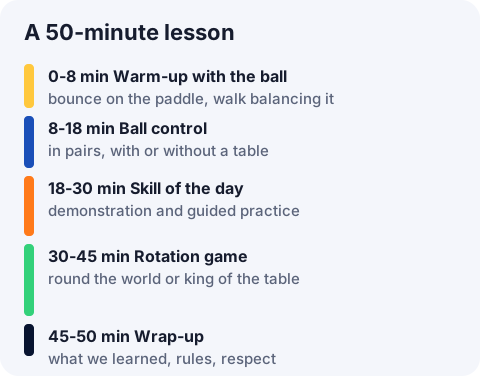
1. Warm-up with the ball (8 min)
Every student has a paddle and a ball. Run through these challenges:
- balance the ball on the paddle and walk around the gym;
- bounce the ball up on the paddle and count the bounces;
- alternate the two sides of the paddle;
- dribble the ball on the floor with the paddle while walking.
2. Ball control in pairs (10 min)
In pairs, facing each other about 6 feet (2 m) apart:
- rally with one bounce on the floor between them;
- count how many rallies in a row the pair can make;
- pairs with a table do the same on the table.
3. Skill of the day (12 min)
Pick one skill per lesson. For the first lesson, try the grip and the basic forehand:
- Show the shakehand grip: hold the paddle like a handshake, index finger resting on the rubber.
- Show the ready position: feet apart, knees bent, paddle in front of the body.
- Demonstrate the forehand: a short stroke from the hip forward, finishing with the paddle around face height.
- Students shadow the stroke without a ball, then with a ball tossed by a partner.
- Finally, pairs try to rally forehand to forehand.
In later lessons, switch the skill: backhand, serve, push, footwork. The full progression is in table tennis fundamentals.
4. Rotation game (15 min)
With few tables, a rotation game keeps everyone playing. Two options:
- Round the world: the class lines up at both ends of the table; each student hits once and runs to the other end. Miss and you are out until the next round.
- King of the table: one student holds the table; whoever wins a point against them takes their place.
These and other PE games are explained in fun ping pong games for kids.
5. Wrap-up (5 min)
Questions to finish:
- What was hardest today?
- How does the ball have to bounce on a serve?
- How did you react when your partner made a mistake?
Teaching with only a few tables
| Problem | Solution |
|---|---|
| Only one table | Rotation at the table plus stations around it: balancing, targets, floor rallies |
| No tables | Push two desks together with a row of books as the net |
| Not enough paddles | Cardboard paddles, sturdy paper plates or thin hardback books |
| Very large class | 5-minute stations and paired floor rallies |
| Uneven floor | Rally in the air, without bounces, for the control drills |
Long benches, cafeteria tables and even the gym floor with a line of tape as a net work for the first drills.
Assessment
Assess participation and progress, not match results:
- can keep the ball on the paddle for a few seconds;
- returns the ball after one bounce, at least some of the time;
- can explain the serve rule and scoring to 11;
- waits their turn and respects the result.
The rules to explain to the class are in table tennis rules summary, and there is a version to print in printable ping pong rules.
Safety and inclusion
- Space stations apart to avoid paddle swings hitting anyone.
- Agree that no one chases a ball into another pair's area during a rally.
- Students with disabilities can take part with adaptations. Para table tennis has classes for standing and wheelchair players (see para table tennis).
Frequently asked questions
How do you write a table tennis lesson plan?
Set an objective, list equipment and plan the timings. A structure that works: ball warm-up, ball control in pairs, one skill of the day, a rotation game and a wrap-up, in about 50 minutes.
How do you teach table tennis in PE without tables?
Use desks pushed together with books as a net, benches, cafeteria tables or the floor with a line of tape. Ball control drills work even without a table.
What are good table tennis PE games?
Round the world, king of the table, target challenges with cups and counting rallies in a row are easy to run with big groups.
What table tennis skills should you teach first?
Grip, ready position and the basic forehand. Then backhand, serve and push.