Shakehand vs penhold: which table tennis grip should you choose?
For most people, shakehand is the better grip to start with: the backhand is more natural, it covers both sides of the table well and it is the grip most coaches teach. Penhold is worth it if you want a fast game close to the table, with lots of wrist and a strong forehand, and you are willing to put extra work into your backhand and footwork.
In this article
"Shakehand or penhold?" is one of the first questions people ask once they start taking table tennis seriously. Both grips work, and both have won Olympic and world titles. The difference is the style of play each one favors.
This guide compares them side by side and helps you choose. If you are not sure how to do each grip yet, start with our table tennis grip guide.
Shakehand vs penhold in one sentence
With shakehand you hold the paddle as if shaking hands, with one side for forehands and the other for backhands. With penhold you hold the handle like a pen, pointing up, and your wrist is much freer.
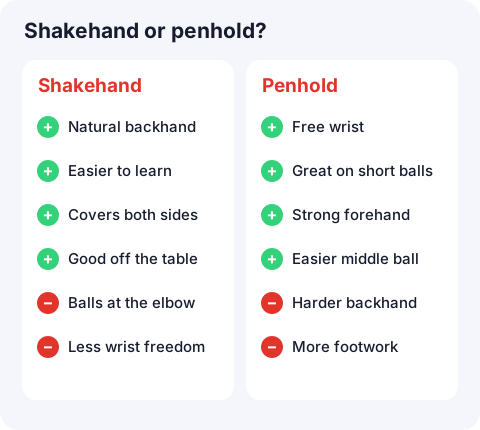
Side by side comparison
| Aspect | Shakehand | Penhold |
|---|---|---|
| Backhand | Natural, strong with topspin | Harder; needs the reverse backhand to attack |
| Forehand | Strong | Strong, with lots of wrist |
| Short balls over the table | Good | Excellent, very free wrist |
| Ball at the body | The classic weak spot (the elbow) | Usually easier |
| Away from the table | Works well on both sides | More limited on the backhand |
| Learning curve | Easier, lots of material | Fewer coaches and videos |
| Paddle | Any standard paddle | Works with a standard paddle; penhold blades exist |
When shakehand is the better choice
Shakehand is the safer pick for most players:
- You are a beginner and want to learn from coaches, clubs or videos. Most material teaches this grip.
- You want a balanced game, attacking with topspin from both wings.
- You play a bit further from the table or enjoy long rallies.
- You are a kid or teen with a coach, who will most likely teach shakehand.
The weak spot of shakehand is the ball aimed straight at your playing elbow, where you have to choose quickly between forehand and backhand. Good footwork and practice fix most of that.
When penhold is the better choice
Penhold makes sense when:
- You like playing close to the table, fast, with short balls, flicks and varied serves.
- Your forehand is your weapon and you do not mind moving a lot to use it.
- You have played penhold for years and feel at home. Switching after a long time is like starting over.
- You have a penhold coach who can teach the reverse backhand.
The weak spot is the backhand, especially attacking with topspin. The reverse penhold backhand fixed much of that at the top level, but it takes a lot of practice.
What do the pros use?
Most players at the top of the rankings today use shakehand. Penhold was dominant for decades, especially in China, and still has top players, but it has become less common. That does not make penhold worse: it means more kids learn shakehand, and that shows at the top.
How to decide in 3 steps
- Grab a paddle and hit simple forehand and backhand rallies with both grips, 10 minutes each.
- Notice which grip keeps the paddle steady without thinking about it, and which backhand feels less awkward.
- If there is no clear winner, go with shakehand and give it at least a few months before thinking about switching.
Common mistakes when choosing
- Copying your idol. Using a champion's grip guarantees nothing. Pick what works for you.
- Switching back and forth. Every switch resets your progress. Decide and stick with it.
- Thinking penhold "has no backhand". It does; it is just different and takes more work.
- Ignoring your coach. If you train at a club, the grip your coach knows best will speed you up.
Frequently asked questions
Shakehand or penhold: which is better?
Neither is better at everything. Shakehand is more balanced and easier to learn; penhold gives more wrist and a strong forehand, but the backhand is harder.
What grip do pro table tennis players use?
Most use shakehand today. Penhold still appears at the top level, but it has become less common over the last few decades.
Should a beginner start with penhold?
You can, but the usual advice is shakehand, because there are far more coaches and resources to learn from.
Can you switch from penhold to shakehand?
Yes. Many players make that switch, but it takes time for your strokes to feel natural again.
Do I need a different paddle for each grip?
A standard paddle works for both. Penhold-specific blades with shorter handles exist, but you do not need one.