How to hit a table tennis forehand, step by step
To hit a forehand, stand with your feet a little wider than your shoulders and your right foot slightly back (for right-handers), turn your waist to bring the paddle back to hip height, hit the ball in front of your body as it rises or at the top of the bounce, and finish with the paddle near your forehead.
In this article
The forehand is the stroke you hit on the side of your playing arm: for a right-hander, balls on the right side. It is the first stroke almost every coach teaches and, for many players, the strongest shot in their game. The basic forehand, also called the forehand drive, is the foundation for the forehand loop later on.
Here is the forehand technique step by step, plus the most common mistakes and a simple drill.
Stance
- Feet: a little wider than shoulder width. For a right-hander, the right foot is slightly behind the left.
- Knees: bent, with your weight on the balls of your feet, not your heels.
- Upper body: leaning slightly forward.
- Distance: about an arm's length from the table.
- Paddle: in front of your body, a bit above table height, in the ready position.
Use a neutral shakehand grip. If you are not sure how to hold the paddle, see our table tennis grip guide.
The forehand stroke, step by step
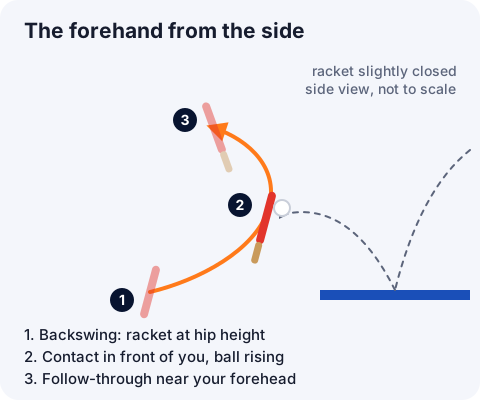
- Backswing: turn your waist and right shoulder back, bringing the paddle to about hip height beside your body. Your weight shifts to your right leg.
- Paddle angle: keep the face slightly closed, tilted toward the table. Against balls with little spin, the angle is almost square.
- Contact: rotate your waist forward and hit the ball in front of your body, slightly to the right, as it rises or at the top of the bounce.
- Touch: the paddle meets the back and a bit of the top of the ball, moving forward and slightly upward.
- Follow-through: let your arm carry on until the paddle ends near your forehead, pointing where you sent the ball. Your weight moves to your left leg.
- Recover: relax and get straight back to the ready position for the next ball.
Where the power comes from
Forehand power comes mostly from waist rotation and the weight transfer from one leg to the other. The arm goes along for the ride. The forearm closes at the end, but the wrist stays fairly firm. Hitting with only the arm tires you out and costs you control.
Contact point and timing
The best time to hit is when the ball is rising or at the top of the bounce. If you wait for it to start dropping, it gets lower and slower, and you need to lift more.
Always hit in front of your body. If the ball gets past you and you hit beside or behind yourself, the shot loses power and direction.
Common forehand mistakes
- All arm. Without turning your waist, the stroke is weak and inconsistent.
- Elbow glued to your side, or flying away. Keep about a hand's width or two between elbow and body.
- An open paddle. With the face tilted up, the ball flies high and long. Close it a little.
- A floppy wrist. On the basic forehand the wrist does not whip. That comes later, with the loop.
- Flat-footed on your heels. Without bent knees you are late to every ball. Our footwork guide helps here.
- Finishing low or across your chest. The paddle should end high, near your forehead.
Simple drill: crosscourt forehand
With a partner, both of you hit forehands crosscourt (corner to corner, on each player's forehand side).
- Start slow with no-spin balls and count how many you can hit in a row without missing.
- Once you pass 20 in a row, add a little speed.
- Then switch to down the line: one player hits forehands and the other returns with backhands.
- Finish with 2 minutes where each player picks the right ball to speed up.
No partner? Shadow the stroke in front of a mirror, or practice against a wall or a robot. There are more ideas in how to practice table tennis alone.
Frequently asked questions
What is a forehand in table tennis?
It is the stroke hit on the side of your playing arm. For a right-hander, it is a ball hit on the right side of the body, with the palm side of the paddle.
What is the difference between a forehand and a backhand in ping pong?
The forehand is hit on your paddle side and relies more on body rotation. The backhand is hit in front of your body, on the other side, with a shorter motion.
How can I improve my table tennis forehand?
Turn your waist more, hit the ball in front of you at the top of the bounce, and repeat the stroke in long crosscourt rallies until it becomes automatic.
Why does my forehand always go long?
Usually the paddle is too open or you are hitting the ball as it falls. Close the angle a little and take the ball earlier.
Is a forehand drive the same as a forehand loop?
Not quite. The forehand drive has little spin. The forehand loop uses a more low-to-high swing to put heavy topspin on the ball.