Spin in table tennis: topspin, backspin and sidespin explained
Topspin makes the ball rotate forward, dip faster and kick forward off the bounce. Backspin makes it rotate backward, float and slow down off the bounce. Sidespin makes the ball curve sideways. To return any of them, you adjust your paddle angle against the spin.
In this article
A table tennis ball weighs just 2.7 grams (less than a tenth of an ounce) and can spin extremely fast. That is why spin matters as much as speed in table tennis. Understanding the three basic spins is what separates someone who just "gets the ball back" from someone who can attack and control the point.
Why the ball curves
When the ball spins, it drags the air around it. On one side the air moves faster, on the other slower, and that creates a force that pushes the ball sideways relative to its path. This is the Magnus effect, the same thing that makes a soccer ball bend on a free kick or a baseball curve. The direction of the curve depends on the direction of the spin. We go deeper in the physics of spin.
Spin also acts at two more moments: on the bounce, when the spin grips the table and changes the ball's speed and height, and on contact with the paddle, when the rubber picks up the spin and sends the ball off in a direction you did not expect.
The three basic spins
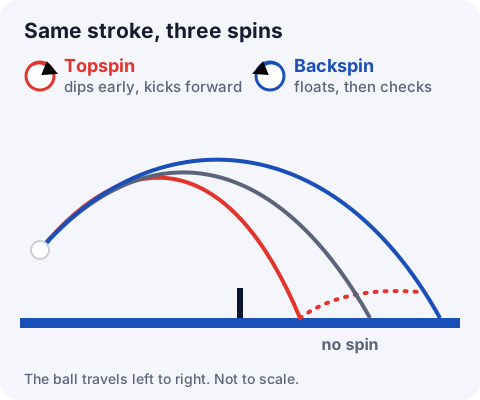
| Spin | How the ball rotates | In the air | On the bounce | On your paddle |
|---|---|---|---|---|
| Topspin | Forward, top over bottom | Dips faster, curves downward | Speeds up and stays low | Jumps up and long |
| Backspin | Backward, bottom over top | Floats and seems to "hang" | Slows down, sometimes almost stops | Drops down, into the net |
| Sidespin | Around a vertical axis | Curves left or right | Kicks a little sideways | Goes off to the side |
Topspin
Topspin is the spin of the modern attack. You brush the ball with the paddle moving upward, grazing the top or back of the ball. Because the ball dives at the end of its flight, you can hit hard and still land it on the table. That is why nearly every high-level point is decided with topspin. More in what is topspin.
How to return it: close your paddle (tilt the face down) and block or counter over the top of the ball. With an open paddle, the ball flies high or long.
Backspin
Backspin (often called underspin or "chop") is the spin of defense and short serves. You slide an open paddle under the ball, from high to low. The ball stays slow, low and hard to attack. More in what is backspin.
How to return it: open your paddle (face up) and push back under the ball with your own backspin, or lift it with a loop that goes more up than forward. Hit it flat and it goes into the net.
Sidespin
Sidespin shows up mostly on serves. The paddle crosses the side of the ball, so it curves in the air and deflects off your paddle. It is almost always mixed with topspin or backspin.
How to return it: angle your paddle slightly to compensate for the deflection, or hit with more pace so the spin has less time to act.
Mixed spins and the no-spin ball
In practice nearly every ball is a mix: backspin with sidespin, topspin with sidespin. There is also the no-spin ball (a "float" or "dead ball"), which looks like backspin but barely rotates. It is dangerous precisely because it fools you: if you expect backspin, you open your paddle too much and the ball pops up.
How to put spin on a ping pong ball
- Brush, do not push. Spin comes from grazing the ball with the rubber, not from hitting it flat.
- Use grippy rubber. Tacky, grippy rubbers spin more. Very cheap paddles with hard, slick rubber barely spin the ball.
- Accelerate at contact. Spin depends on paddle speed at the moment of contact, not on swinging your whole arm hard.
- Thin contact. The more tangential the contact (the paddle just grazing the ball), the more spin and the less speed.
- Wrist and forearm. On serves, a loose wrist adds extra spin.
The step by step version is in how to put spin on a ping pong ball.
How to read your opponent's spin
- Watch the paddle at contact. Its motion tells you the spin: upward means topspin, downward means backspin, sideways means sidespin.
- Watch the flight. A ball that dives is topspin; a ball that floats and arrives slowly is usually backspin.
- Listen. A thin, "brushing" contact usually carries more spin than a flat, solid sound.
- Watch the ball's logo. On slower balls, you can sometimes see it rotate.
- Play safe. If you cannot tell, return a controlled ball to the middle of the table and adjust on the next point.
Frequently asked questions
What is the most used spin in table tennis?
Topspin, for attacking, and backspin, for serves and short rallies. Both show up in almost every point.
What does backspin do in ping pong?
It makes the ball rotate backward, so it floats, stays low and slows down on the bounce. Hit it with a square paddle and it drops into the net.
How do you return heavy backspin?
Open your paddle and push under the ball, or loop it with a clearly upward swing.
Why do my returns always go high?
Most likely the ball had topspin and your paddle was open. Close the angle a little and hit over the top of the ball.
Can a cheap ping pong paddle make spin?
A little. Hard, slick rubbers grip the ball poorly. A paddle with decent rubber makes a big difference when you are learning to spin the ball.