Table tennis grips: shakehand, penhold and which to choose
There are two main table tennis grips: the shakehand grip, where you hold the paddle as if shaking hands, and the penhold grip, where you hold it like a pen. Most beginners should start with a neutral shakehand grip, because it gives a natural backhand and is the easiest to learn.
In this article
Your grip is simply how you hold the paddle. It sounds like a small detail, but it sets the racket angle on every stroke, how free your wrist is and even the style you end up playing. A bad grip is one of the most common reasons balls fly long, drop into the net or refuse to take spin.
This guide covers the table tennis grip styles, how to do each one step by step, the usual mistakes and which grip to choose.
What are the table tennis grip styles?
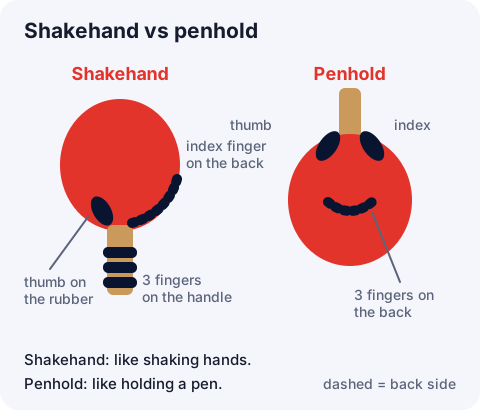
There are two big families:
| Grip | Also called | What it looks like | Where it is common |
|---|---|---|---|
| Shakehand | Handshake grip | Like shaking hands | Most players worldwide |
| Penhold | Pen grip | Like holding a pen | Traditional in Asia; Chinese and Japanese styles |
You will also see the "Seemiller" grip (index finger along the edge of the blade), but it is rare and not a good starting point. Some videos mention a "katana" grip, which is just a shakehand grip with the handle held a bit more sideways, like a sword. In practice nearly everyone plays shakehand or penhold.
How to hold a ping pong paddle with the shakehand grip
Shakehand is the most used grip today and the one most coaches teach first.
- Pick the paddle up by the handle with a relaxed hand, as if you were about to shake someone's hand.
- Let the handle rest against the base of your fingers and your palm, without squeezing.
- Wrap your middle, ring and little fingers around the handle.
- Rest your thumb on the forehand rubber, close to the handle, without stretching it toward the middle of the blade.
- Lay your index finger along the bottom edge of the backhand rubber.
- Check that the edge of the blade lines up with the "V" between your thumb and index finger.
Neutral, forehand and backhand shakehand
Small variations of the shakehand grip change the balance between your two wings:
- Neutral: the blade edge sits in the middle of the "V". This is the one to learn first, because forehand and backhand stay balanced.
- Forehand (strong) grip: the hand turns slightly toward the forehand side. Forehands get easier and backhands harder.
- Backhand (weak) grip: the opposite. It helps the backhand and hurts the forehand.
Some players shift slightly during a rally, but that comes later. Stay neutral while you learn.
How to hold the paddle with the penhold grip
With penhold, the handle points up and the head of the blade points down.
- Pinch the neck of the handle between your thumb and index finger, where the handle meets the blade.
- Rest your other three fingers on the back of the blade for support.
- Keep your hand loose: power comes from your arm and body, not from squeezing.
There are two main styles. In the Chinese penhold, the three back fingers are curled, which makes it easier to use the other side of the paddle for backhands. In the Japanese/Korean penhold, the back fingers are straighter, giving a very solid forehand. The details are in our penhold grip guide.
Which table tennis grip is best?
No grip is best for everyone. Top players have won the biggest titles with both. What changes is what comes easily and what takes work:
- Shakehand gives a natural backhand, covers both sides of the table well and is easier to learn, since far more coaches and videos teach it.
- Penhold gives great wrist freedom on short balls and a strong forehand, but the backhand takes longer to build.
For beginners, the usual advice is a neutral shakehand grip. If you are curious about the other option, the full comparison is in shakehand vs penhold.
Common grip mistakes
- Squeezing too hard. A tight hand locks the wrist and kills touch. Hold just firmly enough that the paddle does not twist.
- Index finger in the middle of the backhand rubber. On a shakehand grip it belongs along the edge. In the middle, it blocks your backhand.
- Thumb across the forehand face. A thumb stretched up the blade pulls the angle around and makes it unstable.
- Drifting without noticing. Many players slide into a strong or weak grip mid-game. Check your grip between points.
- Holding the end of the handle. Your hand should sit against the blade, not down at the butt of the handle.
A simple drill to lock in your grip
Hold the paddle in a neutral shakehand grip and bounce the ball upward, alternating one bounce on the forehand side and one on the backhand side without changing your grip. Start with 20 in a row and build up. It shows right away if your hand rotates between sides.
Then take it to the table and practice your forehand and backhand with the same grip.
Frequently asked questions
What is the most common table tennis grip?
The shakehand grip, where you hold the paddle as if shaking hands. Most players in the world, including at the top level, use it.
Which grip is best for beginners?
A neutral shakehand grip. It balances forehand and backhand, and it is what most coaches teach, so it is easier to find help.
What are the names of the table tennis grips?
The two main ones are shakehand and penhold. Penhold splits into Chinese and Japanese/Korean styles. The Seemiller grip is a rare variation.
Can I switch grips later?
Yes, but it feels like relearning your strokes. The sooner you decide, the easier it is. If in doubt, start with shakehand.
How do you hold a ping pong paddle correctly?
Relaxed hand on the handle, three fingers wrapped around it, thumb on the forehand rubber near the handle and index finger along the edge on the back of the blade.