Why do ping pong players serve like that?
Pro serves look strange because players try to put as much spin on the ball as possible and hide that spin, inside very strict rules. The ball must start on an open palm and rise at least 16 cm (about 6 inches), so the toss is high. Contact is low so the ball stays short and low, and the fast motions and fake follow-throughs are there to confuse the receiver.
In this article
In a basement game, a ping pong serve is simple: ball in hand, a little tap, done. Then you watch a pro match and see players crouch down, toss the ball way up, turn sideways, whip the paddle in a blur and sometimes stomp on the floor. It looks like a different sport.
It is not showing off. Every detail of a pro serve has a reason, and almost all of them come from two things: the rules and spin.
The serve is the one shot you fully control
For the rest of the rally you react to your opponent. On the serve, you choose the spin, speed, height and placement. That is why players invest so much in it. A good serve can win the point outright or set up an easy attack on the third ball (see serve and third ball attack).
The goal is to put heavy spin on the ball and leave the receiver unsure which spin it is. That explains almost everything that looks weird.
The rules that shape the motion
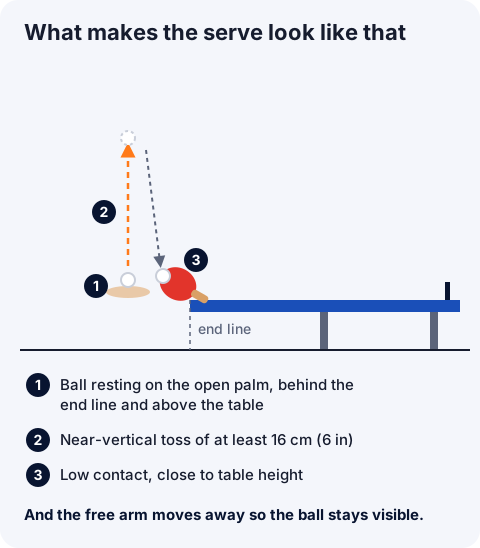
The ITTF serve rules are strict, and they dictate the shape of the motion:
| Rule | What you see on TV |
|---|---|
| The ball starts at rest on an open, flat palm | Players show the ball in their palm before serving |
| The ball rises at least 16 cm (about 6 in), nearly straight up | The high toss, sometimes far above the head |
| The ball stays behind the end line and above the table | Players serve with the hand near the corner of the table |
| The ball may only be struck as it falls | A tiny pause before contact |
| The receiver must see the ball the whole time | The free arm whips out of the way after the toss |
The full rules are in table tennis serve rules. The no-hiding rule, which changed how players serve in the early 2000s, has its own article: the hidden serve rule.
Why is the toss so high?
The rule asks for at least 16 cm, but many players toss much higher. The higher the toss, the faster the ball is falling at contact, and a faster-falling ball can help generate more spin. A high toss also gives the server time to set up and vary the motion. The downside is that timing gets harder, so many players prefer a medium toss.
Why do they crouch?
Crouching keeps the contact point low, close to table height. That way the ball comes out flat, crosses low over the net and is hard to attack. A high serve is a gift to the receiver.
Some players take this to the extreme with the squat serve, bending their knees deeply at contact. It is the kind of serve that confuses people who are new to the sport. And the "serving with their head" look people search for is usually just this: the head dropping low to stay over the ball.
Why is the motion so fast and full of fakes?
Because spin is read from the paddle's movement. If the receiver sees the paddle moving up, they expect topspin. Moving down means backspin. To trick them, the server:
- accelerates the paddle only at the instant of contact;
- adds a fake follow-through in a different direction from the real contact;
- uses the same motion for serves with different spins, like the ghost serve, which looks heavy with backspin but barely spins.
These spins are easier to understand after reading about the spin serve.
Why do they stand sideways?
Many players serve forehand while standing sideways in the backhand corner. This frees the arm for a big motion, as in the pendulum serve, and leaves the player ready to attack the next ball with the forehand. Other serves change the arm position completely, like the tomahawk serve, with the paddle upside down.
And the foot stomp?
Many players stomp right at contact. The noise covers the sound of the ball on the rubber, which would give away a clue about the spin. There is a whole article on it: why do table tennis players stomp when serving.
Can you serve like that at home?
Yes, and it is worth trying. Start with the basics: ball on an open palm, a toss of at least a hand's length, contact on the way down. Then practice a short backspin serve, the most useful serve for beginners. The step by step is in how to serve in table tennis.
Frequently asked questions
Why do ping pong players serve weird?
Because they try to put heavy spin on the ball and hide it, while following strict rules: ball on an open palm, a toss of at least 16 cm (6 in) and contact on the way down, with the ball always visible.
Why do table tennis players crouch when serving?
To keep the contact point low, near table height, so the ball crosses low over the net and is hard to attack.
Why is the ping pong serve toss so high?
The rule requires at least 16 cm. Many players toss higher because a faster-falling ball helps generate more spin and gives time to set up the motion.
Can you hide the ball when serving in ping pong?
No. From the toss until contact, the receiver must be able to see the ball. Your free arm and body cannot block it.