Why do table tennis players stomp when serving?
Players stomp at the exact moment of contact to cover the sound of the ball on the paddle. That sound gives away clues about spin: a thin, brushing contact sounds different from a flat hit. The stomp also helps with rhythm and balance. The official rules do not ban stomping.
In this article
A pro gets ready to serve, tosses the ball and, right as the paddle meets it, slams a foot on the floor. Thud. If you are new to table tennis, it looks like nerves or an early celebration. It is neither.
The stomp has a clear purpose: hiding the sound of the serve. For some players it is also a way to time the motion.
The sound of the serve gives away the spin
Experienced players read spin in several ways: the paddle's movement, the ball's flight, the logo spinning on the ball, and also the sound (see how to read spin).
A thin contact, where the paddle brushes the ball, usually produces a lot of spin and a softer sound. A fuller contact, with the ball hitting the rubber more squarely, produces little spin and a sharper sound. To a trained ear, that difference is a valuable clue. It helps tell a real backspin serve from a disguised no-spin serve.
The stomp erases the clue
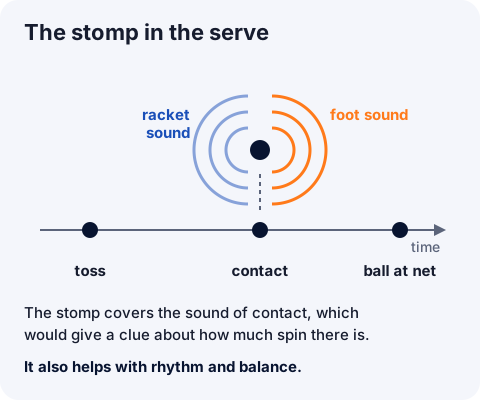
When the foot hits the floor at the same instant as contact, the thud covers the sound of the ball on the rubber. The receiver is left with only visual clues, which the server also tries to hide with fast motions and fake follow-throughs. That is why the stomp has to be in sync: before or after contact, it hides nothing.
This is especially useful for serves that rely on deception, like the ghost serve or a no-spin serve with the same motion as a backspin serve.
A tradition from the combination-bat era
The stomp became famous in an era when sound mattered even more. In the 1970s and 1980s many players used paddles with different rubbers on each side, in the same color. Grippy rubber and pips sound very different on the ball. By twirling the paddle and stomping, a player could hide which side they had used.
The ITTF ended that trick by requiring two different colors on the paddle. The full story is in why are ping pong paddles red and black. The stomp, however, stuck around, because it still helps disguise spin.
Rhythm and balance
Not everyone stomps to deceive. For many players, the stomp is part of the motion:
- It sets the timing. The foot hitting the floor acts as a "now!" that syncs the whole body with contact.
- It adds stability. Planting the foot firmly at contact helps keep balance in a crouched or twisted serve.
- It prepares the next ball. A planted foot helps you push off quickly for the third ball.
- It is a habit. Players who learned it in their club often stomp without thinking.
Is stomping legal in table tennis?
Yes. The ITTF serve rules cover the ball, the hand, the toss and visibility, but they do not ban stomping. See what is required in table tennis serve rules.
The limit is common sense. An umpire can warn a player for behavior that unfairly disturbs the opponent. A normal stomp at the moment of the serve is accepted at every level. Making noise while your opponent is serving is a different story.
Should you stomp on your serve?
For beginners, it is not a priority. First learn to serve with spin and keep the ball short and low (see spin serve). If you already have two or three serves with different spins and the same motion, the stomp can be an extra detail that makes them harder to read.
If you try it, remember:
- The stomp must happen at the exact moment of contact.
- It must not throw off your balance or slow your recovery.
- Use it on every serve. If you only stomp on your heaviest spin serve, the stomp becomes the clue.
Frequently asked questions
Why do table tennis players stomp when serving?
To cover the sound of the ball on the paddle, which gives clues about spin. The stomp also helps with timing and balance.
Is the stomp serve legal in ping pong?
Yes. The official serve rules do not ban stomping. An umpire only steps in if a player makes noise to unfairly disturb the opponent.
Does the sound of the serve reveal the spin?
It gives clues. A thin, brushing contact usually carries more spin and sounds different from a flat hit. Experienced players combine sound with the paddle's motion.
Should beginners stomp when serving?
There is no need. First learn to serve with spin and keep the ball short and low. The stomp is a detail for players who already have varied serves.