The tomahawk serve: how to do it and how to return it
The tomahawk serve is a forehand serve played with the racket upright, tip pointing up, contacting the right side of the ball (for right-handers). It produces sidespin opposite to the pendulum serve: the ball curves to the server's left and the return tends to go to the server's right. Tilting the racket mixes that sidespin with backspin or topspin.
In this article
Most players learn the pendulum serve first, the most common forehand serve. The problem is that with only one serve, your opponent gets used to its sidespin. The tomahawk serve fixes that: it is a forehand serve that spins the ball the opposite way from the pendulum.
The name comes from the motion, which looks like a downward tomahawk chop. Here is how to hold the racket, how to serve it, its variations and how to return it.
What is a tomahawk serve?
In a tomahawk serve, the racket is upright, with the tip pointing up, and contact is on the right side of the ball (for right-handers). The racket moves down and forward, brushing that side of the ball from back to front.
The result is sidespin that makes the ball curve to the server's left. When it hits the receiver's racket, the ball tends to go off to the server's right. It is the same direction of spin as the backhand serve and the reverse pendulum serve, but played with the forehand.
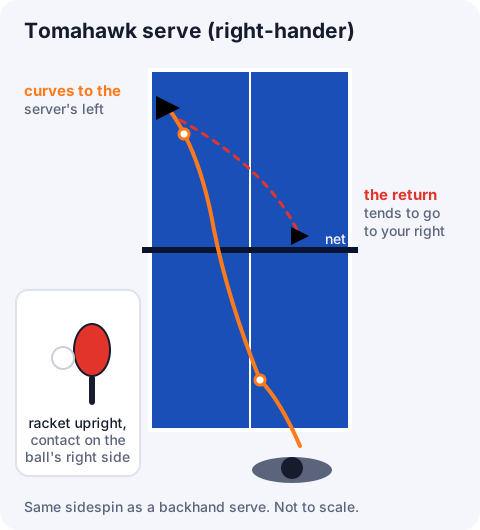
Why use the tomahawk serve?
| Advantage | Why |
|---|---|
| Sidespin opposite to the pendulum | With both serves, your opponent cannot tell which way the ball will kick |
| It is a forehand serve | You stay in forehand position, ready to attack the third ball |
| Lots of spin | The upright racket frees the wrist to accelerate at contact |
| Easy to vary | Tilting the racket changes the spin with almost no change in motion |
The most common drawback is that the racket face is very visible to the receiver, which makes the serve easier to read. So disguise depends on wrist speed and on your motion after contact.
How to hold the racket
The grip changes a little from your normal one:
- Release the back fingers and hold the handle mainly with your thumb and index finger.
- Turn the racket until the tip points up and the forehand face points to your left.
- Keep your wrist loose, ready for a short, fast motion.
After serving, switch back to your normal grip quickly. It is worth practicing that switch without a ball. More on grips in table tennis grip.
Tomahawk serve step by step
- Stand near your backhand corner or the middle of the table, facing the table more squarely than for a pendulum serve.
- Hold the racket upright, tip pointing up, forehand face toward the ball.
- Toss the ball vertically at least 16 cm (about 6 inches) from an open palm.
- Start with the racket high, near your shoulder, and bring it down and forward.
- Contact the right side of the ball with the upper part of the racket, brushing from back to front.
- Accelerate at contact and add a fake motion afterward to hide the spin.
All the ping pong serve rules apply: the ball stays behind the end line, above the table and visible to the receiver.
Variations: sidespin with backspin, topspin or no spin
The tomahawk always carries sidespin. What changes is the mix:
- Side-backspin: tilt the racket so it passes under the ball at contact. The ball stays low and receivers tend to return it into the net.
- Side-topspin: tilt the racket tip over the ball and brush the top. Returns tend to go high.
- Nearly no spin: contact the ball near the handle, which moves slower. Same motion, little spin.
To understand each spin, see spin serve.
Reverse tomahawk
In the reverse tomahawk, the racket is still upright but contact is on the other side of the ball and the motion goes the opposite way. The sidespin ends up similar to a pendulum serve. It is less common and harder to coordinate, used to vary the regular tomahawk without changing your stance.
Common mistakes
- Contact behind the ball: the ball comes off with no sidespin. Touch the side of the ball.
- Whole-arm swing: the tomahawk is a wrist and forearm serve. A stiff arm kills the spin.
- Serve too high: tilting the racket up too much makes the ball pop up. Keep it low over the net.
- Staying in the serving grip: if you do not return to your normal grip, your third ball suffers.
How to return a tomahawk serve
- Read the side: the ball will kick to the server's right (your left, facing them). Aim your racket slightly the other way to compensate.
- Read backspin or topspin from the racket tilt at contact: passing under the ball, open your racket; passing over it, close it.
- When in doubt, return short to the middle, where sidespin matters less.
The full guide is in how to return a serve.
Frequently asked questions
What is a tomahawk serve in table tennis?
It is a forehand serve with the racket upright, tip pointing up, contacting the side of the ball. It produces sidespin opposite to the pendulum serve.
Which way does a tomahawk serve spin?
For right-handers, the ball curves to the server's left, and the opponent's return tends to go to the server's right.
What is the difference between a tomahawk and a pendulum serve?
Both are forehand serves, but they spin the ball in opposite directions. In the pendulum, the racket swings right to left; in the tomahawk, it stays upright and contacts the right side of the ball.
What is a reverse tomahawk serve?
A variation where the upright racket contacts the other side of the ball and moves the opposite way. Its sidespin is similar to a pendulum serve.
Is the tomahawk serve legal?
Yes, as long as it follows the serve rules: a toss of at least 16 cm (about 6 inches), the ball behind the end line and visible to the receiver.