Basic tactics: serve and third-ball attack
The third ball is your second touch in a rally, right after your serve and your opponent's return. The tactic is to serve with it in mind: a serve that forces a predictable return lets you attack first. The most common pattern is a short backspin serve, a long push return and a loop to a corner or the middle.
In this article
In table tennis, the first few touches of a point decide a lot. The serve is touch 1, your opponent's return is touch 2, and your next shot is the third ball. Good servers do not just think about the serve; they think about what comes after it.
This is the most basic and most used tactic in the sport, from club level to the Olympics. Here is how the third ball attack works and how to train it.
What is a third ball attack?
The idea is simple: use your serve to control the return and be ready to attack the ball you expected.
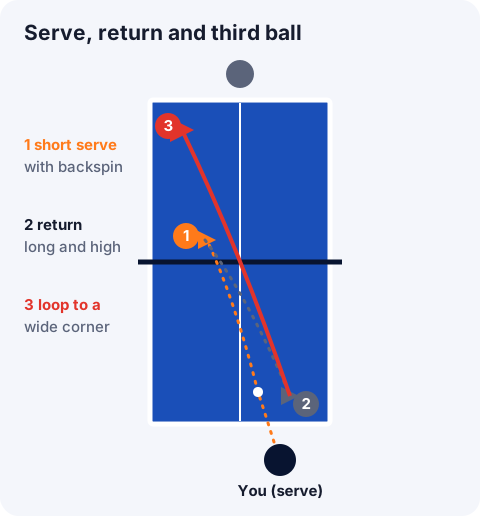
- You serve short with backspin.
- Your opponent cannot safely attack a short, heavy backspin ball, so they push it back, often long.
- You are already in position and loop the long ball.
The key is step 2: a good serve limits your opponent's options. If they only have two or three likely returns, you can be ready for them.
4 serve and third-ball patterns
| Serve | Most likely return | Your third ball |
|---|---|---|
| Short backspin | Long push | Loop to a corner or the elbow |
| Short no-spin (looks like backspin) | High push or weak flick | Hard attack on the high ball |
| Long and fast to the backhand | Block or fast backhand to the middle | Counter-hit or loop to the open corner |
| Short sidespin | Return drifting toward the spin side | Attack to the opposite side |
1. Short backspin, then loop the long push
This is the classic pattern. The serve should be low and would bounce twice on the far side if untouched. For your loop, aim at a corner or the elbow (the middle of your opponent's body), where they hesitate between forehand and backhand.
2. The disguised no-spin serve
Use the same motion as your backspin serve but contact the ball with no spin. If your opponent pushes expecting backspin, the ball pops up. Your third ball is a direct attack on the high ball. See why in the no-spin ball.
3. Long, fast serve
It catches players who expect short serves. The return often comes back fast but to a predictable spot. Stay close to the table, ready to counter.
4. Sidespin serve
Sidespin makes the return drift to one side. If your sidespin pushes the ball toward your backhand, get ready on that side and aim your attack at the opposite corner. See sidespin serve.
Getting ready for the third ball
- Recover to your ready position right after the serve. Many players "admire" their serve and arrive late.
- Lean toward your backhand side. That way your forehand covers most of the table.
- Decide in advance. Make a plan: if it comes long, I attack; if it comes short, I drop it short.
- Attack with margin. The third ball does not need to be your hardest shot. A spinny, well-placed ball already puts you in charge.
Third ball attack drills
| Drill | How | Sets | Goal |
|---|---|---|---|
| Serve + loop | You serve short backspin, partner pushes long to your forehand, you loop | 5 x 10 | 6 of 10 on the table |
| Serve + free loop | Same, but partner chooses where to push | 5 x 10 | 5 of 10 on the table |
| No-spin serve + attack | Partner pushes without knowing the spin, you attack the high ball | 3 x 10 | Point won 5 of 10 times |
| Long serve + counter | Fast serve to the backhand, partner returns, you counter-hit | 4 x 10 | 6 of 10 on the table |
| Serve game | Normal points, but only points won by the third ball count | 2 games to 11 | More points than the game before |
First, practice the serve alone with a bucket of balls as in how to practice table tennis alone. A short, low serve is the base of everything here. To review, see short vs long serve.
What about the fourth ball?
If your opponent knows this tactic too, they will try to attack first on the return or block your third ball well. The fourth ball is their answer. That is why mixing up your serves matters: if you always run the same pattern, they learn to wait for it.
Frequently asked questions
What is the third ball attack in table tennis?
Your first shot after your serve, answering your opponent's return. It is the third touch of the point.
What is the best serve for a third ball attack?
A short, low backspin serve is the most common, because it pushes your opponent into a backspin return, often long.
Where should I aim my third ball?
At the corners or your opponent's elbow, the middle spot where they must choose between forehand and backhand.
Can beginners use third ball tactics?
Yes, once they have a consistent short serve and a loop against backspin. It is a great goal for the first few months.
What if my opponent returns short?
Drop it back short and low, or flick it if the ball is high. Do not force an attack on a short, low ball.