Ghost serve: the backspin serve that comes back
A ghost serve is a short serve with so much backspin that, after bouncing on the other side, the ball stops and comes back toward the net. It is completely legal. To do it, open the racket wide, brush the bottom of the ball with a fast wrist and give it almost no forward speed. To return it, move in early and take the ball at the top of the bounce, before it comes back.
In this article
You serve, the ball crosses the net, bounces on the other side and... comes back. Your opponent lunges forward, the ball runs away from them and sometimes rolls all the way back to your side. That is the ghost serve, a serve with so much backspin it seems to defy physics.
It is not a trick and it is not illegal: it is just backspin taken to the extreme. This guide explains why the ball comes back, how to serve it and how to return it when you are the one receiving.
What is a ghost serve?
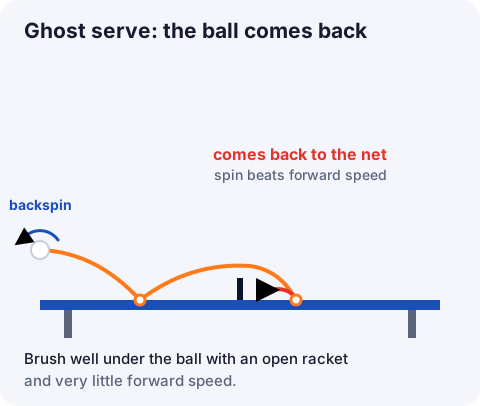
A ghost serve is a short backspin serve with lots of spin and very little speed. After it bounces on the receiver's side, the backspin beats the small forward speed, and the ball brakes, stops and drifts back toward the net.
It is used more as a variation than as a main serve. The threat of the ball coming back forces the receiver to reach deep over the table, and that opens space for your other serves.
Why does the ball come back?
On the bounce, a ball with backspin "grabs" the table. Friction between the table and the bottom of the ball, which is spinning forward, pushes the ball backward. On a normal serve, forward speed is bigger than that push and the ball just slows down a bit.
On a ghost serve the opposite happens: the spin is so strong and the speed so low that the backward push wins. The ball reverses direction. For the details, read what is backspin.
Is the ghost serve legal?
Yes. It is a normal serve with a lot of backspin. It has to follow the same ping pong serve rules: a toss of at least 16 cm (about 6 inches), the ball behind the end line and visible to the receiver.
What if the ball comes back to the server's side without the receiver touching it? The server wins the point, because the receiver failed to make a return. The exception is a receiver in a wheelchair: then a serve that comes back toward the net is replayed, as explained in wheelchair table tennis.
How to do a ghost serve
- Use the same grip as a forehand backspin serve, with a loose wrist.
- Toss the ball low, while still respecting the 16 cm minimum, and let it drop close to the table.
- Open the racket a lot, almost parallel to the floor.
- Brush the bottom of the ball with a fast wrist snap, back to front, using the tip of the racket.
- Give it almost no forward speed: the ball should bounce near the net on your side and cross very low.
- Aim for the second bounce to land just past the net on your opponent's side.
The three secrets
| Secret | How to get it |
|---|---|
| Lots of spin | Thin, grazing contact, with the wrist accelerating at contact |
| Low speed | The stroke goes more under the ball than forward |
| Short bounce | First bounce near the net on your side, ball low |
Grippy rubber helps a lot. With a very slick or worn paddle, it is hard to generate enough spin, as explained in when to replace rubber.
How to practice
Do not worry about the ball coming back at first. Start with a short backspin serve that bounces twice on the other side. Then gradually take off speed and add spin until you see the ball stop dead. A good test: if the ball, untouched, drifts back toward the net after its second bounce, you are on the right track. A full routine is in how to practice your serve.
How to return a ghost serve
- Move in early. Get your foot and body close to the net as soon as you spot a short, slow serve.
- Take the ball at the top of the bounce, before it starts coming back.
- Open your racket and return it with a short push, or flick it if you are confident. A flat racket sends it into the net.
- Do not chase a ball that is already retreating: you will arrive overstretched and out of control.
More tips in how to return a serve.
Common mistakes
- Too much speed: the ball has backspin but keeps going. Take off speed.
- Ball too high: opening too much and hitting upward makes the ball pop up. Keep the racket low.
- Hitting with the middle of the racket and a stiff arm: little spin. Use the tip and your wrist.
- Using it all the time: receivers adjust. Mix it with no-spin and long serves.
Frequently asked questions
What is a ghost serve in table tennis?
It is a short serve with so much backspin that, after bouncing on the other side, the ball brakes and comes back toward the net.
Is the ghost serve legal in table tennis?
Yes. It is an ordinary backspin serve with extra spin, and it has to follow the normal serve rules.
How do you make a ping pong ball come back on a serve?
Open the racket a lot, make thin contact under the ball with a fast wrist and give it almost no forward speed. The ball should cross low and bounce just past the net.
What happens if my serve comes back to my side?
If the receiver did not touch it, you win the point. The exception is against a wheelchair player, when a serve that comes back toward the net is replayed.
How do you return a ghost serve?
Move in early, take the ball at the top of the bounce before it comes back, and return it with an open racket, usually with a short push.