The hidden serve rule: history and controversy
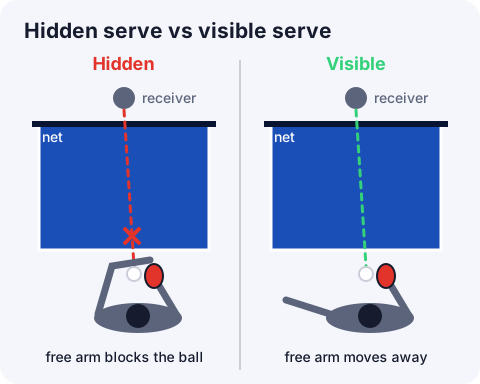
A hidden serve is one where the receiver cannot see the ball at contact because the server's body, head or free arm is in the way. Since September 1, 2002, ITTF rules require the ball to stay visible the whole time and the free arm to move out of the space between the ball and the net right after the toss.
In this article
For decades, the best servers in the world had a weapon that is now illegal: hiding the ball at contact. The opponent saw the toss and saw the racket move, but never saw the instant the rubber touched the ball. Without seeing contact, reading the spin was a guessing game.
The hidden serve rule changed that in 2002. Here is what the rule says, why it was introduced, how umpires judge it and why, more than twenty years later, it still causes arguments at major events.
What is a hidden serve?
A hidden serve is any serve where the receiver cannot see the ball at some point between the toss and contact. What blocks the view can be:
- the free arm (the one that tossed the ball), left in front of the ball;
- the shoulder or torso, when the server rotates;
- the head, when the player leans over the ball;
- in doubles, the server's partner.
It all comes down to one thing: you read a serve's spin by watching contact. Our guide on how to read spin explains why that matters so much.
What the rule says today
The serve rules are in the ITTF Laws of Table Tennis (section 2.6). The parts that deal with hidden serves are:
- From the start of the serve until contact, the ball must stay above the level of the playing surface and behind the end line.
- The ball must not be hidden from the receiver by the server, the doubles partner or anything they wear or carry.
- As soon as the ball is tossed, the server's free arm and hand must be removed from the space between the ball and the net. That space runs from the ball to the net and extends upward without limit.
- It is the server's responsibility to serve so the umpire can be satisfied the serve is legal. If not, the umpire can call a fault.
Under the rules, when an umpire is unsure about a serve, they may, the first time in a match, stop play and warn the server. After that, any serve that is not clearly legal is a fault and the receiver wins the point. The other requirements, like the 16 cm (about 6 inch) toss, are covered in our ping pong serve rules guide.
How serving worked before 2002
Serve rules got stricter step by step. First came requirements on the toss: the ball had to rest on an open palm and go up nearly vertically, so players could not spin it with their fingers. But nothing stopped a player from leaving the free arm in front of the ball after the toss, or turning the body to hide contact.
In the 1990s, with modern rubbers and glues producing huge amounts of spin, hidden serves became very hard to return. Many points ended on the serve or the return, rallies got short, and spectators had a hard time following what was going on.
The 2002 change
The ITTF went through a set of reforms meant to make the sport more watchable for fans and TV:
| Year | Change |
|---|---|
| 2000 | 40 mm ball replaces the 38 mm ball |
| 2001 | Games to 11 points instead of 21 |
| 2002 | Hiding the ball on the serve is banned |
The hidden serve rule took effect on September 1, 2002. At the time, the ITTF president called it the last important step in modernizing the sport. The goal was to give the receiver a fair chance to see what the server was doing. You can read about the other two reforms in why table tennis changed to 11 points and the history of the ping pong ball.
Why the rule is still controversial
On paper, the rule is clear. Enforcing it is hard:
- The umpire is not where the receiver is. Umpires sit beside the table and have to imagine what the receiver sees.
- It all happens in a split second. Contact on a serve is extremely brief, and the server's body is moving the whole time.
- The head and shoulder are gray areas. Many top servers lean far over the ball, and whether the head blocked contact is a question of angle.
That is why, for years, players and coaches complained the rule was rarely enforced at the top level. More recently, big events have started using video review for some calls. At the 2025 World Championships, for example, serves were called hidden and upheld on replay because the server's head blocked the receiver's view.
How to serve without hiding the ball
- Move your free arm away right away. After the toss, pull it to the side or back, away from the line between ball and net.
- Do not close your shoulder too much. On a forehand serve, your free shoulder cannot sit between the ball and your opponent.
- Make contact beside your body, not behind it. Hit the ball where the receiver can see it.
- Disguise spin with motion, not with your body. Today's best serves fool opponents with fast wrist action and fake follow-throughs after contact, which are perfectly legal.
Frequently asked questions
What is a hidden serve in table tennis?
It is a serve where the receiver cannot see the ball at contact because the free arm, shoulder, head or doubles partner is in the way. Under ITTF rules it is a fault.
When were hidden serves banned?
The rule banning hidden serves and requiring the free arm to move away took effect on September 1, 2002.
Can your free arm stay in front of the ball when serving?
No. As soon as you toss the ball, your free arm and hand must leave the space between the ball and the net.
Does the umpire warn you before calling an illegal serve?
Under the rules, an umpire who is unsure may warn the server once per match. After that, any serve that is not clearly legal is a fault.
Are hidden serves allowed in casual ping pong?
There is no umpire, so it is up to the players. The fair choice is the official rule: the ball stays visible from toss to contact.