Intermediate table tennis drills: 8 drills to get past the plateau
Intermediate players improve when they swap fixed drills for semi-random and random ones, where the ball can come to more than one spot. The most useful drills train the forehand to backhand transition, the short and long game, loop against loop and the third ball after the serve.
In this article
There comes a point where your rally looks smooth, your loop lands, and your matches still do not get better. That is the classic intermediate plateau. The reason is almost always the same: in practice the ball always comes to the same spot, and in a match it never does.
Intermediate table tennis drills fix this step by step. You keep the repetition that builds strokes, and add the uncertainty that builds reading and decision making.
What changes in intermediate training
Once you have a forehand, a backhand, a push and a decent loop, practice needs new goals:
- Transition: switching from forehand to backhand (and back) without losing balance.
- Decisions: spotting early whether the ball is short or long, to the middle or the corner.
- Linking: chaining the serve, third ball and fifth ball together.
- Quality under pressure: keeping the stroke clean when the ball comes faster or with more spin.
The simplest way to organize this is to go from fixed drills to random ones.
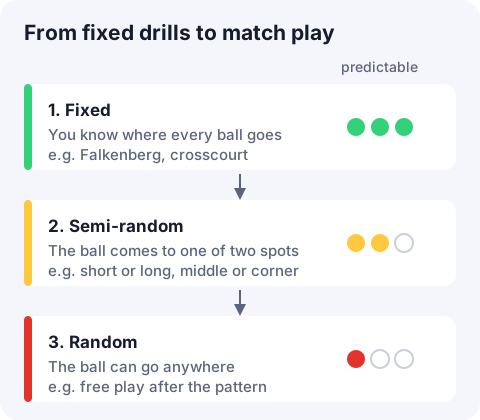
The drills below follow that order. All of them need a partner; the basics are in table tennis drills with a partner.
Fixed drills (to start the session)
1. Looping Falkenberg
The Falkenberg drill at match pace, with your partner blocking. Sets of 60 seconds. Use it as the heavy footwork part of the session.
2. Two backhands, two forehands
Your partner sends two balls to your backhand and two to your forehand. You play backhand, backhand, forehand, forehand. It trains switching strokes with your shoulders and hips, without a pivot.
Semi-random drills
3. Transition from the middle
Your partner alternates the ball between your backhand and your elbow (the middle of your body). You decide on the spot whether to use a forehand or a backhand. The ball at the elbow is one of the hardest in the game, and training it on purpose pays off.
4. Backhand rally with one free ball
You play backhand crosscourt. At any moment your partner can go down the line, and you have to get there with your forehand. Start with one free ball every 4 or 5 balls.
5. Short or long
Your partner returns your serve with a short or long push, their choice. On the short ball you step in and push short or flick; on the long ball you step back and loop. The goal is to read the length early and adjust your distance from the table.
6. Loop against push, then keep attacking
Your partner pushes, you open with a loop, they block anywhere and you keep attacking. It trains the step from the first loop, slower and spinnier, to the second, faster one.
Random drills
7. Loop against loop
Both players loop crosscourt, a bit further from the table. After 4 or 5 balls, the ball is free. This is counter-loop practice, and it shows up in every match from intermediate level up. Technique in counter loop.
8. Third and fifth ball
You serve, your partner returns however they like, you attack the third ball and the point is live. Only points won by the fifth ball count. This forces you to plan the serve and the attack together, as explained in serve and third ball.
A sample week for intermediate players
| Day | Focus | Drills |
|---|---|---|
| Session 1 | Footwork and transition | 1, 2, 3 + points |
| Session 2 | Serve, return and opening | 5, 6, 8 |
| Session 3 | Rhythm and counter-attack | 4, 7 + a full match |
In each session, spend about a third of the time on fixed drills, a third on semi-random ones and a third on random drills and points. If you can, one multiball training session a week speeds up technical fixes.
Common intermediate mistakes
- Only playing points. It feels productive, but you barely repeat what needs work.
- Only doing fixed drills. The stroke looks great and your matches stay the same.
- Drilling your strengths. It is more fun, but the plateau is usually in your weakest stroke.
- Not writing anything down. Without a record it is hard to tell if you improved. A table tennis training log helps.
For a bigger picture plan, see how to get better at ping pong faster.
Frequently asked questions
What are good table tennis drills for intermediate players?
Looping Falkenberg, transition from the middle, backhand rally with a free ball, short or long, loop against loop and third ball attack. The key is moving from fixed drills to semi-random and random ones.
How do I know if I am an intermediate table tennis player?
Usually when you can rally and push consistently, loop against backspin and have two or three serves with different spin.
What is a semi-random drill in table tennis?
A drill where the ball can come to one of two agreed spots, such as short or long. You train the stroke and the decision at the same time.
Why did I stop improving at ping pong?
Often because practice became too predictable. Add drills with free balls and work on the weakest part of your game.