Table tennis drills with a partner: 8 ping pong drills for two players
The best table tennis drills with a partner start with crosscourt and down-the-line rallies, then move to one-to-two footwork, push against push and loop against block, and finish with serve, return and points with rules. Agree on the pace, count your balls and switch roles every set.
In this article
With a partner on the other side, table tennis practice gets a lot more done. But playing points all session teaches less than you think: rallies are short and you almost never hit the same stroke twice in a row. Agreed drills fix that. You both know where the ball is going, and each of you repeats what you need to improve.
Here are 8 table tennis drills with a partner, from the simplest to the most game-like, with sets, goals and a 60-minute session you can copy.
How to practice well with a partner
Before the drills, three ground rules that make a big difference:
- One trains, one helps. In most drills one player is "working" and the other keeps the ball in play. Switch roles every set.
- Rhythm first, power later. The goal is to keep the ball on the table. If either of you misses a lot, slow down.
- Count your balls. Goals like "20 in a row" keep you focused far better than just hitting.
If you are both new, the beginner training plan shows which strokes to learn first.
Basic ping pong drills for two
1. Forehand crosscourt
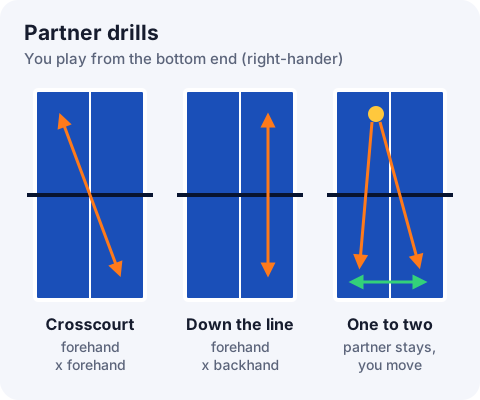
The classic. Both players hit forehands corner to corner, crosscourt. The diagonal is the longest line on the table, so it is the easiest one to keep the ball in play.
- Sets: 3 to 5 minutes.
- Goal: 30 in a row, then 50.
2. Backhand crosscourt
Same thing on the other side of the table. The backhand is usually more compact and quicker; keep your elbow in front of your body.
3. Down the line
One player hits forehands and the other backhands, along the same side line. The ball travels a shorter distance, so it takes more control. Great for training direction, not just the stroke.
4. One to two
Your partner stays in one spot and alternates the ball to your backhand and your forehand. You move and send everything back to the same place. Once it is solid, move on to the Falkenberg drill, which adds the pivot.
- Sets: 1 minute on, 1 minute rest.
- Goal: get your body behind the ball instead of reaching with your arm.
Spin drills
5. Push against push
Both players trade backspin balls (the push) on the backhand diagonal. Keep the ball low and short. Later, one player starts mixing short and long pushes.
6. Loop against block
One player loops, the other blocks. This is the drill that builds attacking strokes the most, because the block comes back with a steady rhythm. Start with forehand crosscourt, then switch sides.
- Sets: 45 to 60 seconds.
- Goal: 10 loops in a row with the same arc and depth.
Drills that feel like a match
7. Serve and return
One player serves 10 balls mixing spin and height, the other only returns and tries to place the ball. Then swap. Hardly anyone practices returns, and they decide a lot of points. Tips in how to return a serve.
8. Serve, return and third ball
Player A serves short, B pushes long, A attacks with a loop and the point is live. This is the serve and third ball pattern at the heart of the modern game. Play sets of 5 serves and keep score.
A 60-minute session with a partner
| Block | Drill | Time |
|---|---|---|
| Warm-up | Easy forehand and backhand rally | 10 min |
| Control | Crosscourt (1 and 2) and down the line (3) | 10 min |
| Footwork | One to two (4) | 10 min |
| Spin | Push against push (5) and loop against block (6) | 15 min |
| Game | Serve and third ball (8) | 10 min |
| Finish | Free points or one game | 5 min |
If you have a box of balls, several of these drills work even better as multiball training, with one player feeding and the other hitting.
Common mistakes when drilling with a partner
- Turning it into a match too early. Once a rally becomes a contest, the drill is over. Save the competition for the end.
- Always drilling the same thing. Take turns: one day the focus is one player's forehand, next time the other's backhand.
- Skipping rest. Short sets with breaks beat 20 straight minutes of fading technique.
Frequently asked questions
What are the best table tennis drills with a partner?
Crosscourt and down-the-line rallies, one-to-two footwork, push against push, loop against block, and serve with third ball attack. Together they cover control, footwork, spin and game play.
What ping pong drills should beginners do with a partner?
Start with a forehand crosscourt rally and only move to the next drill when you can hit 30 in a row together.
How long should each table tennis drill last?
Between 1 and 5 minutes per set, depending on intensity. Footwork drills need short sets, around 1 minute.
Does practicing with a weaker partner help?
Yes, if the drill is agreed. The weaker player gets rhythm, and the stronger one works on control and placement.