The counter-loop: attacking topspin with topspin
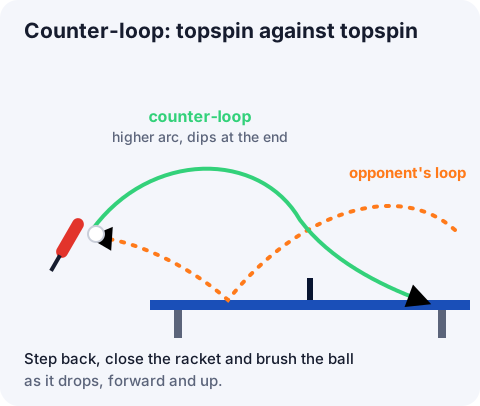
A counter-loop is returning your opponent's topspin with another topspin instead of just blocking. Step back a little, close the racket a lot and brush the top and back of the ball, more forward than upward. The incoming spin already lifts the ball off your racket, so the stroke is shorter and flatter than a loop against backspin.
In this article
When your opponent attacks with topspin, the usual answer is the block: closed racket, little movement, the ball goes back on their pace. It works, but it leaves the initiative with the attacker. The counter-loop changes that: you answer an attack with an attack.
It is the stroke behind the most spectacular rallies in modern table tennis, with both players a meter or two from the table trading loops. This guide covers when to use it, how to do it and how to practice it.
What is a counter-loop?
A counter-loop is a topspin stroke played against a ball that already carries topspin. The difference from looping against backspin is the spin coming in:
| Incoming ball | What happens on your racket | What your stroke should look like |
|---|---|---|
| Backspin | The spin pulls the ball down | More upward, racket more open |
| Topspin | The spin kicks the ball up | More forward, racket well closed |
Because your opponent's topspin already makes the ball "climb" off your racket, you do not need to lift it. What you need is a closed angle and a forward brush over the top of the ball.
When to counter-loop
- When you have been pushed back from the table. At mid-distance a block loses its bite and the counter-loop becomes the best option.
- Against slow or medium loops. A ball with lots of spin and little speed is ideal to counter.
- When the ball comes to your forehand with time. That is the most comfortable situation to swing freely.
Block instead when the ball is very fast and low, right off the bounce, or when you are out of position. A counter-loop without balance turns into an error.
How to counter-loop on the forehand
- Take half a step back and to the side to buy time and space. Feet apart, knees bent.
- Bring the racket back at ball height or slightly above, not low like a loop against backspin.
- Close the racket a lot: the face points forward and down.
- Wait for the ball to start dropping, at the top of the bounce or just after it.
- Rotate your hips and torso and brush the top and back of the ball, with the stroke going more forward than upward.
- Finish with the racket around forehead height and recover quickly to the ready position.
The key is to accelerate at contact, not push the ball. Thin, brushing contact creates spin and gives control. Flat contact, hitting the ball square, sends it long. The basics of the stroke are in our forehand loop guide.
Backhand counter-loop
The backhand counter-loop is more compact and relies more on the forearm and wrist:
- Face the ball, with the racket in front of your body.
- Close the racket and cock your wrist slightly back.
- Hit the ball at the top of the bounce, brushing forward and a little upward.
- Use the elbow as a pivot: the forearm rotates forward and the wrist snaps at the end.
Close to the table, many modern players use a short backhand counter that is almost an active block: it takes the ball early and sends it back with spin. To build the base, see backhand loop.
Close to the table or far back?
| Distance | What the counter-loop looks like |
|---|---|
| Right at the table | Short stroke, ball on the rise, almost a block with brush |
| Mid-distance (3 to 6 ft) | The classic counter-loop, with trunk rotation and a higher arc |
| Far back | Very high arc, more spin and less speed; close to a lob |
The farther back you are, the higher the arc should be, because the ball has to travel farther to land on the other side.
Common mistakes
- Racket too open: the ball flies high and long. Against topspin, close it more than feels necessary.
- Swinging upward: that is the stroke for backspin. Against topspin, go forward.
- Hitting too early at mid-distance: the ball is still rising with lots of energy. Wait for the top.
- Flat feet: without adjusting distance you end up overreaching or cramped.
- Trying to kill the ball: a safe first counter-loop beats a big swing into the net.
Drills to practice
- Loop to block: your partner blocks, you play continuous loops to groove the stroke.
- Loop to loop at mid-distance: both of you about a meter (3 ft) back, trading forehand loops crosscourt, without power.
- Multiball: your partner feeds topspin balls for you to counter. See how to set it up in multiball training.
Frequently asked questions
What is a counter-loop in table tennis?
It is returning your opponent's loop with another loop instead of blocking. You close the racket and brush the ball forward, using the spin already on it.
How do you return topspin in ping pong?
With a closed racket. Close to the table, block or play a short counter-hit. Farther back, counter-loop with a forward stroke.
Why does my counter-loop go long?
Usually because the racket is too open or the stroke goes too far upward. Close the angle and brush forward over the top of the ball.
Should I block or counter-loop?
It depends on distance and the ball. Right at the table against a very fast ball, block. At mid-distance against slow or medium balls, counter-loop.
Should beginners practice counter-looping?
First get comfortable with looping against a block and with blocking. The counter-loop comes later, once your basic loop is consistent.