How to get better at ping pong faster: what actually makes a difference
To get better at ping pong faster, practice one focus at a time, put serve and return first, attack your weakest stroke, play different styles and film yourself. A control-oriented paddle, a coach or more experienced player, and a simple log of what you practice speed things up.
In this article
- The loop that makes you better
- 1. Practice one thing at a time
- 2. Put serve and return first
- 3. Attack your weakest stroke
- 4. Use drills, not just points
- 5. Quality reps
- 6. Play different styles
- 7. Film yourself
- 8. Get feedback
- 9. Use gear that helps
- 10. Write it down, rest and stay consistent
- What pays off most at each stage
Two people can practice for the same number of hours and improve at very different speeds. The difference is rarely talent. It is how that practice time is used.
These are the 10 changes that speed up improvement in table tennis the most, from the simplest to the one that takes more organization. None of them needs expensive gear.
The loop that makes you better
Players who improve fast follow a loop, whether they know it or not: they play, notice what went wrong, pick one thing to fix, drill it, and play again to test it.
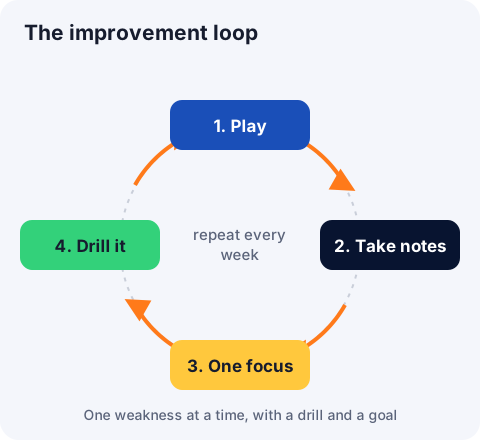
The tips below help you do each part of that loop better.
1. Practice one thing at a time
"Practice table tennis" is too vague. "Today I will land 8 out of 10 forehand loops against backspin crosscourt" is a session. Pick one goal per session, two at most, and build your drills around it.
2. Put serve and return first
Every point starts with a serve and a return, and many points end within the first three balls. Yet almost nobody practices those shots outside of matches. Ten minutes of serves per session pays off hugely. Start with how to serve in table tennis and how to return a serve.
3. Attack your weakest stroke
Opponents will look for your weakness, whether it is your backhand, short balls or the ball at your elbow. Drilling what you already do well is more fun, but the biggest gains are usually in your weakest stroke.
4. Use drills, not just points
Points matter, but they repeat each stroke very little. Agreed drills give you hundreds of reps per session. A good split is two thirds drills, one third match play. Ideas in table tennis drills with a partner and, once you have the basics, intermediate table tennis drills.
5. Quality reps
A thousand sloppy balls lock in a bad stroke. Start slow, get the shape right and only then speed up. When fatigue ruins your technique, end the set.
6. Play different styles
If you only play the same three people, you learn to beat them, not to play. Look for lefties, choppers, long pips players and big hitters. Tournaments and other clubs help a lot. See the main table tennis playing styles.
7. Film yourself
Your phone is the cheapest coach there is. Film one session a week, from the side and from behind, and compare it with videos of experienced players. Mistakes you cannot feel often jump out on screen. To get more out of pro videos, see how to learn by watching pro matches.
8. Get feedback
A coach, or even a stronger player at your club, can spot in minutes what would take you months to notice. Even a few lessons a year to fix the basics make a difference.
9. Use gear that helps
Very fast paddles punish every mistake and slow down learning. Until your technique is solid, a control setup is usually the better choice. See the best beginner paddle.
10. Write it down, rest and stay consistent
- Write it down: a table tennis training log shows what works and stops you repeating the same mistakes.
- Rest: your body needs recovery. Training when you are very tired raises the risk of injury and hurts technique.
- Stay consistent: three short sessions a week usually beat one long one.
What pays off most at each stage
| Stage | What to prioritize |
|---|---|
| Beginner | Grip, forehand and backhand rally, push, a simple serve |
| Advanced beginner | Loop against backspin, spin serves, footwork |
| Intermediate | Return, third ball, transition, semi-random drills |
| Advanced | Tactics, counter-looping, consistency under pressure |
If you are just starting, read the common beginner mistakes too.
Frequently asked questions
How do I get better at ping pong fast?
Practice one focus at a time, prioritize serve and return, attack your weakest stroke, use drills as well as points, play different styles and film yourself.
How long does it take to get good at ping pong?
It depends on how often you practice, how well and whether you have feedback. Players who train several times a week with drills and coaching usually improve much faster than those who only play now and then.
How can I get better at ping pong by myself?
You can improve your serve, stroke mechanics, footwork and fitness alone. Reading spin and tactics need other players.
What should I practice first in table tennis?
Grip, ready position, forehand and backhand rally and a simple serve. Then the push and the loop.
Is it better to practice ping pong every day?
Not necessarily. Rest is part of improving. Frequent, focused sessions are worth more than training tired every day.