Multiball training: how it works and drills to try
Multiball is a drill where a partner (the feeder) hits one ball after another from a basket, without waiting for your return. You repeat the same stroke many times in little time, with the ball always where it should be. It is great for learning strokes, footwork and fitness.
In this article
In a normal rally, every miss stops the drill and someone has to chase the ball. In multiball, that never happens: the feeder has a full basket and sends the next ball right away. You get through in 1 minute what would take 5 in regular practice.
That is why multiball training is used in clubs all over the world, from beginners to national team players.
How multiball works
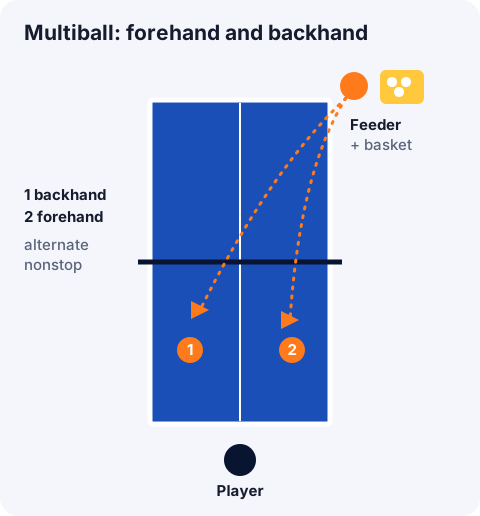
- The feeder stands on the far side of the table with a basket or box of balls in reach.
- They bounce the ball on their own side and hit it to the agreed spot.
- The player hits and gets ready for the next ball.
- Returned balls pile up on the floor and get collected at the end of the set.
Gear
| Item | Suggestion |
|---|---|
| Balls | 50 to 100 training balls, all the same |
| Basket | A bucket, box or dedicated multiball basket |
| Ball picker | A net on a pole or a pickup tube to save time |
| Catch net (optional) | Behind the feeder's end to stop balls |
You do not need 3-star balls, but they should all be the same type. See ping pong balls.
How to feed well
Feeding is a skill. A few rules:
- Steady rhythm. Send the next ball as the player finishes the stroke and recovers.
- Bounce on your side. The ball bounces on the feeder's half first, then crosses the net, like a normal shot.
- The right spin. To practice loops against backspin, feed backspin. To practice blocking, feed topspin.
- Start easy. Slow balls to one spot. Add speed and variety gradually.
6 multiball drills
1. Forehand to one spot
- Sets: 4 x 30 balls, 1 minute rest.
- Feed: medium ball, no spin, to the forehand corner.
- Goal: 25 of 30 on the table, crosscourt.
2. Alternating forehand and backhand
- Sets: 4 x 30 balls.
- Feed: one to the backhand, one to the forehand, as in the diagram.
- Goal: recover to center between balls without crossing your feet.
3. Loop against backspin
- Sets: 5 x 20 balls.
- Feed: medium backspin, slightly long, to the forehand.
- Goal: 14 of 20 on the table, clearing the net with margin. See the technique in forehand loop.
4. Falkenberg pattern
- Sets: 4 x 45 seconds.
- Feed: backhand, forehand from the backhand corner, wide forehand, repeat.
- Goal: full movement with the stroke ready in time. Great for footwork.
5. Short and long
- Sets: 4 x 20 balls.
- Feed: one short ball (step in and push or flick), one long ball (step back and loop).
- Goal: adjust your distance from the table without losing balance.
6. Random
- Sets: 3 x 30 balls.
- Feed: the feeder varies spot and spin without warning.
- Goal: read the ball and react. This is the closest drill to a real match.
A 30-minute multiball session
| Block | Drill | Time |
|---|---|---|
| 1 | Forehand to one spot | 6 min |
| 2 | Alternating forehand and backhand | 6 min |
| 3 | Loop against backspin | 8 min |
| 4 | Falkenberg | 5 min |
| 5 | Random | 5 min |
Swap roles halfway: the feeder learns too, because feeding demands control of spin and placement. Drop this block into the beginner training plan in place of the "stroke of the week" once a week.
Safety and good habits
- Pick up balls between sets. A ball underfoot is an ankle injury waiting to happen.
- Take the rests. Multiball is intense; technique falls apart when you are tired.
- Do not speed up too soon. Speed without technique only locks in mistakes.
Frequently asked questions
What is multiball training in table tennis?
A drill where a feeder hits many balls in a row from a basket without waiting for your return, so you repeat a stroke many times in a short time.
How many balls do you need for multiball?
About 50 to 100 training balls. With fewer, you stop too often to collect them.
Is multiball good for beginners?
Very. With slow balls to one spot, it is one of the fastest ways to learn a stroke.
Multiball or robot: which is better?
A human feeder adapts rhythm and spin on the fly and can correct you. A robot never tires and needs no partner. They complement each other.
How long should a multiball session be?
Twenty to thirty minutes in short sets with rests is a complete session.