The Falkenberg drill in table tennis: step by step, sets and variations
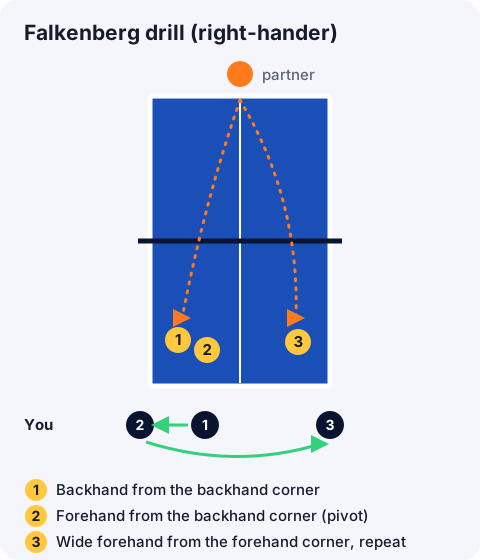
The Falkenberg drill is a three-ball footwork pattern. Your partner sends two balls to your backhand corner and one to your forehand corner, and you play a backhand, a pivot forehand from the backhand corner and a wide forehand, then repeat. It trains the pivot, the crossover step and recovery.
In this article
The Falkenberg drill is probably the best known footwork drill in table tennis. In three balls it packs the movements that show up most in real rallies: a backhand, a pivot to use your forehand from the backhand side, and a big move to reach a wide ball on the forehand.
It is named after the Swedish club Falkenbergs BTK, from the town of Falkenberg, where the drill became popular. The club's players included Stellan Bengtsson, the 1971 men's singles world champion, and from there the drill spread to clubs everywhere. Today it is a staple for anyone who already has the basic strokes and wants to get their body to the ball on time.
What is the Falkenberg drill?
It is a fixed three-ball pattern. Your partner hits two balls to your backhand corner and one to your forehand corner. You answer like this:
| Ball | Where your partner sends it | What you play |
|---|---|---|
| 1 | Backhand corner | Backhand |
| 2 | Backhand corner | Pivot forehand |
| 3 | Forehand corner | Wide forehand |
After ball 3, the pattern starts again. Coaches also call it the two-one drill (two to the backhand, one to the forehand). In the most common version you hit everything to your partner's backhand, and they just block and place the ball where the pattern says.
How to do the Falkenberg drill step by step
- Start position. Stand slightly toward your backhand side, knees bent, weight on the balls of your feet, in your ready position.
- Ball 1, backhand. Play a compact backhand and already get ready to move left (for right-handers).
- Ball 2, pivot. Move to your left, bring your right foot back, turn your hips and hit a forehand from the backhand corner. Your body ends up almost side-on to the table.
- Ball 3, wide forehand. Push hard to the right. If the distance is big, use a crossover step. Hit the forehand with your body behind the ball, not with a stretched arm.
- Back to the middle. Recover with short steps and start again with ball 1.
What separates a good Falkenberg from a sloppy one is recovery. If you hit ball 3 and stand there admiring it, you will be late for the next ball 1. The individual steps are explained in table tennis footwork.
The footwork for each ball
- Backhand to pivot: a short move, but you need to clear space for your arm. The classic mistake is not stepping back far enough and hitting a cramped forehand into your own body.
- Pivot to wide forehand: the longest move in the drill. For very wide balls, a crossover step is faster than several side shuffles.
- Wide forehand back to the backhand: short side steps without crossing your feet, keeping the same height.
Keep your knees bent the whole time. If your head bobs up and down between balls, you lose time and balance.
Sets, timing and pace
The Falkenberg gets tiring fast at match pace. Start slow and only speed up when the pattern runs clean.
| Level | Strokes | Set | Rest |
|---|---|---|---|
| New to the drill | Controlled drives | 6 to 8 patterns in a row | 1 minute |
| Intermediate | Loop against block | 45 to 60 seconds | 1 minute |
| Advanced | Loops at match pace | 60 to 90 seconds | 1 to 2 minutes |
Do 4 to 6 sets and switch roles with your partner. To fit more balls into less time, the same pattern works great with multiball training or a table tennis robot set to three spots.
Falkenberg drill variations
Once the basic version is solid, change one thing at a time:
- Looping Falkenberg: all three balls as loops (see forehand loop), with your partner blocking.
- Start with a serve: you serve short, your partner returns to your backhand, and the pattern begins. It trains the move from serve into the rally.
- Ball 3 down the line: you change the direction of the last ball, so your partner has to work harder to block.
- Falkenberg into free play: after two or three patterns, your partner can go anywhere and the point is live.
- Reverse Falkenberg: two balls to the forehand, one to the backhand, for players who need to work on getting back to the backhand side.
These progressions move the fixed pattern closer to a real match. For more drills at this level, see intermediate table tennis drills.
Common mistakes
- Reaching with the arm. Stretching instead of moving your feet makes the stroke weak and erratic.
- Pivoting without turning the hips. The forehand from the backhand corner needs space and rotation.
- No recovery. Getting back to the middle is part of the drill.
- Speeding up too soon. Speed without technique just grooves the mistake. Missing a lot? Slow down.
- Inconsistent partner. If the blocks land all over the place, it becomes a different drill. Agree on the pace first.
Warm up properly first (see warm-up and fitness). The Falkenberg has lots of changes of direction, and cold legs complain.
Frequently asked questions
What is the Falkenberg drill in table tennis?
A three-ball footwork drill: a backhand from the backhand corner, a pivot forehand from the same corner and a wide forehand from the forehand corner. Then the pattern repeats.
Why is it called the Falkenberg drill?
It is named after the Swedish club Falkenbergs BTK, from the town of Falkenberg, where the drill became popular with the club's players.
Can beginners do the Falkenberg drill?
Yes, at a slow pace with controlled drives. Ideally you already have a decent forehand and backhand and know the ready position.
How long should each Falkenberg set last?
Between 45 and 90 seconds depending on your level, with about 1 minute of rest. Do 4 to 6 sets.
Do lefties do the Falkenberg drill the same way?
Yes, mirrored. The first two balls go to the lefty's backhand corner, which is on the other side of the table.