The flick in table tennis: how to attack short balls
The flick is a short attack played over the table against short balls. Step your foot under the table, bring the paddle behind the ball with your wrist cocked, take the ball at the top of the bounce and snap your wrist forward and up. It lets you attack a short serve instead of just pushing it back.
In this article
The flick is an attack over the table. When the ball lands short, near the net, there is no room for a full loop. Instead of just returning it with a push, you use your wrist to hit over the top of the ball and send it back fast with topspin.
The flick used to be mainly a surprise shot. Today it is one of the main ways to return a serve, especially the backhand flick.
When to flick
- Against short serves with no spin or light backspin.
- Against short pushes that sat up a little.
- To take the initiative before your opponent attacks.
Against short balls with heavy backspin, the flick is harder and riskier. A push may be the better choice, or a flick with a much more upward swing.
Stance
- Inside foot under the table. For right-handers, usually the right foot, on both forehand and backhand flicks.
- Body close to the ball. Your head comes down near ball height so you can see it well.
- Elbow forward. The arm stays bent, not stretched.
The flick, step by step
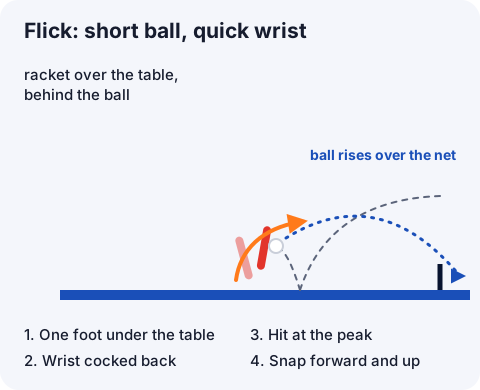
- Read the ball: is it short, and how much backspin does it have?
- Step in with your inside foot under the table and bring your body close to the ball.
- Bring the paddle behind the ball, over the table, with your wrist cocked back (on the backhand, the paddle tip points at you).
- Contact: take the ball at the top of the bounce, on the back and top.
- Snap your wrist forward and up in a short, quick motion. The forearm follows.
- Recover: step back out and return to ready. Flicks often come back fast.
Flicking against no-spin vs backspin
| Against no spin | Against backspin | |
|---|---|---|
| Angle | Paddle closed | Paddle squarer or slightly open |
| Direction | More forward | More upward |
| Contact | Back and top | Back and a bit underneath |
| Speed | Can be fast | More spin, less speed |
If you are unsure of the spin, a flick with more spin and less speed is safer. See also how to read spin.
Backhand flick and banana flick
The backhand flick is the most common. With the paddle in front of your body and the wrist well cocked, you can cover much of the table and create plenty of spin.
A well-known variation is the banana flick (also called the chiquita). The wrist wraps around the outside of the ball, mixing topspin with sidespin so the ball curves. It became famous among pros because it works even against short backspin.
The forehand flick is harder, because your body must get very close to the ball and the paddle comes from the side. Many players use the backhand even for short balls in the middle or slightly to the forehand.
Common flick mistakes
- Not stepping in. Reaching with your arm leaves you with no control.
- Hitting late. Once the ball drops below the net, the flick goes high or into the net.
- Too big a swing. The flick is short. A long stroke sends the ball long.
- A locked wrist. Without wrist, there is no speed or spin.
- A closed paddle against backspin. The ball goes into the net. Open slightly and lift more.
- Standing still afterward. A flick gives you little time for the next ball. Recover fast.
Simple drill
- Your partner serves short with no spin to your backhand. You backhand flick crosscourt.
- After 10 balls, they serve short with light backspin. Adjust the angle and lift more.
- Then they mix short serves to the middle and the forehand. Step in every time.
- Finish with real points: short serve, flick, free play.
Frequently asked questions
What is a flick in table tennis?
It is a short attack over the table against short balls, using mostly the wrist to hit over the top of the ball and send it back with topspin.
How do you do a backhand flick?
Step your foot under the table, bring the paddle behind the ball with your wrist cocked and snap the wrist forward and up at the top of the bounce.
Flick vs loop: what is the difference?
A loop is a full stroke on a ball that has bounced deep enough to swing at. A flick is a compact, wrist-driven attack on a short ball over the table.
Can you flick against backspin?
Yes, with a more open paddle and a more upward motion, focusing on spin. Against very heavy backspin, a push may be safer.
What is a banana flick?
It is a backhand flick where the wrist wraps around the outside of the ball, mixing topspin and sidespin so the ball curves.