Table tennis training log: how to track your practice and progress
A table tennis training log records, in a few lines, the date, the focus of the session, drills with number goals (like 7 out of 10 serves on target), what worked, what to fix and the plan for next time. Reviewing it once a week shows your progress and stops you repeating the same mistakes.
In this article
Almost every player leaves practice with a feeling: "that went well" or "nothing worked today". A week later the feeling is gone, and the lesson with it. A training log fixes that with five minutes of notes.
It does not need to be fancy. A notebook, your phone's notes app or a spreadsheet all work. What matters is writing down the same things every time, so you can compare.
Why keep a training log
- It shows real progress. Going from 5 to 8 serves on target in a month is motivating, and you only notice it if you write it down.
- It gives sessions a focus. If you write the plan for next time, you arrive at the table knowing what to do.
- It stops repeat mistakes. Patterns like "I always miss sidespin serve returns" pop out when you reread your notes.
- It helps your coach. If you take lessons, the log shows what happened between them.
- It prepares you for matches. Notes on opponents are gold before a tournament.
What to write after each session
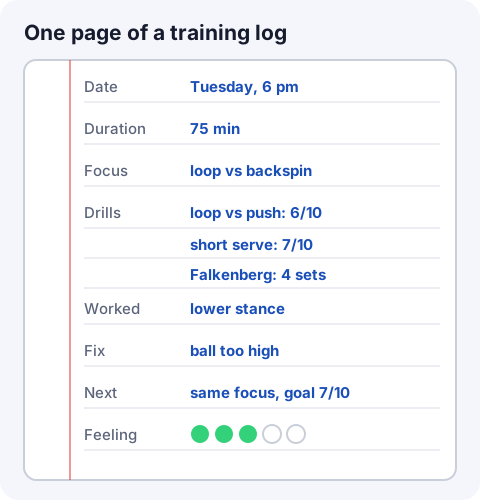
| Field | Example | Why track it |
|---|---|---|
| Date and duration | Tuesday, 75 min | See frequency and volume |
| Focus | Loop against backspin | Keep one goal per session |
| Drills and numbers | Loop vs push: 6 out of 10 on the table | Measure progress |
| What worked | Lower stance improved the arc | Repeat what works |
| What to fix | Ball going too high | Know what to drill |
| Next session | Same focus, goal 7 out of 10 | Arrive with a plan |
| How your body felt | 3 out of 5, shoulder a bit tired | Spot fatigue and aches early |
If the same ache keeps showing up in your log, do not ignore it: see a health professional. See also table tennis injuries.
A template to copy
Copy this and fill it in after each session:
- Date / duration:
- Focus:
- Drill 1 + number:
- Drill 2 + number:
- What worked:
- What to fix:
- Next session:
- Feeling (1 to 5):
Simple numbers to track your progress
Tracking does not need gadgets. A few numbers anyone can count:
| What to track | How to count it |
|---|---|
| Consistency | Longest crosscourt rally without a miss |
| Serve | How many of 10 short serves would bounce twice on the other side |
| Serve accuracy | How many of 10 serves hit a painter's tape target |
| Loop | How many of 10 loops against backspin land |
| Return | How many of 10 returns your partner cannot attack |
| Match play | Games won and lost in points with rules |
Pick two or three numbers based on the month's focus. Drills to measure them are in table tennis drills with a partner and intermediate table tennis drills.
Match and opponent notes
After matches and tournaments, write down:
- Opponent and style: righty or lefty, attacker, chopper, pips.
- Result and game scores.
- What worked against them: serves, placement, pace.
- Where I lost points: return, ball to the elbow, high balls.
- Next time: one concrete idea.
These notes help a lot when you prepare for a tournament, especially against opponents you meet again and again.
How to review your log
- Every week (5 minutes). Reread the week's sessions. Did the numbers go up? Did you stick to the focus?
- Every month (15 minutes). Compare the numbers with last month and pick next month's focus.
- After every tournament. Reread your match notes and pick the weakness that cost the most points.
That is the loop from how to get better at ping pong faster: play, take notes, pick one focus, drill it, repeat.
Notebook, app or spreadsheet?
| Format | Upside | Watch out |
|---|---|---|
| Notebook | Quick, no distractions | Harder to compare numbers |
| Phone notes | Always with you | Gets messy without a fixed template |
| Spreadsheet | Charts and easy comparison | More work to set up |
| Training app | Reminders and history | Many are built for the gym, not table tennis |
The best format is the one you will actually use after every session.
Frequently asked questions
What should I write in a table tennis training log?
Date, duration, the session's focus, drills with numbers, what worked, what to fix, the plan for next time and how your body felt.
How do I track my table tennis progress?
Count simple things like your longest rally, how many of 10 serves hit a target and how many of 10 loops land. Compare month to month.
Is a notebook or an app better for a training journal?
Either works. The best format is the one you use every time. A notebook is faster; a spreadsheet makes numbers easier to compare.
How often should I review my training log?
A quick review every week and a longer one every month, plus after every tournament.