History of the ping pong paddle: from vellum to sponge rubber
The first ping pong paddles were bare wood or vellum stretched over a frame. In 1901 pimpled rubber arrived and gave players control. In the 1950s, sponge under the rubber added huge speed and spin and changed the game. The red and black rule came in the 1980s, and since 2021 the colored side can also be blue, green, pink or violet.
In this article
A modern ping pong paddle is a piece of engineering: layered wood, sometimes with carbon fiber, a sponge and a rubber sheet with thousands of pips facing inward. But it started as a parlor toy, and every change to the paddle changed how the game is played.
Here is the history of the ping pong paddle, from vellum to sponge rubber.
Late 1800s: wood, vellum and cork
In the first parlor games in England, paddles were improvised. Some were plain wood; others were battledores with vellum stretched over a wooden frame, like a small drum. The sound of the ball on those drums is one popular explanation for the name "ping-pong", covered in table tennis vs ping pong.
Paddles covered in cork, cloth or sandpaper also showed up. With them you could barely spin the ball: the game was mostly pushing it back and forth.
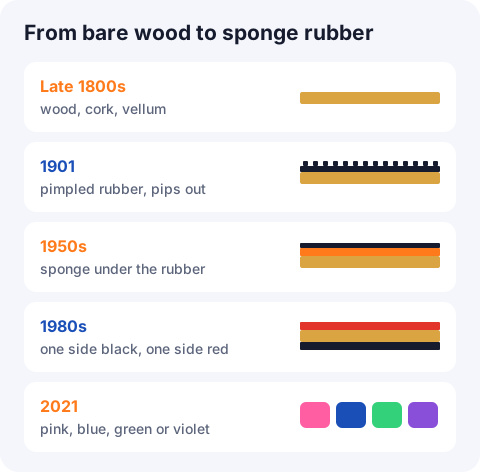
1901: pimpled rubber
Around 1901, Englishman E. C. Goode glued a sheet of pimpled rubber onto a wooden blade. The rubber gripped the ball, giving more control and a little spin. The celluloid ball arrived at about the same time, and together they created modern table tennis. The ball's story is in history of the ping pong ball.
For about fifty years this was the standard paddle: wood with thin pips-out rubber and no sponge. Today it is called a hardbat, and hardbat events are still played in the US by fans of the classic style. The game was slower and more defensive, with long rallies, as in the era of the Hungarians who dominated the early World Championships.
The 1950s: the sponge revolution
In the early 1950s, Japanese players began using paddles with a thick layer of sponge. Sponge "holds" the ball for an instant and sends it back with far more speed and spin. In 1952, Hiroji Satoh won the world title with a sponge paddle, and opponents could barely return his shots.
Sponge split the sport. To stop an arms race of ever-faster paddles, the ITTF began limiting covering thickness: today, rubber plus sponge can be at most 4 mm.
The sandwich: sponge plus inverted rubber
The design that stuck was the sandwich: a layer of sponge glued to the blade, topped with a rubber sheet with the pips facing in (smooth on the outside). The smooth surface grips the ball and lets you spin it heavily. That equipment made the modern topspin loop possible. See what is topspin.
The 1980s: colors and speed glue
In the 1970s and 1980s, some players used very different rubbers on each side, both the same color, and twiddled the paddle in their hand so opponents could not tell which side would hit the ball. To end this, the ITTF required two clearly different colors and, by the mid-1980s, set the rule: one side black, the other red. More in why paddles are red and black.
The same decade saw speed glue spread, making rubber springier after each re-gluing. It was banned in 2008, as told in speed glue ban.
2021: new colors
In October 2021, the ITTF widened the allowed colors. One side must still be black, but the other can be red, blue, green, pink or violet. The idea was to make the sport more visual while keeping the contrast that helps the opponent read the stroke. Details in table tennis paddle rules.
The ping pong paddle today
| Part | Today |
|---|---|
| Blade | At least 85% natural wood, in plies; may include fibers like carbon |
| Sponge | Many thicknesses, within a 4 mm total limit with the rubber |
| Rubber | ITTF-approved models, smooth (inverted) or pips-out |
| Colors | One side black, the other red, blue, green, pink or violet |
The short timeline:
| Era | Change | Effect on the game |
|---|---|---|
| Late 1800s | Wood, vellum, cork | Almost no spin |
| 1901 | Pimpled rubber | More control |
| 1950s | Sponge | Speed and spin explode |
| 1960s on | Sandwich with inverted rubber | The modern loop is born |
| 1980s | Black and red sides | No more color tricks |
| 2021 | New colors | More visual options |
To choose a paddle today, see table tennis rubber and how to choose a paddle.
Frequently asked questions
What were the first ping pong paddles made of?
Plain wood or vellum stretched over a frame, like small drums. Some were covered in cork, cloth or sandpaper.
Who invented rubber on ping pong paddles?
Englishman E. C. Goode is credited with gluing the first sheet of pimpled rubber onto a blade, around 1901.
When were sponge paddles introduced?
In the early 1950s, by Japanese players. Hiroji Satoh won the 1952 world title with a sponge paddle.
Why are ping pong paddles red and black?
So the opponent can tell which side hit the ball. The two-color rule came in the 1980s, after players twiddled paddles with same-colored but very different rubbers.
When were blue ping pong paddles allowed?
From October 2021. The colored side can be red, blue, green, pink or violet, but the other side must be black.