Speed glue: what it was and why table tennis banned it
Speed glue was a glue with volatile solvents that players applied to their rubber before each match. The solvent swelled the sponge and stretched the rubber, adding speed and spin. The ITTF banned glues containing volatile organic compounds (VOCs) for health reasons: the decision came in 2007, and it applied to senior play from September 2008, after the Beijing Olympics.
In this article
Anyone who played competitive table tennis in the 1990s remembers the sharp smell in the hall before matches. It was speed glue: players gluing and re-gluing their rubbers minutes before walking onto the court, chasing a few extra miles per hour on the ball.
Speed glue shaped the game for nearly three decades before it was banned. Here is what it was, why it worked and what replaced it.
What was speed glue?
Speed glue was a solvent-based glue, similar to the rubber cement used to patch bike tires. Players spread it on the rubber's sponge and on the blade and stuck everything together shortly before playing.
The trick was the solvent. Soaking into the sponge, it made the sponge swell slightly. The top sheet did not swell as much, so it ended up stretched under tension, like a trampoline. The result:
- More speed: the ball shot off the paddle with a catapult effect.
- More spin: the stretched rubber gripped the ball better.
- A signature sound: a loud "click" on every stroke.
The effect lasted only a few hours, as the solvent evaporated. That is why pros re-glued before every match, sometimes more than once a day.
Where speed glue came from
The discovery is usually credited to Hungary's Tibor Klampár, who reportedly noticed in the late 1970s that his rubber played faster right after gluing. In the 1980s the technique spread and became standard at the top level. A game that was already fast thanks to sponge rubber got faster still. The full equipment story is in history of the ping pong paddle.
Why was speed glue banned?
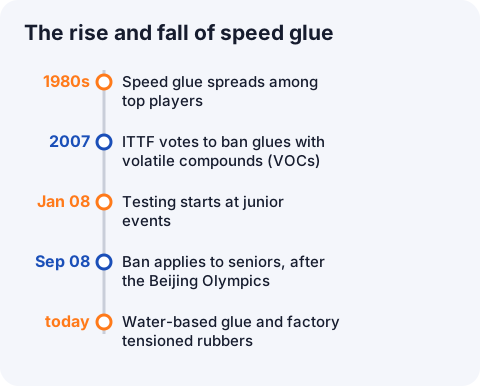
The main reason was health. The solvents in speed glue are volatile organic compounds (VOCs). Breathing those fumes regularly, in closed halls, worried doctors and officials, especially for young players. The products were also flammable, which made handling them risky.
The ban came in stages:
| When | What happened |
|---|---|
| 2007 | The ITTF decides to ban glues containing VOCs |
| January 2008 | Testing starts at junior events |
| September 2008 | The ban applies to senior play, after the Beijing Olympics |
Beijing 2008 was the last Olympics where speed glue was allowed. Since then, major international events have run racket control with devices that detect solvent fumes in the rubber. A paddle that fails cannot be used.
What players use today
After speed glue, the industry found other routes:
- Water-based glue: the only kind allowed today. It just holds the rubber in place, with no speed effect. See how to glue rubber.
- Factory-tensioned rubbers: the tension speed glue used to create is now built in during manufacturing. Many modern rubbers are sold as "tensor" or pre-tensioned. See the types in table tennis rubber.
- Boosters: oils brushed onto the sponge to mimic the glue effect. ITTF rules forbid any physical or chemical treatment of the rubber after manufacture, so boosting is against the rules, even though it is hard to detect.
How the game changed
Without speed glue, and with the 40 mm ball and later the plastic ball, top-level table tennis became a little less explosive. Players rely more on technique and physical power to create speed, and less on a boost from the rubber. Current equipment rules are in table tennis paddle rules.
For club players, the change was good news too: no more solvent fumes, less money spent on glue and rubbers that last longer between gluings.
Frequently asked questions
What is speed glue in table tennis?
A solvent-based glue that swelled the sponge and stretched the rubber, making the paddle faster and spinnier for a few hours.
Why was speed glue banned in table tennis?
For player health: the solvents were volatile organic compounds, harmful when inhaled regularly, and also flammable.
When was speed glue banned?
The ITTF decided the ban in 2007. Testing began at junior events in January 2008, and the ban applied to senior play from September 2008.
What glue is legal in table tennis?
Water-based table tennis glue without volatile solvents. It is the only type allowed in competition.
Are boosters legal in table tennis?
No. The rules forbid any treatment of the rubber after manufacture, and boosters fall under that ban.