What is topspin in table tennis?
Topspin is spin where the ball rotates forward, in the same direction it travels. It makes the ball dip faster in the air, stay low and speed up after the bounce, and jump upward off the opponent's paddle. It is the spin of attack: it lets you hit hard and still land the ball on the table.
In this article
Topspin is spin where the ball rotates forward: the top of the ball moves in the same direction it is traveling. In table tennis it is the most important spin for attacking. Almost every modern attacking stroke, from the forehand loop to the flick, puts topspin on the ball.
Knowing what topspin does helps you both attack with it and defend against it.
How the ball rotates with topspin
Picture the ball traveling from your paddle to your opponent's side. With topspin, the top of the ball rotates forward, toward your opponent, and the bottom rotates back toward you. It is the same rotation as a wheel rolling forward, just much faster.
You create it by brushing the ball from low to high, with the paddle grazing the back and top of the ball.
What topspin does to the ball
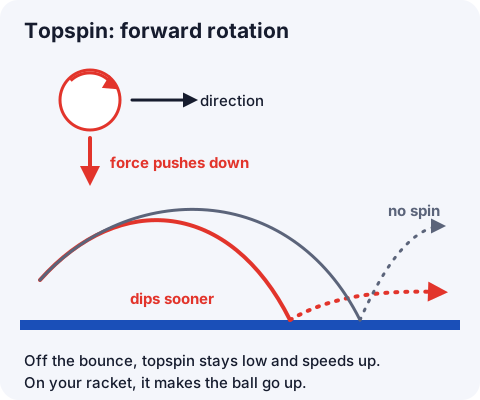
In the air: it dips faster
A topspin ball feels a downward force from the Magnus effect (see the physics of spin). In practice, its path curves down at the end. That has a huge consequence: you can hit harder and higher over the net and still land the ball on the table.
On the bounce: it kicks low and forward
When a topspin ball hits the table, the spin grips the surface and pushes the ball forward. It comes off lower and faster than your opponent expects. That is why topspin seems to "accelerate" after the bounce.
On the opponent's paddle: it jumps up
When a topspin ball hits the receiver's paddle, the spin sends it upward. If the opponent holds the paddle square or open, the ball flies high and long. That is the most common mistake against topspin.
Topspin vs backspin
| Topspin | Backspin | |
|---|---|---|
| Rotation | Forward | Backward |
| In the air | Dips faster | Floats longer |
| On the bounce | Low and fast | Slows down |
| On the opponent's paddle | Jumps up | Drops, into the net |
| To return it | Closed paddle | Open paddle |
| Typical use | Attack | Serve, push, defense |
See the other side in what is backspin.
How to hit topspin
- Start with your paddle below the height of the ball.
- Keep the paddle face almost square (against backspin) or slightly closed (against topspin).
- Swing low to high and forward, accelerating through contact.
- Use a thin contact, grazing the back and top of the ball instead of hitting through it.
- Finish high, toward your target.
How to return topspin
- Close your paddle. Tilt the face toward the table. The more spin, the more closed.
- Take it early. Hit the ball right after the bounce, before it rises much.
- Block or counter. A short block uses your opponent's pace; a counter-loop with a closed paddle sends back even more spin.
- Do not push it. Pushing against topspin almost always pops the ball up.
Common mistakes against topspin
- An open paddle. The ball goes high and long.
- Hitting late. The ball rises and gets hard to control.
- Backing off too far. Away from the table, topspin arrives faster and higher.
- A big swing on the block. Against heavy topspin, the smaller the motion the better.
Frequently asked questions
What is topspin in table tennis?
It is spin where the ball rotates forward. It dips faster in the air, comes off the bounce low and fast, and jumps up off the opponent's paddle.
What is the difference between topspin and backspin?
With topspin the ball rotates forward and dips; with backspin it rotates backward, floats and slows down on the bounce.
How do you return topspin in ping pong?
Close your paddle, take the ball right after the bounce and block or counter with a short motion.
Why does topspin land even when you hit hard?
Because the forward rotation creates a downward force in the air (the Magnus effect) that makes the ball dive at the end of its flight.