How to build your racket in RealTT
In RealTT your racket is a blade plus two rubbers. Your forehand rubber is your class (how you attack) and your backhand rubber is your subclass (how you answer). There are 7 rubber types and 6 blades, each with a strength and a weakness, and an item's tier only turns both up.
In this article
In real table tennis, serious players build their own racket (paddle): they pick a blade and a rubber for each side. RealTT follows the same logic. Your racket changes the speed, spin and control of your shots, and how much your opponent's spin bothers you.
This guide shows how to build your racket in RealTT, what each rubber and blade does, and how to pick the right combo for your style.
Where to build your racket
Everything lives in the Equip tab. Under Character you see your Power (the combined strength of your racket) and four slots: Blade, Forehand, Backhand and Outfit. Your Backpack holds every item you own.
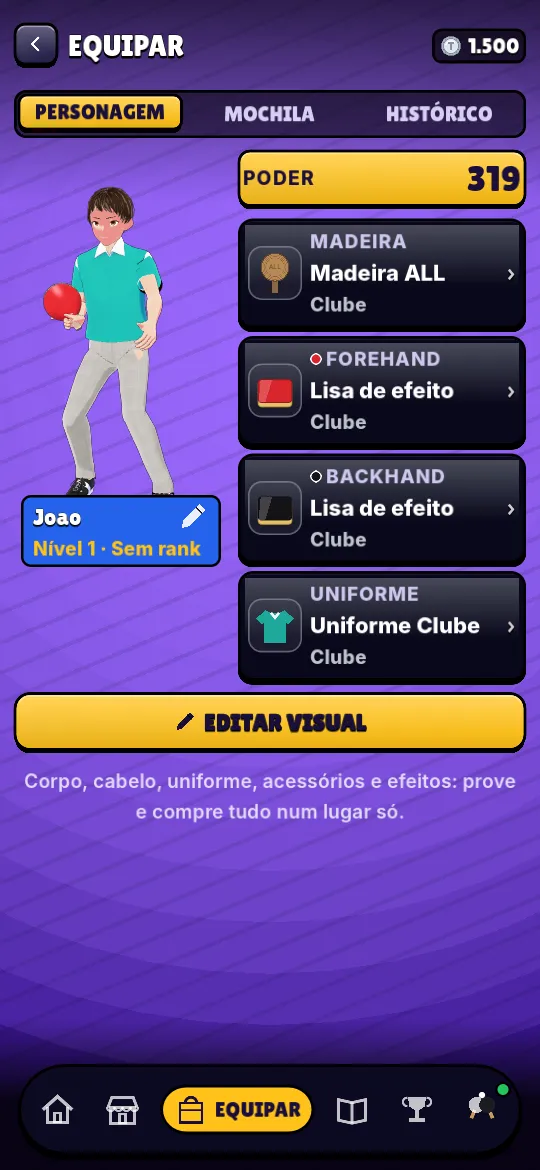
- Open the Equip tab and tap Backpack.
- Tap a rubber or blade to open its details.
- Check What it is, its strength and weakness, and Compared with what you wear.
- Tap Equip as FH or Equip as BH (for rubbers) or Equip (for blades).
The comparison shows, number by number, what gets better and what gets worse against what you have on now. It is the safest way to decide on a swap.
Class and subclass: forehand and backhand
In RealTT, your forehand rubber is your class: it sets how you attack. Your backhand rubber is your subclass: it sets how you answer. As the ITTF rule says, one side of the racket is black and the other a different color. By default, the forehand is red and the backhand is black.
The two sides together also set a play style, which the game shows when you build your first racket. Two smooth rubbers make a Two-wing attacker; a smooth forehand with long pips on the backhand makes an Attacker with a wall; short pips on both sides make a Pips hitter. There are nine styles in all.
The 7 rubber types
Every rubber type has six numbers: speed, spin, control, spin resistance, spin reversal and tack. None is best at everything:
| Rubber | Class | What it gives you | What it asks of you | Who it suits |
|---|---|---|---|---|
| Spin inverted | Spin Mage | The heaviest topspin and backspin; the easiest to learn | Feels the opponent's spin the most | Beginners and anyone who loves spin |
| Speed inverted | Gunslinger | The fastest loops and kills | Little margin: swing too hard and it goes long | Attackers with good timing |
| Tacky inverted | Dragon | Huge spin on serves and pushes | Slow and soft on gentle touches | Patient players with a big forehand |
| Short pips | Lightning | Fast, flat hits; ignores most incoming spin | Little spin of its own; hard to loop a backspin ball | Hitters who stay close to the table |
| Medium pips | Trickster | Steady control, a little reversal: hard to read | Not extreme at anything | Blockers who like to vary the ball |
| Long pips | Mirror | Sends the spin back reversed: a loop returns as backspin | Weak for attacking, and slow | Defenders and blockers, usually on the backhand |
| Anti-spin | Guardian | Almost immune to spin; low, awkward balls | No attack at all; the slowest rubber | Defenders who want to break the rhythm |
To understand these types on a real paddle, read the table tennis rubber guide.
The 6 blades
A blade has speed, spin and control, and adds them to both rubbers. In a blade's numbers, 50 means it changes nothing; above 50 it adds, below 50 it takes away.
| Blade | How it plays |
|---|---|
| Blade ALL | Slow and flexible. The most control, made for learning |
| Blade ALL+ | A little quicker than ALL, still forgiving |
| Blade OFF- | Between all-round and offensive. Speed with feel |
| Blade OFF | Stiff and fast, for hitting through the ball |
| Blade OFF+ | Very fast and very stiff. It asks for a full stroke |
| Blade DEF | Slow and flexible, for chopping and blocking |
The ALL, OFF and DEF classes come from the categories real manufacturers use. More in table tennis blade.
Tiers: the same item, stronger
Every item has a tier, from most common to rarest: Club, Regional, National, Continental, World Tour, Olympic and Grand Smash. The tier never changes the item's type: long pips stay long pips, just better at what they do. A Grand Smash item also rolls a bonus of 10% to 15% on one of its numbers.
You win items in Story mode: every win gives a drop from that rival, at a random tier. From level 3, the Market lets you buy and sell items with other players, at a fixed price per tier. Bolas de Ouro (Gold Balls) never buy gear.
Racket colors and looks
Red and black are unlocked from the start. The other rubber colors (Green, Blue, Purple, Pink, Olympic flame and Grand Smash gold) unlock with the best tier you have ever dropped. The game follows the ITTF rule: the two sides must be different colors and one of them must be black.
Under Customise your racket you can also change the handle, tape, sponge and end cap. That is looks only: your racket plays the same.
How to pick your combo
- Starting out: Spin inverted on both sides with Blade ALL. It is the most forgiving setup and the one that teaches you the most about spin.
- Attacker: Speed inverted or Tacky inverted on the forehand, a smooth rubber on the backhand and an OFF blade. It asks for good timing.
- Close to the table: Short pips on one or both sides, with Blade ALL+ for steady blocks.
- Defender: Long pips or Anti-spin on the backhand with Blade DEF. You live on your opponent's spin and pace.
Frequently asked questions
What is the best rubber in RealTT?
None is best at everything: every item has a weakness. To start, Spin inverted is the most forgiving. To attack, Speed inverted is the fastest; to defend, Long pips send the spin back reversed.
How do I get rubbers and blades in RealTT?
By winning Story mode matches, which give one drop per win, or by buying from other players in the Market, from level 3.
What is racket power?
A number that adds up the strength of your blade and both rubbers. Before each Story match, you compare your power with your rival's.
Can I use long pips on the forehand?
Yes. Any rubber goes on either side. Long pips are more common on the backhand because they are weak for attacking.
Does changing the handle or tape change how I play?
No. The handle, tape, sponge and end cap are looks only.