Table tennis racket rules: colors, rubbers and the blade
A table tennis racket can be any size, shape or weight, but the blade must be flat, rigid and at least 85% natural wood. Each side used to hit the ball needs an ITTF-approved rubber, with one side black and the other a bright color such as red, blue, green, pink or violet.
In this article
Unlike tennis or badminton, a table tennis racket (or ping pong paddle, as most Americans call it) has no fixed size. It can be big, small, round or square. In exchange, the rules about the surface that touches the ball are strict: color, thickness, type of rubber and even how it is treated.
Here are the ITTF racket rules, what changed with colors, and what can get your paddle rejected at a tournament. If you are shopping for one, also read how to choose a paddle.
The blade
- Size, shape and weight are free. There is no minimum or maximum.
- The blade must be flat and rigid.
- At least 85% of its thickness must be natural wood. Glue layers inside the blade may be reinforced with fiber, such as carbon or glass fiber, but each one may be no thicker than 7.5% of the total thickness or 0.35 mm, whichever is smaller.
- Every layer must be of even thickness. Extra material can be added to shape the handle.
That is why "carbon" blades on the market are really wooden blades with thin fiber layers between the plies.
The rubbers
Each side of the blade used to hit the ball must be covered with one of these two types:
| Type | What it is | Maximum thickness, including glue |
|---|---|---|
| Ordinary pimpled rubber | A single layer of rubber with pimples out, no sponge | under 2.05 mm |
| Sandwich rubber | Sponge covered by a pimpled rubber sheet, pimples in (smooth, "inverted") or pimples out | under 4.05 mm |
The pimpled layer must have between 10 and 30 pimples per cm², and in a sandwich rubber it may be at most 2 mm thick. In tournaments, the rubber must be a model approved by the ITTF, which publishes an official list that is updated regularly. Approved rubbers carry the ITTF logo and approval number near the handle.
More rules about the rubber:
- it goes up to the edge of the blade, but not beyond it;
- the part near the handle, where your fingers go, may be left uncovered;
- it must be used without any physical or chemical treatment. Products that "boost" the rubber, known as boosters, are banned in competition.
Colors: why the two sides are different
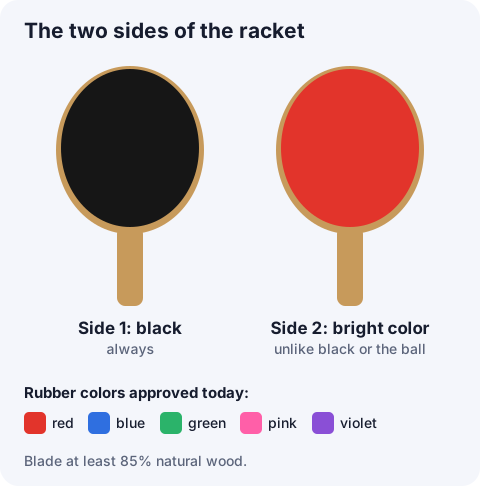
The rule says one side of the racket is black and the other is a bright color, clearly different from black and from the color of the ball. Both surfaces must be matte.
The reason is reading spin. Many players use a different rubber on each side, for example a smooth inverted rubber and a long pimpled one, which spin the ball in very different ways. If both sides were the same color, a player could twiddle the paddle in their hand and hide which rubber they used.
For decades the bright color was red only. In 2021, the ITTF began approving rubbers in blue, green, pink and violet too. The other side is still always black.
Even if you only hit with one side, both sides must follow the color rule.
Does hitting with the wood count?
No. If you hit the ball with a side that does not have the required covering, such as bare wood or a rubber that does not meet the rules, your opponent wins the point. The edge of the blade is not one of the racket's sides, so a ball that catches the edge and lands correctly stays in play.
Your racket at a tournament
- Before the match, you show your racket to your opponent and the umpire, and they may inspect it.
- During the match, you may only change rackets if yours is accidentally damaged so badly that it cannot be used.
- At bigger events, there is racket control that checks thickness, flatness and banned substances.
Very worn rubbers, with bubbles or peeling, can also be rejected, because they make the surface uneven. Learn when it is time for new ones in when to replace your rubber.
Frequently asked questions
What are the rules for a table tennis racket?
Size, shape and weight are free, but the blade must be flat, rigid and at least 85% natural wood. Each side used needs an ITTF-approved rubber, one black and one a bright color.
Why are ping pong paddles two different colors?
So your opponent can see which side, and which rubber, you used on each shot, since each rubber spins the ball differently.
What rubber colors are allowed?
One side is always black. The other can be red, blue, green, pink or violet in ITTF-approved rubbers.
Can you use a paddle without rubber?
Not in official play. Hitting with a side that has no legal covering gives your opponent the point.
Can you change your paddle during a match?
Only if it is accidentally damaged so badly that it cannot be used.