History of the ping pong ball: from celluloid to plastic
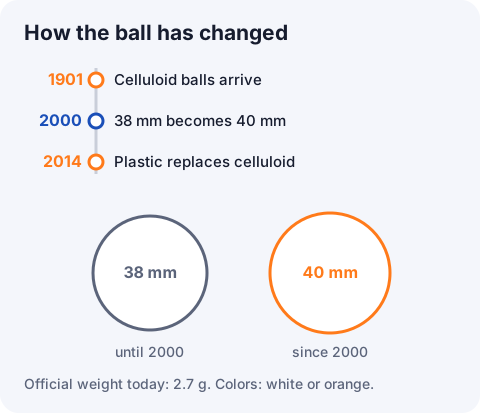
The first ping pong balls were made of rubber or cork. Around 1901, light, hollow celluloid balls became the standard and stayed in use for over a century. In 2000 the ITTF enlarged the ball from 38 mm to 40 mm to slow the game down, and in 2014 it replaced celluloid with plastic, which is safer to make and ship.
In this article
The ping pong ball looks like the simplest thing in the sport: hollow, white or orange, almost weightless. But every change to it, however small, changed how the game is played. The celluloid ball turned a parlor game into a sport, and a 2 mm size change in 2000 reshaped the pro game.
Here is the history of the ping pong ball, from cork to plastic.
The first balls: cork, rubber and improvisation
In the late 1800s, when table tennis was still a parlor game in England, people used whatever they had. There are records of rubber balls, cork balls and even balls wrapped in cloth so they would not mark the furniture. Many books repeat the story of balls carved from champagne corks, a nice tale that is hard to confirm.
The trouble was that these balls bounced unevenly and were too heavy for quick exchanges. The game was slow and full of dead balls.
When was the ping pong ball invented? 1901 and celluloid
Around 1901, English enthusiast James Gibb came across celluloid balls on a trip to the United States and realized they were perfect for the game: light, hollow, with a high and consistent bounce.
Celluloid, an early plastic made from nitrocellulose, became the standard. Together with the pimpled rubber paddle that appeared at the same time, the new ball gave the game speed and a little spin. The paddle's story is in history of the ping pong paddle.
The celluloid ball lasted more than a hundred years. For most of the 20th century it measured 38 mm across.
2000: from 38 mm to 40 mm
By the 1990s, top-level table tennis was almost too fast to follow. With modern rubbers and speed glue, points ended in two or three shots, and TV viewers could barely see the ball. The ITTF decided to act.
After the Sydney Olympics, in October 2000, the official ball grew from 38 to 40 mm (about 1.57 inches), and the weight went up to 2.7 g. It sounds tiny, but a bigger ball meets more air resistance: it travels a bit slower and spins a bit less. Rallies got longer.
| 38 mm ball | 40 mm ball | |
|---|---|---|
| In use | Until 2000 | Since October 2000 |
| Speed | Faster | Slightly slower |
| Spin | More | Slightly less |
| Goal of the change | Longer rallies that are easier to watch |
It was part of a package of reforms that also brought 11-point games in 2001. See why table tennis changed to 11 points.
2014: goodbye celluloid
Celluloid has one big problem: it is flammable. That made manufacturing and shipping more complicated and costly, and supply was shrinking. The ITTF decided to replace it, and from July 2014 international events switched to plastic balls.
The new balls are marked 40+, because they came out slightly larger than the old ones. The first versions had a seam, like celluloid balls; seamless balls followed, and later ABS plastic balls, which are the most common today.
How the plastic ball changed the game
Players and coaches noticed differences during the switch:
- Less spin: plastic grips the rubber slightly less.
- A slightly different bounce: early balls varied more from brand to brand.
- More power and more backhand: with less spin, the game rewarded heavier hitting and close-to-the-table backhand exchanges.
Manufacturers have improved a lot since then, and today's 3-star 40+ balls are very consistent. How to pick yours is in ping pong balls.
The ball today
| Spec | Current rule |
|---|---|
| Diameter | 40 mm (about 1.57 in) |
| Weight | 2.7 g (about 0.095 oz) |
| Material | Plastic (no more celluloid in competition) |
| Colors | White or orange, matte |
| Marking | 40+ and ITTF approval |
For all these changes in order, see the history of table tennis.
Frequently asked questions
When was the ping pong ball invented?
Celluloid ping pong balls came into the game around 1901, thanks to English enthusiast James Gibb. Before that, people used rubber or cork balls.
When did ping pong balls change from 38 mm to 40 mm?
In October 2000, after the Sydney Olympics. The bigger ball is a little slower and spins a little less.
Why did table tennis stop using celluloid balls?
Celluloid is flammable, which made it hard to manufacture and ship. The ITTF switched to plastic balls in 2014.
What does 40+ mean on a ping pong ball?
It marks the plastic ball, which is slightly larger than the old 40 mm celluloid ball.
Are orange ping pong balls legal?
Yes. The rules allow white or orange matte balls, and organizers pick the color that contrasts best with the table and background.