Table tennis rubber: inverted, short pips and long pips
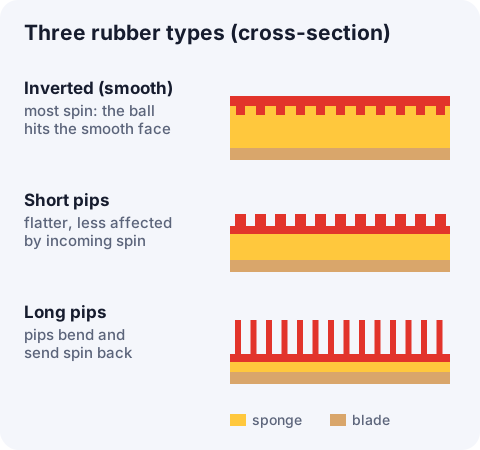
There are three main types of table tennis rubber. Inverted rubber has the pimples facing in and gives the most spin; most players use it. Short pips are flatter and less affected by incoming spin. Long pips send spin back reversed and are used by defenders.
In this article
The rubber is the part of your paddle that touches the ball, so it shapes spin more than any other part. Two paddles with the same blade can play completely differently just because of the rubber.
Here is how the types of table tennis rubber (ping pong rubber) differ, what hardness and sponge change, and what the rules require.
What rubber is made of
Almost every rubber has two parts:
- Topsheet: a sheet of rubber with pimples (tiny cylinders) on one side.
- Sponge: the soft layer underneath that adds speed and "catapult."
What defines the type of rubber is which way the pimples face and their shape.
Rubber types
| Type | Pimples | Spin | Speed | Best for |
|---|---|---|---|---|
| Inverted | Facing in, smooth surface out | Most | Slow to very fast | The vast majority, beginner to pro |
| Short pips | Facing out, short and wide | Medium; less affected by incoming spin | Fast and flat | Close-to-table hitters |
| Medium pips | Facing out, in between | Unpredictable | Medium | Blockers who like variation |
| Long pips | Facing out, tall and thin | Returns spin reversed | Slow | Choppers and blockers |
| Anti-spin | Smooth but with almost no grip | Almost none | Slow | Rare blocking and variation style |
Inverted rubber
This is the standard. The ball hits a smooth, grippy surface, which creates lots of friction and therefore lots of spin. Loops, pushes and spin serves all work best with it. Two common families:
- Tensor rubbers (European/Japanese style): bouncy; the ball comes off fast even on medium strokes.
- Tacky rubbers (Chinese style): sticky topsheet and hard sponge. Lots of spin, but they demand full strokes.
Short pips
With pimples out, the ball touches their tips. Contact is shorter and less sensitive to your opponent's spin. Play gets flatter and faster, good for hitting the ball early close to the table. You get less spin than with inverted.
Long pips
Tall, thin pimples bend at contact. Instead of creating new spin, they tend to keep the rotation the ball already had, so spin comes back reversed: your topspin returns as backspin. Many defenders use it. If you face one, read how to play against long pips.
Hardness and sponge
Sponge hardness is given in degrees, but each brand uses its own scale, so compare only within one brand. In general:
- Soft sponge: more control and spin on slow strokes; good for beginners.
- Hard sponge: more speed on big shots; needs technique and power.
Sponge thickness (from 1.5 mm up to max) matters a lot too. See sponge thickness explained.
What the rules say
Under ITTF rules:
- Each hitting side must be covered with ITTF-approved rubber, with the logo and approval number visible near the handle.
- Rubber with sponge (inverted or pips) can be at most 4 mm thick in total, including glue. Pimpled rubber with no sponge, at most 2 mm.
- One side must be black and the other a bright color clearly different from black and the ball. Since 2021, the approved colors are red, blue, green, pink and purple.
- Rubber must not be physically or chemically treated to change its properties after it leaves the factory.
- Rubber must cover the blade up to the edge without going past it.
How to choose your rubber
- Start with inverted on both sides. It is the safest way to learn proper technique.
- Pick hardness for your level. Soft to start, medium once your strokes are solid.
- Think side by side. Many players use a slightly harder rubber on the forehand and a softer one on the backhand.
- Pips are a style. Short or long pips are a way to play, not an "upgrade."
Frequently asked questions
What is the difference between inverted rubber and short pips?
On inverted rubber the pimples face in and the ball hits a smooth, grippy surface, giving more spin. On short pips the ball hits the pimple tips, making play flatter and less affected by spin.
Are long pips legal?
Yes, as long as the rubber is ITTF-approved. Many defenders use long pips on one side.
Can my rubber be blue or purple?
Yes. Since 2021, the ITTF allows blue, green, pink and purple as well as red for the non-black side.
Which rubber gives the most spin?
Inverted rubber, especially grippy or tacky ones. Short pips give less spin and long pips create almost none of their own.
Can I use the same rubber on both sides?
Yes, as long as one side is black and the other a bright approved color. Many players do.