How to choose a table tennis paddle
Choose a paddle for your level, not for top speed. Beginners play better with a control blade (ALL), soft inverted rubber and a 1.5 to 1.8 mm sponge. Fast and carbon blades only help once your strokes are consistent.
In this article
Every ping pong paddle on the shelf promises "maximum speed" and "extreme spin." At the table, what wins points is something else: putting the ball where you want, over and over. This guide shows how to choose a ping pong paddle by looking at the parts that actually change your game.
The core idea is simple: the right table tennis paddle (or racket, as it is officially called) matches your level and style. It is rarely the fastest one in the store.
The parts of a paddle
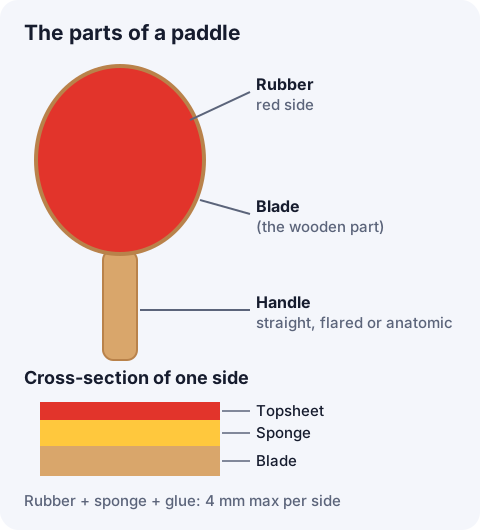
A paddle has three parts:
- Blade: the wooden base. It sets much of the speed and the feel at contact.
- Rubber: the covering on each side. It is a topsheet (the layer with pimples) on top of a sponge. This is what creates spin.
- Handle: the part you hold. It changes comfort and how freely your wrist moves.
What makes a good ping pong paddle: 5 criteria
1. Your level
This matters most. Very fast paddles magnify mistakes: a tiny error becomes a ball that flies long. While you are still learning the forehand and backhand, you want a paddle that forgives.
2. Blade speed and control
Manufacturers rate blades on a scale from defense to attack: DEF, ALL (allround), OFF-, OFF and OFF+. The closer to OFF+, the faster and harder to control. All-wood 5-ply blades are usually the most controllable; 7-ply and carbon blades are faster. More in table tennis blades.
3. Rubber type
Nearly every player uses inverted rubber (smooth side out) on both sides because it gives the most spin. Short pips and long pips are style choices for players who know what they want. See table tennis rubber.
4. Sponge thickness
A thicker sponge makes the rubber faster and spinnier on big shots, but less precise on short touches. For a first paddle, 1.5 to 1.8 mm is ideal. Strong attackers use 2.0 mm or max.
5. Handle and weight
| Handle | Shape | Best for |
|---|---|---|
| Straight (ST) | Same width all the way | Players who switch grip a lot between forehand and backhand |
| Flared (FL) | Wider at the end, thinner in the middle | Most players; stays secure in the hand |
| Anatomic (AN) | Bulges in the middle | Players who like a fuller grip |
A fully assembled paddle usually weighs somewhere between 150 g and 200 g (about 5.3 to 7 oz). Heavier paddles put more power on the ball but tire your arm and slow your reactions.
Table: which paddle at each level
| Level | Blade | Rubber | Sponge |
|---|---|---|---|
| Casual and beginner | ALL, 5-ply wood | Soft control inverted | 1.5 to 1.8 mm |
| Intermediate | ALL+ or OFF-, 5 or 7 ply | Medium-hard inverted | 1.8 to 2.0 mm |
| Advanced attacker | OFF or OFF+, 7-ply or carbon | Offensive inverted | 2.0 mm to max |
| Defender (chopper) | DEF | Soft inverted, long pips optional on one side | Thin, or no sponge on long pips |
Pre-made or custom?
A pre-made paddle comes with the rubbers already glued. A custom paddle is built from parts: you buy the blade and the rubbers separately. For your first year, a good pre-made paddle is plenty. Once you know what you want from your rubber, going custom pays off. The full comparison is in pre-made vs custom paddle.
What the rules say
To play in tournaments, your racket must follow the ITTF (International Table Tennis Federation) Laws:
- The blade can be any size, shape or weight, but must be flat, rigid and at least 85% natural wood by thickness.
- Each hitting side must be covered with ITTF-approved rubber, with the logo and approval number visible.
- One side must be black and the other a bright color clearly different from black and from the ball. Since 2021, blue, green, pink and purple are allowed as well as red.
- Rubber with sponge can be at most 4 mm thick in total, including the glue.
See table tennis racket rules for details.
Common buying mistakes
- Buying the fastest paddle "to grow into." It slows your progress.
- Picking a paddle because a pro uses it. Pros use gear built for their level.
- Ignoring the handle. A handle that does not fit your hand hurts every stroke.
- Playing with old, slick rubber. Rubber with no grip makes almost no spin.
Frequently asked questions
What is a good ping pong paddle for beginners?
A control paddle: an ALL 5-ply blade, soft inverted rubber and a 1.5 to 1.8 mm sponge. It forgives mistakes and helps you learn proper strokes.
How do I know if a paddle is fast?
Check the blade rating (DEF, ALL, OFF-, OFF, OFF+), the number of plies, whether it has carbon and the sponge thickness. More plies, carbon and thick sponge mean more speed.
Is a heavier ping pong paddle better?
Not necessarily. It adds power but tires your arm and slows your reactions. Most players do well with a medium weight.
Which handle should I choose?
Flared (FL) is the most popular and stays secure in the hand. Straight (ST) makes grip changes easier. Hold a few if you can.
Can my paddle rubber be any color?
For tournaments, one side must be black and the other an ITTF-approved bright color such as red, blue, green, pink or purple.