How to return a serve in table tennis: read the spin, return it better
To return a serve well, stand close to the table in a ready position, watch the server's paddle at contact to read the spin, and adjust your paddle angle: open against backspin, more closed against topspin or no spin, and aimed to cancel the kick against sidespin. Attack long serves; return short ones short or with a push.
In this article
Returning serve is one of the hardest moments in table tennis. The server picks the spin, the speed and the placement; you have a split second to figure all of it out and respond. No wonder so many points end on the serve or the return.
The good news is that service return can be trained. With a solid stance, a method for reading spin and a few go-to answers, you will miss far less and start using your return to win points.
The ready position
- Close to the table, about an arm's length from the end line, so you can reach short serves.
- On your backhand side, a little left of center (for right-handers), because the forehand reaches further.
- Feet apart, knees bent and weight on the balls of your feet, ready to move in or back.
- Paddle in front of you, at table height, in a neutral position.
Remember you can make the server wait: if they serve before you are ready and you do not try to return it, it is a let. See what is a let in table tennis.
How to read the spin on a serve
Read the clues in the order they appear:
- The server's paddle motion. Where is it going at contact? Top to bottom, under the ball, suggests backspin. Low to high, topspin. Sideways, sidespin.
- Sound and speed. A heavy brush often sounds "thinner". A serve with little spin often comes off with a sharper knock.
- The flight. A ball that floats and checks up on the bounce has backspin. A ball that speeds up after the bounce has topspin.
- The logo. On slow serves, you can see whether the mark spins a lot or a little.
Watch out for the follow-through: many servers keep the paddle moving in another direction after contact to fool you. What matters is the moment of contact. To train this skill, see how to read spin.
The answer to each serve
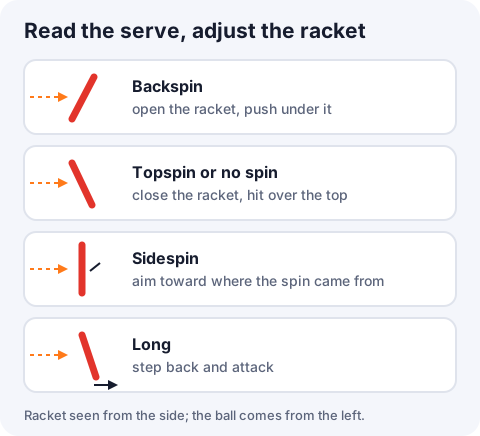
| Serve | Paddle angle | Safe return | Aggressive return |
|---|---|---|---|
| Short backspin | Open | Short push back | Flick, if the backspin is light |
| Long backspin | Open, swinging upward | Long push | Loop, lifting the ball well |
| Short topspin or no-spin | More closed | Short touch over the top | Flick |
| Long topspin | Closed | Block | Loop or counter-hit |
| Sidespin | Angled to compensate | Aim toward where the server's paddle came from | Attack, aiming opposite to the kick |
The sidespin rule: your return tends to go the way the server's paddle was moving. So aim toward where it came from. See why in sidespin serve.
Short or long: decide fast
Your first decision is not the spin, it is the length:
- Long serve: take a step back and attack. A long serve is your chance to take the initiative.
- Short serve: step in, with your paddle-side foot under the table, and return it short, with a push or a flick.
The most common mistake is getting stuck in between: attacking a short serve with no room, or passively returning a long one.
Common return mistakes
- Standing too far back and not reaching short serves.
- Flat paddle against backspin: the ball goes into the net.
- Hitting everything hard: against a heavily spun serve, power only magnifies the error.
- Watching only the ball: the server's paddle gives the spin away first.
- Not adjusting after a miss: if the same serve got you twice, change your angle or your answer.
How to practice service return
Ask a partner to serve 10 balls in a row with the same spin, then 10 mixing two spins from the same motion. First, focus on simply getting the ball on the table. Then on placement. Return improves quickly when you see the same serve many times.
Frequently asked questions
How do you return a backspin serve?
Open your paddle and push under the ball, returning it with backspin. If the serve is long, you can loop it, lifting the ball well.
How do you return a sidespin serve in table tennis?
Aim toward where the server's paddle swing came from, to cancel out the kick.
How can you tell what spin is on a serve?
Watch the server's paddle at contact: under the ball is backspin, low to high is topspin, sideways is sidespin.
Where should you stand to return a serve?
Close to the table, a little toward your backhand side, knees bent and paddle in front of you.
Why do my returns keep going into the net?
The serve probably has backspin and your paddle is too flat. Open it more and push under the ball.