Backhand serve: how to do it and when to use it
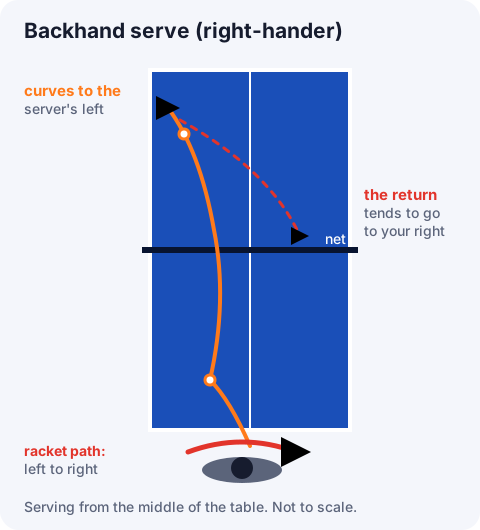
In a backhand serve, you serve from the middle of the table with the ball in front of your body, and the racket moves left to right (for right-handers). It is easy to learn, lets you vary backspin, sidespin and no-spin with almost the same motion, and spins the ball the opposite way from a pendulum serve. It is a great option for beginners and for doubles.
In this article
When people think of high-level serves, the forehand pendulum serve comes to mind first. But the backhand serve has a special place: it is one of the easiest to learn, it works great in doubles and several elite players use it as their main serve.
This guide covers stance, grip, step-by-step technique, variations and when to use the backhand serve. If you are just starting, read how to serve in table tennis first.
What is a backhand serve?
It is a serve played with the backhand side of the racket, with the ball in front of your body. For right-handers, the racket moves from left to right, brushing the ball. The motion resembles a normal backhand, only shorter, with the wrist doing most of the work.
The sidespin goes the opposite way from the pendulum serve: the ball curves to the server's left and the return tends to go to the server's right. It is the same direction as the tomahawk serve and the reverse pendulum.
Advantages of the backhand serve
| Advantage | Why |
|---|---|
| Easy to learn | The motion feels natural and the ball stays in front of your eyes |
| Easy to vary | Backspin, sidespin and no-spin come from almost the same motion |
| Central position | You serve from the middle and are ready for forehand or backhand |
| Great for doubles | You serve close to the center line, with a good angle for the diagonal |
The main drawback is that the receiver can see the racket well. Disguise has to come from wrist speed and from your motion after contact.
Stance and grip
- Stand in the middle of the table or slightly toward your backhand side, facing the table.
- Feet shoulder-width apart, right foot slightly forward (for right-handers), knees bent.
- Use your normal grip, but keep your wrist very loose. Some players move the thumb closer to the center of the blade for extra control.
- Keep your elbow in front of your body, roughly at chest height.
Backhand serve step by step
- Hold the ball still on your open palm, behind the end line and above the level of the table.
- Toss it vertically at least 16 cm (about 6 inches), in front of your body.
- Bring the racket back near your left hip, with your wrist cocked inward.
- Let the ball drop to around net height.
- Release your wrist and forearm from left to right, brushing the ball with the racket.
- Add a fake motion after contact and recover quickly to the ready position.
Always follow the ping pong serve rules: the ball stays visible, the toss is nearly vertical and you never hide contact with your body.
Backhand serve variations
The same motion produces different spins depending on which part of the ball you brush:
- Side-backspin: the racket passes under and across the ball, moving downward. The most used variation, short and low.
- Side-topspin: the racket passes across and over the ball, moving upward. Returns tend to go high.
- No-spin: the motion looks the same, but you hit the ball almost flat, without brushing. Perfect for fooling receivers who expect backspin.
- Long and fast: hit more forward, with the first bounce near your own end line. Use it to surprise receivers who step in expecting a short serve.
To choose between short and long serves, see short vs long serve.
When to use the backhand serve
- As your main serve, if the pendulum feels awkward or you prefer serving from the middle.
- To vary your sidespin, if your forehand serve is the pendulum. The two spin the ball in opposite directions.
- In doubles, because the rules require a crosscourt serve, from your right half to your opponent's right half. More in doubles serve.
- Against lefties, because the curve takes the ball toward their backhand side. See how to play against a lefty.
Common mistakes
- Stiff arm: without a loose wrist, the ball comes out high and spinless.
- Ball too far from your body: you overreach and lose control. Toss it in front and close.
- Hitting on the rise: the rules require hitting the ball as it falls, and control is better that way too.
- Always the same spin: receivers adapt fast. Alternate backspin and no-spin.
Frequently asked questions
How do you do a backhand serve in table tennis?
Stand in the middle of the table, toss the ball in front of your body and, with a loose wrist, move the racket from left to right, brushing the ball (for right-handers).
Is the backhand serve good for beginners?
Yes. It is one of the easiest serves to learn, because the motion is natural and the ball stays in front of your eyes.
Which way does a backhand serve spin?
For right-handers, the ball curves to the server's left and the return tends to go to the server's right, the opposite of a pendulum serve.
Is a backhand serve legal in ping pong?
Yes. You can serve with either side of the racket, as long as the toss and visibility rules are followed.
Is a forehand or backhand serve better?
Neither is better at everything. The forehand pendulum creates lots of spin and disguise, while the backhand serve is easier and works well from the middle. Ideally you have both.