How to serve in doubles: the rule, positioning and tactics
In doubles, the serve must go from your right half and bounce on your opponent's right half, diagonally, and the center line counts as in. The server stands near the right side of the table, the partner gets ready to step in right after, and the pair agrees on the serve beforehand with hidden hand signals.
In this article
The doubles serve differs from the singles serve in two ways: the target is smaller, because the ball must go diagonally from one right half to the other, and the serve is not only yours, because your partner hits your pair's next ball. That is why, in doubles, serves are planned together.
Here you will find the doubles serve rule, where each player stands and which serves work best. General doubles rules, like the rotation, are in table tennis doubles rules.
The rule: right to right
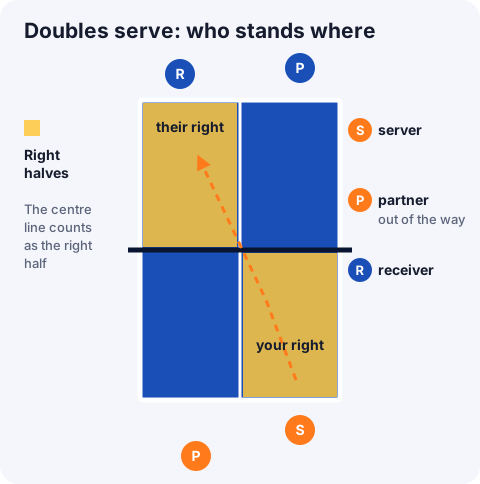
In doubles, the ball must bounce:
- first on the right half of your side;
- then on the right half of your opponent's side, diagonally.
The white center line counts as part of the right half, so a serve on the center line is good. A serve that bounces in a left half, on either side, is the receiver's point.
Everything else follows the singles rule: ball on an open palm, a toss of at least 16 cm (about 6 in), contact on the way down, behind the end line, and the ball always visible to the receiver. Neither the server nor the server's partner may hide the ball. See table tennis serve rules.
Where the server and partner stand
- The server stands near the right corner of the table (the forehand side for a right-hander), because the ball must come from the right half.
- The partner stands beside or slightly behind, out of the way, ready to step in for the third ball.
- After serving, the server moves out of the way quickly, usually back and to the side, to make room for the partner.
In pairs with one right-hander and one left-hander, movement is easier, because each player tends to move off to a different side.
Plan the serve: hand signals
Since your partner hits the next ball, they need to know what you are about to serve. That is why doubles servers give hidden signals under the table with their hand before serving. Each pair makes up its own code, for example:
- fingers up or down for topspin or backspin;
- open or closed hand for short or long.
That way your partner can already get into position for the most likely return.
The best doubles serves
The serving area is smaller, and the receiver knows which half the ball will land in. So:
| Serve | Why it works in doubles |
|---|---|
| Short backspin | The receiver has little room to attack; the most used serve |
| Short no-spin | Same motion as backspin; draws a high return |
| Fast long serve down the center line | Catches a receiver who is set wide |
| Long serve to the sideline corner | Pulls the receiver off the table and opens space |
In general, short, low serves are the foundation in doubles, because the receiver has fewer angles and the server's partner has time to get ready. See more in short vs long serves.
Receiving in doubles
The receiver also stands near the center line, on the right side of their end. Since the serve can only come to that half, the receiver can stand further "into" the table than in singles and attack long serves more easily. That is why a loose long serve in doubles is usually punished.
Common mistakes
- Serving straight, from your right to your opponent's left: point lost.
- Forgetting who serves after 2 points. Remember: the previous receiver becomes the server.
- Partner in front of the ball, hiding the serve. That is illegal.
- Serving without a plan: your partner arrives late for the third ball.
Frequently asked questions
How do you serve in doubles table tennis?
The ball goes from the server's right half and bounces on the receiver's right half, diagonally. All other rules are the same as in singles.
Does a serve on the center line count in doubles?
Yes. The center line is part of the right half.
Does the serve have to go diagonal in doubles ping pong?
Yes. Always right to right, diagonally.
How many serves does each player get in doubles?
Two in a row, like in singles. At 10-10, one each. The order rotates among all four players.
Why do doubles players give signals under the table?
To tell their partner which serve is coming, so the partner can get ready for the next ball.