How to play against a left-handed player
Against a lefty, remember that both forehands are on the same side of the table. Your forehand crosscourt goes to their backhand, and their forehand crosscourt goes to your backhand, which is the lefty's most dangerous shot. Use down-the-line balls, attack their middle, adjust to their reversed serve spin and practice with lefties whenever you can.
In this article
Plenty of players who handle right-handers well fall apart against a lefty. The angles feel wrong, the serves spin the unexpected way and the opponent's best shot always seems to land in the worst spot. It is not your imagination: playing a left-hander really is different, and you can prepare for it.
This guide explains the geometry of the table against lefties, where to attack, how to serve and how to receive. It is written from a right-hander's point of view, but the logic works the same for a lefty facing righties.
Why lefties feel awkward
The main reason is familiarity. Left-handers are a minority, so most right-handers practice and play far more against other righties. Lefties, meanwhile, spend their whole lives playing right-handers and know that matchup well.
On top of that, almost everything is mirrored:
- crosscourt shots send the ball to different places;
- a lefty's pendulum serve spins the opposite way from a righty's;
- their middle (the crossover point) is on the other side of the table.
Great left-handed champions, like China's Xu Xin, Ding Ning and Wang Chuqin, show how that mirror can become a weapon.
The geometry of the table against a lefty
When a righty faces a lefty, both forehands are on the same side of the table. That changes everything:
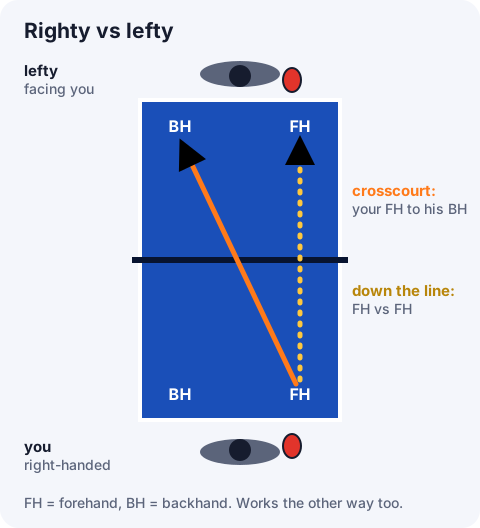
| Your shot | Against a righty it goes to | Against a lefty it goes to |
|---|---|---|
| Forehand crosscourt | Their forehand | Their backhand |
| Forehand down the line | Their backhand | Their forehand |
| Backhand crosscourt | Their backhand | Their forehand |
| Backhand down the line | Their forehand | Their backhand |
And the most important part: a lefty's forehand crosscourt goes straight to your backhand. It is their most natural, most powerful shot, and it lands on the side where you are usually weaker against big balls.
Where to attack a lefty
- Their middle. The crossover point between forehand and backhand, near the elbow of the racket arm, is hard for any player. Against a lefty it is on the opposite side from what you are used to, so train your eye to aim at the side of their body where the racket is.
- Their wide forehand, down the line. Your forehand down the line goes to their forehand. Played wide, it pulls the lefty off the table.
- Their backhand with your forehand crosscourt. It is your longest, safest diagonal. Use it to build the point.
- Change direction. Alternating crosscourt and down the line forces the lefty to move, which is what they least want.
How to defend
- Prepare your backhand. Since their forehand crosscourt comes to your backhand, a solid backhand block is essential.
- Adjust your ready position. Many righties stand slightly more toward their backhand side against lefties to cover that diagonal.
- Avoid medium, long, spinless balls to their backhand. That is the ball they will step around and smash with their forehand crosscourt, right into your backhand.
Serving to a lefty
- A righty's pendulum serve curves the ball to the receiver's left, which is the lefty's forehand side. Short, it pulls them out of position; long and wide, it can catch them off guard.
- The backhand serve and the tomahawk spin the other way and take the ball toward the lefty's backhand. Great for variety. See backhand serve.
- A fast, long serve to the middle is dangerous and often overlooked.
Returning a lefty's serve
A lefty's pendulum serve spins the opposite way from a righty's. The ball kicks the opposite way from what your reflexes expect:
- Watch the racket at contact as always, but remember the sidespin is reversed.
- Angle your racket the other way compared with what you would do against a righty.
- When in doubt, return short to the middle. It is the safest return against any sidespin.
More techniques in how to return a serve.
How to train for lefties
- Find lefties at your club and ask to drill patterns with them.
- Practice your backhand block against crosscourt forehands.
- Drill down-the-line patterns, because against a lefty that becomes your forehand-to-forehand ball.
- Watch left-handed players' matches, noticing where their opponents send the ball. Our guide to table tennis playing styles helps you read each type.
Frequently asked questions
How do you play against a lefty in table tennis?
Remember that the forehands are on the same side. Go down the line to attack their forehand, use your forehand crosscourt to their backhand, aim at their middle and have a solid backhand block ready.
Do left-handed table tennis players have an advantage?
They often have a familiarity edge: righties face few lefties, while lefties play righties all the time. With practice, that edge shrinks.
What serve should I use against a left-handed player?
Alternate the pendulum serve, which goes toward their forehand, with the backhand or tomahawk serve, which goes toward their backhand. Long serves to the middle also work.
Why can't I return a lefty's serve?
Because their sidespin goes the opposite way from what you are used to. Angle your racket the other way and, when in doubt, return short to the middle.
Where is a lefty's weak spot?
As with any player, the middle of the body, near the elbow of the racket arm. Against a lefty, that spot is on the opposite side from a righty's.