Short vs long serves: when to use each in table tennis
A short serve would bounce twice on your opponent's side and makes it hard for them to attack. A long serve lands near the end line and goes off the table, pushing your opponent back. The tactic is to mix them: the short serve is the base, and the long serve surprises a receiver who is waiting for short.
In this article
Just as important as a serve's spin is its length: where the ball bounces on the other side. A serve loaded with spin that lands right in your opponent's hitting zone loses all its power. A simple serve in the right spot can win the point.
Here is the difference between short, half-long and long serves, how to do each one and when to use them in a match.
Short, half-long and long
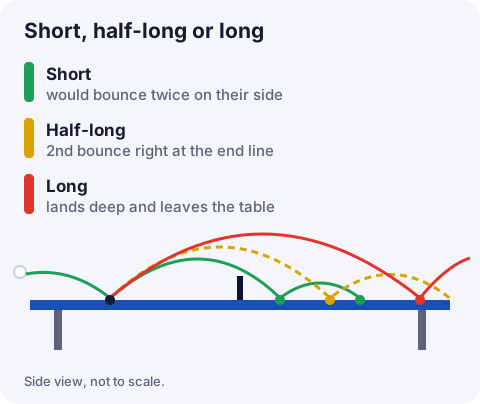
| Serve | Where it bounces on the other side | What it causes |
|---|---|---|
| Short | Near the net; would bounce twice on the table | Your opponent cannot hit a full loop |
| Half-long | The 2nd bounce would land right at the end line | Your opponent hesitates between attacking and pushing short |
| Long | Near the end line, then off the table | Your opponent can attack, but has to back up and has less time |
The simplest test for a short serve: if nobody touched the ball, it would bounce twice on your opponent's side.
How to do a short serve
- First bounce closer to the net. On a short serve, the first bounce lands around the middle of your side, a bit further forward than on a long serve.
- Soft contact. Less forward speed, more brush.
- Use backspin. Backspin makes the ball check up on the bounce and helps keep it short.
- Hit low. Contact around net height so the ball skims over.
The short backspin serve is the most used serve in table tennis. See how to do it in backspin serve.
How to do a long serve
- First bounce near your own end line. That keeps the ball low and sends it deep.
- Faster contact. More forward speed, with topspin, sidespin or no spin.
- Aim for the corners or the body. A fast long serve to the backhand corner, the forehand corner or your opponent's elbow is the most uncomfortable.
A long, slow serve is the ball every attacker dreams of. If it goes long, it has to be fast and low.
When to serve short
- Against strong attackers. A short serve takes away their first-ball loop.
- When you want to control the rally. The most common return of a short backspin serve is another push, which you can attack.
- Most of the time. At high levels, most serves are short or half-long.
When to serve long
- To surprise. After several short serves, your opponent creeps toward the table. A fast long serve catches them too close.
- Against players with a weak backhand receive or slow footwork.
- Against defensive choppers who like to play far from the table, when you want a faster point.
- To change the rhythm. An occasional long serve stops your opponent from crowding the table.
The half-long serve: an experienced player's weapon
The half-long serve, whose second bounce would land right on the end line, is hard to execute, but it creates doubt: your opponent does not know whether to loop it or push it short. That hesitation often leads to weak returns.
Think about the third ball
The serve does not end with the serve. Choose the length based on what you want to do next:
| Your serve | Most likely return | Your third ball |
|---|---|---|
| Short backspin | Long or short push | Loop against the backspin |
| Short no-spin | High push or flick | Attack the high ball |
| Fast long | Block or loop | Counter-attack or block |
This link between serve and attack is the subject of serve and third ball attack.
Frequently asked questions
What is a short serve in table tennis?
A serve that, if nobody touched it, would bounce twice on your opponent's side. It makes attacking hard.
When should you serve long in ping pong?
To surprise a receiver who expects short, against players who react slowly, and to change the rhythm.
How do you keep a serve short?
Hit softer, with more brush and backspin, and aim the first bounce a little closer to the net.
What is a half-long serve?
A serve whose second bounce would land right at your opponent's end line, leaving them unsure whether to attack or push short.
Which is better, a short or a long serve?
Neither on its own. Short is the base at high levels, but without long serves your opponent crowds the table and attacks easily.