Wheelchair table tennis: rules and adaptations
Wheelchair table tennis uses the ITTF rules with a few adaptations. The main ones cover the serve (it is a let if the ball goes out the receiver's sideline, comes back toward the net or stops on their side), keeping contact with the seat, and doubles, where the chair cannot cross the center line. In Paralympic play, classes 1 to 5 are for wheelchair athletes.
In this article
Table tennis is one of the most accessible sports for wheelchair users. The table height is fixed, the ball is light, movements are short and wheelchair players can play against standing players at the same table. It is no surprise the sport has been part of the Paralympic Games since the very first edition, Rome 1960.
This guide covers what changes in the rules, how the table and chair should be set up, which techniques work best and how to get started. Classes and the Paralympic side are covered in detail in para table tennis.
Who plays in a wheelchair
In the Paralympic system, classes 1 to 5 are for seated players. The lower the number, the greater the physical impairment:
- Classes 1 and 2: significant impairment of the trunk and also the arms. Many players have limited strength in the racket hand.
- Classes 3 and 4: good arm function but limited trunk balance, more limited in class 3 than in class 4.
- Class 5: good seated trunk control, with impairment in the legs.
Outside elite sport, nothing stops a wheelchair user from playing at clubs, schools or at home against friends who stand.
What changes in the rules
The rules are the same as standard table tennis, explained in table tennis rules. The wheelchair adaptations are few and very specific.
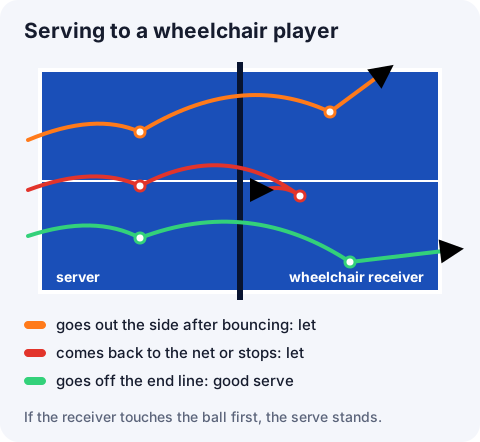
Serving to a wheelchair player
When the receiver is in a wheelchair, the serve is replayed (a let) if the ball, after bouncing on their side:
- goes out over the receiver's sideline, in singles;
- comes back toward the net;
- comes to rest on the receiver's side.
If the receiver strikes the ball before it crosses the sideline or bounces a second time, the serve counts as normal. The reason is simple: a seated player cannot reach balls that go very wide or die near the net.
Contact with the chair and the table
- The player must keep minimum contact with the seat (or cushion), with the back of the thighs, at the moment they strike the ball. Lifting up to reach the ball loses the point.
- The footrest and the feet cannot touch the floor during play.
- The player cannot lean on the table with the free hand. They may only touch the table with the racket hand to regain balance, and only after hitting the ball.
The service toss
The umpire may relax the toss requirements when a disability prevents a player from meeting them. For example, a player may serve from a curved palm or toss the ball another way if they have no hand. For classes 1 and 2 this relaxation always applies.
Wheelchair doubles
- After the serve and the return, either partner may hit the ball. There is no need to alternate, unlike standard doubles rules.
- No part of the wheelchair may cross the imaginary extension of the center line. In mixed pairs with a standing player, the standing player cannot put a foot over that line either.
The table and the chair
| Item | What to check |
|---|---|
| Table legs | Ideally at least 40 cm (about 16 in) in from the end line, so the chair can get close without hitting them |
| Chair | Stable and at the right height; sports chairs help, but your everyday chair is fine to start |
| Space | Clear area behind and beside the table to turn the chair |
| Paddle | Same as anyone's; some players use a strap or grip aid to secure the paddle in the hand |
Many recreational ping pong tables have legs or crossbars near the ends. Check that detail before buying a table, as explained in how to choose a ping pong table.
Technique: what works seated
- Play close to the table. A chair cannot back up quickly, so staying close lets you take the ball early and cover the angles.
- The backhand becomes your main stroke. Sitting square to the table, the backhand covers more area with less movement. The forehand comes in on wide balls to your right side (for right-handers).
- Use the trunk you have. Players with trunk control gain reach by rotating and leaning. Players without it make up for it with anticipation and blocking.
- Attack angles and the body. Against another wheelchair player, very wide balls and balls into the middle of the body are the hardest.
- Watch out for short balls. Balls that die near the net are hard to reach seated, so practice the push and short touch to return them safely.
How to get started
- Contact a local club or your national table tennis association and ask about para or adaptive sessions. Many cities run adaptive table tennis programs.
- Start with backhand rallies and blocking, close to the table.
- Practice your serve patiently: it is a seated player's best weapon.
- If you want to compete, look into classification, done by trained classifiers, which decides the class you play in.
Frequently asked questions
How does wheelchair table tennis work?
It uses the standard ITTF rules plus a few adaptations: serves that go out the side, come back toward the net or stop on the wheelchair receiver's side are lets, players cannot lose contact with the seat and, in doubles, either partner may hit after the return.
Can a wheelchair player play against a standing player?
Yes. When the receiver is in a wheelchair, the special serve rules apply to them. The rest of the game is the same.
What are the wheelchair table tennis serve rules?
The serve is replayed if the ball, after bouncing on the wheelchair receiver's side, goes out the sideline (in singles), comes back toward the net or stops. If the receiver hits it first, the serve stands.
Which Paralympic table tennis classes are for wheelchair users?
Classes 1 to 5. Classes 6 to 10 are for standing players, and class 11 is for players with an intellectual impairment.
Do you need a special table for wheelchair ping pong?
Not a special table, but the legs should be set back at least 40 cm (about 16 in) from the end line so the chair can get close.