Table tennis (ping pong) rules: the complete guide
A game is won by the first player to reach 11 points with a 2-point lead. Each player serves 2 points in a row, the serve must bounce once on each side, and during a rally the ball may bounce only once on your side before you return it.
In this article
The rules of table tennis are set by the ITTF, the sport's international federation, and they apply to sanctioned events all over the world, including those run by USA Table Tennis. Whether you call it table tennis or ping pong, it is the same game with the same official rules. This guide walks through all of them in the order they come up in a match, without the legal language.
How you win a point
Every rally counts. There is no "side out" like in old volleyball scoring: whoever makes the mistake loses the point, no matter who served.
You lose the point if:
- you fail to make a legal serve or return;
- the ball bounces twice on your side of the table;
- you deliberately hit the ball twice in a row;
- your return lands off the table or does not get over the net;
- you touch the ball before it bounces on your side while it is still over the table or heading toward it (this is called obstruction, or a volley);
- you move the table during the rally;
- your free hand (the one not holding the racket) touches the playing surface;
- you, or anything you wear or carry, touches the net or its posts;
- in doubles, you hit the ball out of turn.
Scoring: how many points in a game
A game ends when a player reaches 11 points. If the score is tied at 10-10, play continues until someone leads by 2 points, like 12-10 or 15-13.
Until 2001, games were played to 21 points. The switch to 11 made matches shorter and every point more important, and it is the format used in all official competition today. More detail in table tennis scoring explained.
How many games in a match
A match is always the best of an odd number of games:
| Format | You win by taking | Common in |
|---|---|---|
| Best of 3 | 2 games | Casual events and early rounds |
| Best of 5 | 3 games | Most tournaments |
| Best of 7 | 4 games | Finals and major singles events |
The tournament's own regulations decide which format is used. See how many games are in a match.
Serve: the main rules
The serve has the most rules, because it is where players try hardest to hide spin. The essentials:
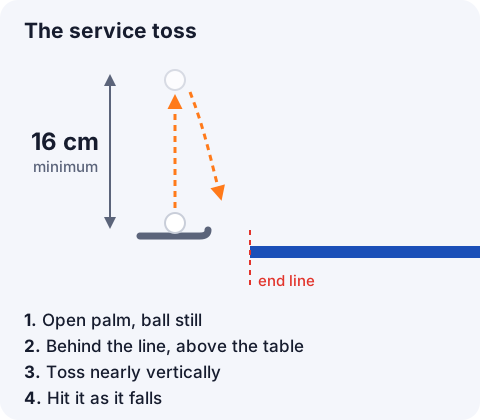
- The ball rests still on your open palm, behind the end line and above the level of the table.
- You toss it nearly straight up, without spin, at least 16 cm (about 6 inches).
- You may only hit the ball once it is falling.
- The ball must bounce first on your side and then on your opponent's side.
- From the toss until contact, the ball must not be hidden from the receiver by your body or free arm.
In singles, the serve can go anywhere on your opponent's side. In doubles, it must go diagonally, from your right half to their right half. All of this is explained with examples in table tennis serve rules.
Who serves and when it switches
Each player serves 2 points in a row, then the serve passes to the opponent. At 10-10, the serve alternates every point. In the next game, the player who received first in the previous game serves first.
Returns: the ball in play
After the serve, the ball must bounce once on your side before you hit it back. A return may go over the net or touch it, as long as it lands on your opponent's side. A return that travels around the outside of the net post, even below net height, is also good.
Does an edge ball count?
Yes. If the ball touches the top edge of the table, the point stands. If it only touches the side of the table, below the edge, it is out. In practice, a ball that clips the edge jumps or changes direction; a ball that hits the side drops straight down. More in edge ball vs side ball.
Let: when the point is replayed
A let is a rally that is not scored and is played again with no change to the score. It happens when:
- the serve touches the net and then lands correctly on the opponent's side;
- the serve is made before the receiver is ready, and the receiver does not try to return it;
- something outside the players' control disturbs the rally, like a ball rolling in from another table;
- the umpire stops play to correct an error, give a warning or bring in the expedite rule.
If the serve touches the net and lands out, it is not a let: the receiver wins the point.
Doubles: the order of play
In doubles, partners hit the ball alternately. If the same player hits twice in a row, the pair loses the point. The serving order rotates: A serves to X, then X serves to B, B serves to Y, Y serves to A, and so on. In the next game, the receiving order is reversed.
Changing ends
Players change ends after each game. In the last possible game of the match (the 3rd, 5th or 7th), they also change when one of them reaches 5 points.
The expedite rule
If a game is still unfinished after 10 minutes of play, the expedite rule comes in, unless at least 18 points have already been scored (for example 9-9 or 10-8). From then on, the serve alternates every point, and if the receiver makes 13 good returns in a rally, the receiver wins the point. It exists to stop endless games between very defensive players, and it stays on until the end of the match. See the expedite rule.
Racket: what is allowed
- The racket can be any size, shape or weight.
- The blade must be flat, rigid and at least 85% natural wood.
- Each side used to hit the ball must be covered with an ITTF-approved rubber.
- One side is black and the other a bright color clearly different from black and from the ball, such as red, blue, green, pink or violet.
- Hitting with a side that has no legal covering, like bare wood, loses the point.
The two colors exist so your opponent can see which rubber you used, since each rubber spins the ball differently.
Official table and ball size
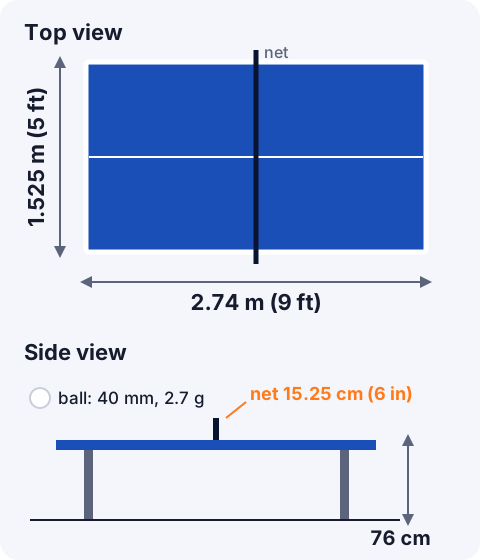
| Item | Official size |
|---|---|
| Table | 2.74 m long × 1.525 m wide (9 ft × 5 ft) |
| Table height | 76 cm (about 2.5 ft) from the floor |
| Net | 15.25 cm (6 in) high |
| Ball | 40 mm across, 2.7 g |
The table must be dark and matte, with a 2 cm white line around the edges. The 3 mm center line splits each side into halves for doubles serves.
Breaks and time-outs
- Up to 2 minutes of warm-up at the table before the match.
- Up to 1 minute between games.
- Each player or pair may call one 1-minute time-out per match.
- Players may towel off after every 6 points and when changing ends.
Frequently asked questions
How many points is a game of table tennis?
A game ends at 11 points. At 10-10, it continues until one player leads by 2.
How many serves do you get in ping pong?
Two in a row each. At 10-10, the serve alternates every point.
Can you hit the ball before it bounces in ping pong?
No. The ball must always bounce once on your side before you return it. Touching it first while it is over the table or heading toward it gives the point to your opponent.
Does a ball that hits the edge of the table count?
Yes, if it touches the top edge. If it only touches the side, below the edge, it is out.
Can you touch the table during a rally?
Your racket hand can, as long as the table does not move. Your free hand must not touch the playing surface while the ball is in play, and no one may move the table.
Are ping pong and table tennis rules the same?
Yes. They are the same sport, and "ping pong" is the popular name. See table tennis vs ping pong.