Para table tennis: classes and rules
Para table tennis uses the ITTF rules with a few adaptations and divides athletes into 11 classes. Classes 1 to 5 are for wheelchair players, 6 to 10 for standing players and 11 for athletes with an intellectual impairment. The sport has been at the Paralympic Games since the first edition, Rome 1960.
In this article
Table tennis is one of the most traditional sports in the Paralympic movement. It has been at the Games since the first edition in 1960 and brings together wheelchair athletes, standing athletes and athletes with an intellectual impairment. The table, ball, net and almost all of the rules are the same as in standard table tennis.
This guide explains how para table tennis works: classification, rule adaptations and how to get started.
Paralympic table tennis history
Table tennis was part of the first Paralympic Games, in Rome in 1960, and has been on the program at every edition since. At the time, events were for wheelchair athletes. Over the years, the program expanded to include standing athletes and, later, athletes with an intellectual impairment.
Today the sport is governed by the ITTF, the same federation that runs Olympic table tennis, through its para table tennis division, which manages the rankings, international events and athlete classification.
Para table tennis classification
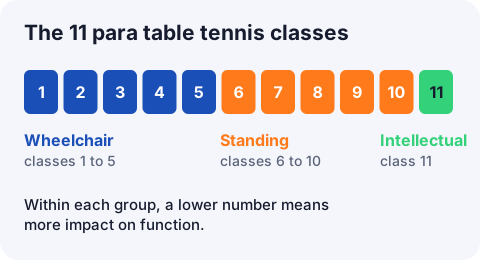
To keep competition fair, athletes go through a classification assessment and are placed in one of 11 classes:
| Classes | Who plays | How |
|---|---|---|
| 1 to 5 | Athletes with a physical impairment who play in a wheelchair | Seated |
| 6 to 10 | Athletes with a physical impairment who play standing | Standing |
| 11 | Athletes with an intellectual impairment | Standing |
Within each group, the lower the number, the greater the impact of the impairment on function. A class 1 player has less movement than a class 5 player; a class 6 player has less than a class 10 player.
At competitions, events carry the class in their name, such as MS1 (men's singles class 1) or WD20 (women's doubles). In some doubles and team events, nearby classes are combined, with a limit on the combined class total of the pair.
Para table tennis rules
The rules are the ITTF's, the same ones explained in table tennis rules: games to 11, win by 2, a tossed serve and so on. The most important adaptations are for wheelchair players.
Serving to a wheelchair player
When the receiver is in a wheelchair, the serve is a let if the ball:
- after bouncing on the receiver's side, comes back toward the net;
- comes to rest on the receiver's side;
- in singles, leaves the receiver's side across a sideline after bouncing on it.
The idea is to rule out serves a seated player has no way of reaching. If the receiver hits the ball before it crosses a sideline or takes a second bounce, the serve stands.
Other adaptations
- Service toss: the umpire can relax the toss requirements when a physical impairment prevents a player from meeting them.
- Contact with the seat: a seated player must keep contact with the seat cushion during the rally. Losing that contact gives the point to the opponent.
- Wheelchair doubles: after the serve and the return, either partner may hit the ball, and no part of a wheelchair may cross the imaginary extension of the center line.
For the standing classes and class 11, the rules are practically the same as standard table tennis.
Brazil's para table tennis stars
Brazil has a strong generation in the sport:
- Bruna Alexandre, class 10, won Paralympic medals at Rio 2016 (two bronzes), Tokyo (singles silver and team bronze) and Paris 2024 (two bronzes). In 2024 she also played the Olympic Games in the team event, becoming the first Brazilian athlete to compete at both the Olympics and the Paralympics.
- Cátia Oliveira, a wheelchair player, won singles bronze at Tokyo and doubles bronze at Paris 2024.
More on the Brazilian scene in table tennis in Brazil.
How to start in para table tennis
- Look for a club or program with a para table tennis group. Adaptive sports organizations and national table tennis associations can point you to options.
- Talk to the coach about your needs and adapt your setup: chair height, support, paddle.
- Learn the basics: position, grip, forehand and backhand.
- To compete, go through functional classification with accredited classifiers.
In the US, USA Table Tennis and the US Olympic & Paralympic Committee are good starting points; other countries have equivalent national bodies.
Frequently asked questions
How does para table tennis work?
It uses the ITTF rules with a few adaptations, mainly to the serve when the receiver is in a wheelchair. Athletes are divided into 11 classes so that competition is fair.
What are the para table tennis classes?
Classes 1 to 5 are for wheelchair players, 6 to 10 for standing players and 11 for athletes with an intellectual impairment. The lower the number, the greater the impact on function.
When did table tennis become a Paralympic sport?
At the first Paralympic Games, in Rome in 1960.
What are the wheelchair table tennis serve rules?
Against a wheelchair receiver, the serve is a let if the ball comes back toward the net, stops on the table or, in singles, leaves across a sideline after bouncing.
Can a wheelchair player play against a standing player?
In casual play and at many clubs, yes. In official para competitions, players compete within their class or class group.