Yellow and red cards in table tennis
In table tennis, a yellow card is a warning for bad behavior and costs no point. If the player offends again in the same match, the umpire shows yellow and red together and awards 1 point to the opponent, then 2 points the next time, after which the referee decides and can disqualify the player. A white card is not a penalty: it signals a time-out.
In this article
Not everyone knows table tennis has cards, like soccer. You rarely see them, because the sport tends to be very sporting, but when they come out they can decide a game: in table tennis, a card can turn into points for your opponent.
This guide explains what yellow and red cards mean in table tennis, when the umpire shows each one and who can receive them. The rules come from the ITTF's regulations for competitions.
The card ladder
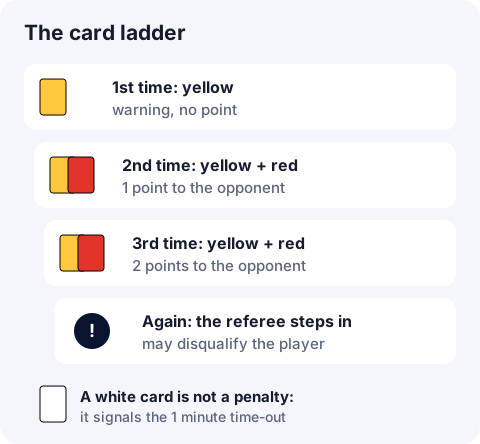
| Offense | Card | Result |
|---|---|---|
| 1st | Yellow | Warning. No point awarded |
| 2nd | Yellow and red together | 1 point to the opponent |
| 3rd | Yellow and red together | 2 points to the opponent |
| Another | Umpire stops play and calls the referee | The referee decides and may disqualify |
Note the detail: the umpire does not show a red card on its own the way soccer referees do. Penalty points are shown with yellow and red together. A red card alone is used by the referee to disqualify.
What a yellow card is for
The yellow card is a formal warning for misbehavior. Under the rules, players and coaches must avoid behavior that unfairly affects an opponent, offends spectators or brings the sport into disrepute. Common examples:
- swearing or abusive language;
- throwing the paddle, kicking the table or the court barriers;
- deliberately breaking the ball or hitting it out of the playing area in anger;
- disrespecting the umpire;
- deliberately delaying play.
Celebrating a point, even loudly, is part of the sport. The problem is behavior that unfairly disturbs the opponent or is offensive.
For minor offenses the umpire may show a yellow card the first time. For serious ones, the umpire can stop play and report straight to the referee.
How long do cards last?
Warnings and penalty points carry over to the end of the individual match. In team events they carry over to the end of the team match. So a player warned in the first game who misbehaves in the fourth goes straight to yellow plus red and a penalty point.
Disqualification
The referee (the official in charge of the whole tournament) can disqualify a player from a match, an event or the entire competition for seriously unfair or offensive behavior, even if the umpire did not report it. The referee signals this with a red card.
Coaches can get cards too
Behavior rules also apply to coaches and other advisers. There is also an advice rule: a coach may talk to the player at any time except during a rally, as long as it does not delay play. If they give advice outside those conditions:
- the first time, the umpire shows a yellow card as a warning;
- if it happens again, the umpire shows a red card and the coach is sent away from the playing area.
Cards given to a coach do not take points from the player.
The service warning is not a card
There is another warning during serves, with no card. If the umpire or assistant umpire is unsure whether a serve is legal, they may, once per match, interrupt play and warn the server. After that, any serve that is not clearly legal is a point for the receiver. This has nothing to do with misconduct cards. The serve rules are in table tennis serve rules.
The white card
A white card is not a penalty. It signals a time-out: each player or pair may call one time-out of up to 1 minute per match by making a "T" with their hands. The umpire raises a white card and places it on the side that called it.
Who shows the cards
The match is controlled by the umpire, seated beside the net. To show a card, the umpire raises an arm above head height and holds the card toward the offender, without leaving the chair. More on duties and signals in table tennis umpire.
How to stay out of trouble
Most cards come from frustration. Breathing between points, having a routine before you serve and letting go of the last mistake help you keep a cool head. See tips in the mental game in table tennis. For the complete rules, read table tennis rules.
Frequently asked questions
What does a yellow card mean in table tennis?
It is a warning for bad behavior. The first time, no point is lost, but the next offense in the same match costs points.
Does a red card in table tennis mean you are out?
Shown with a yellow by the umpire, it gives a point to the opponent. A red card alone, shown by the referee, means disqualification.
How many points do you lose for a card in table tennis?
On the second offense, 1 point goes to the opponent; on the third, 2 points. After that, the referee decides.
Can a coach get a yellow card in table tennis?
Yes, for misbehavior or for giving advice outside the allowed times. The second time, the coach is sent away from the playing area.
What is the white card in table tennis?
It signals the time-out of up to 1 minute that each side may call once per match.