Table tennis umpire: duties and hand signals
A table tennis umpire controls the match from a seat beside the net: checks the equipment, runs the toss, decides every rally, calls the score and enforces the rules on serves, time and behavior. Umpires use hand signals, such as an arm bent upward to award a point and a hand raised above the head for a let. To become one, look for courses run by your national or regional association.
In this article
In an official table tennis match, hardly anyone notices the umpire, and that is the sign of a job well done. But the umpire is the one who decides whether a serve was legal, whether the ball clipped the edge, when to call a let and what the score is.
Here is what a table tennis umpire does, the hand signals, how the score is called and the path for anyone who wants to become an umpire.
The officials in a match
| Official | Where | What they do |
|---|---|---|
| Umpire | Seated beside the net, on one side of the table | Controls the match and makes most decisions |
| Assistant umpire | Opposite the umpire | Helps with certain decisions, such as serves and edge balls on their side |
| Referee | Off the court, in charge of the whole tournament | Rules on questions of law, handles serious penalties and can disqualify |
At smaller tournaments there is often a single umpire per table, or players keep score themselves.
What the umpire does before the match
- checks the table, the net (with a net gauge) and the lighting;
- looks at both players' rackets, which they must show to the opponent and the umpire;
- checks clothing, which must not be the color of the ball;
- runs the toss to decide who chooses to serve, receive or pick an end;
- times the warm-up, which lasts up to 2 minutes.
What the umpire does during the match
- Decides every rally: whether the ball was good, touched the net, or a player touched the table with their free hand.
- Judges the serve: a toss of at least 16 cm (about 6 in), the ball visible, behind the end line and above the table. See table tennis serve rules.
- Calls lets when a rally must be replayed.
- Calls the score after every rally.
- Keeps time: intervals of up to 1 minute between games, towel breaks every 6 points and the 1 minute time-out.
- Applies the expedite system when a game runs past 10 minutes. See the expedite rule.
- Manages behavior and coaching with the cards. See yellow and red cards in table tennis.
Table tennis umpire hand signals
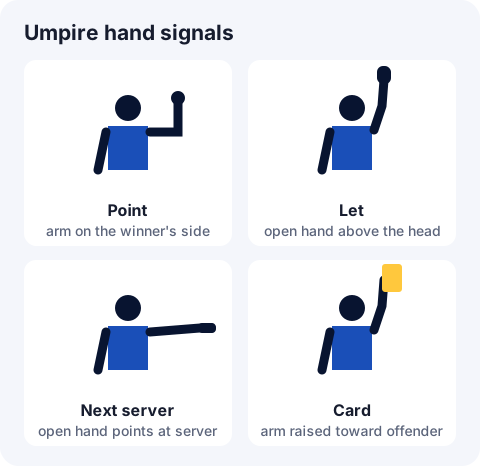
| Situation | Signal |
|---|---|
| Point | Raises the arm on the side of the player who won the point, upper arm horizontal, forearm vertical, closed hand pointing up |
| Let | Raises one open hand above the head |
| Next server | Points at the server with an open hand |
| Yellow or red card | Raises an arm above head height holding the card toward the offender, without leaving the chair |
| Time-out | Raises the white card the same way |
The hand-above-the-head signal is also used to stop play in other situations, such as a ball rolling in from another table. The assistant umpire uses the same gesture to get the umpire's attention.
How the score is called
The umpire calls the score right after each rally, always starting with the score of the player due to serve next. At the start of each game and at every change of server, the umpire also points to the next server and calls their name. In English the score at the start is often called "love all". At the end of a game the umpire calls the final score and the winner.
This helps the players, the crowd and anyone following on the scoreboard. Scoring rules are in table tennis scoring.
The umpire kit
- a score indicator (flip or electronic);
- a net gauge;
- a stopwatch;
- yellow, red and white cards;
- a coin or disc for the toss;
- a score sheet and pen;
- a few approved balls in case one breaks.
How to become a table tennis umpire
The path starts with your national or regional association (in the US, USA Table Tennis), which runs umpire courses and exams. Courses usually combine the rules in theory with practice at real tournaments.
After officiating at national events, umpires can follow the ITTF international path, with levels such as International Umpire and, above it, the Blue Badge, awarded to experienced umpires assessed at major events.
Many umpires start as players. Knowing the rules well helps players too: you know when to question a call and when not to. If you want to play tournaments, see how to enter a table tennis tournament.
How much do table tennis umpires earn?
There is no set amount. At many local tournaments, umpiring is volunteer work or paid per day, and amounts vary by association, event and the umpire's level. For current figures, ask your national or regional association.
Frequently asked questions
What does a table tennis umpire do?
Controls the match: checks equipment, runs the toss, decides every rally, judges serves, calls the score, keeps time and enforces the behavior rules.
What are the table tennis umpire hand signals?
For a point, the arm bent upward on the winner's side. For a let, an open hand above the head. For the next server, an open hand pointing. For cards, the arm raised holding the card.
How do you become a table tennis umpire?
Take the umpire course run by your national or regional association and start officiating at local tournaments. From there you can move to national and international levels.
What is the difference between an umpire and a referee in table tennis?
The umpire controls one match at the table. The referee is in charge of the whole tournament and handles the most serious cases, including disqualifications.
Who decides if the ball hit the edge?
The umpire, except for edges on the side of the table nearest the assistant umpire, which the assistant umpire decides.