The expedite rule in table tennis: 10 minutes and 13 returns
If a game lasts more than 10 minutes and fewer than 18 points have been scored, the expedite rule comes in. From then on, players serve 1 point each in turn, and if the receiver makes 13 good returns in a rally, the receiver wins the point. Once it starts, it stays on until the end of the match.
In this article
The expedite rule (officially the expedite system) is table tennis's answer to games that never end. It exists because two very defensive players can trade hundreds of balls in a single rally and drag a match on for hours. Under the expedite rule, the server is forced to win the point quickly.
It is a rare rule: most players will never see it in action. But it does show up in tournaments, especially when a player who chops from far back meets someone who prefers to wait for mistakes. Here is how it works under the ITTF rules.
When the expedite rule starts
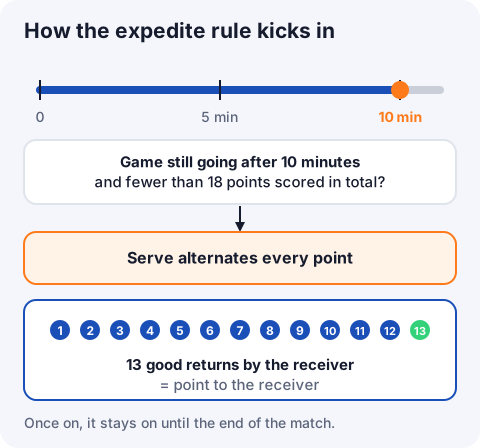
The rule comes in in two cases:
- a game reaches 10 minutes of play and is still not finished; or
- both players (or pairs) ask for it, at any time.
There is one important exception: the rule is not introduced if at least 18 points have already been scored in that game, such as 9-9 or 10-8. In that case, the game is close to the end and carries on normally.
The 10 minutes count actual playing time. Breaks like toweling, chasing the ball or a time-out are not counted. In tournaments, an assistant umpire or another official runs the clock.
What changes when it starts
| Before | Under the expedite rule |
|---|---|
| Each player serves 2 points in a row | Each player serves 1 point in turn |
| A rally lasts as long as it takes | If the receiver makes 13 good returns, the receiver wins the point |
| The server has the edge of starting the attack | The server must win the point before the 13th return |
In practice, the server has 13 of the opponent's returns to finish the point. If they cannot, they lose it. That forces both players to attack when they are serving.
Who serves when it starts
The moment the 10 minutes run out decides who serves:
- If the ball is in play, the umpire stops the rally, which becomes a let. Play resumes with a serve by the same player who served in the interrupted rally.
- If the ball is not in play, play resumes with a serve by the player who received in the previous rally.
The expedite rule does not change the match's order of serving and receiving set at the start of each game.
The stroke counter
Once the rule is in place, a stroke counter calls out the receiver's returns, from 1 to 13. Only the receiver's returns count, not the server's. If the receiver makes a 13th good return, the umpire awards the point to the receiver.
Example: A serves, B returns (1), A hits, B returns (2)... If B reaches a 13th good return and A has not won the point yet, the point goes to B.
It lasts until the end of the match
Once introduced, the expedite rule stays in place until the end of the match, in every remaining game, even fast ones. That is why it changes the match so much: a defender who usually wins through patience now has to attack whenever serving.
Why the rule exists
Before time rules, some matches between defenders became famous for their length, with single rallies lasting many minutes. The ITTF created a system to limit that, and the current version, with 10 minutes and 13 returns, is the one in the official rules today.
It fits with other changes meant to keep the game moving, like changing ends in the deciding game and the switch to 11-point games, which made matches shorter. See how each game is scored in table tennis scoring explained and how long matches run in how many games are in a match.
Tips if the expedite rule comes into your match
- When serving, set up the attack. Use serves that lead to a strong third ball, like a short backspin serve followed by a loop.
- When receiving, play safe. You do not have to win the point, just return 13 times. Solid balls to the middle of the table help.
- Stay calm. The count out loud adds pressure, but the rule is the same for both players.
Frequently asked questions
What is the expedite rule in table tennis?
A rule that starts when a game passes 10 minutes. Players then serve 1 point each in turn, and the receiver wins the point by making 13 good returns.
When is the expedite rule not used?
When at least 18 points have already been scored in the game, such as 9-9 or 10-8. Then the game carries on normally.
Does the expedite rule apply only to that game?
No. Once it starts, it stays on until the end of the match.
Can players ask for the expedite rule?
Yes. It can start at any time if both players or both pairs request it.
Who counts the 13 returns?
An official stroke counter, who calls out the receiver's returns.