The mental game in table tennis
Table tennis points are short and back to back, so your mental game depends on a between-point routine: let go of the last point, review it in one sentence, decide your next serve or return, then refocus with the same ritual. Slow breathing, process goals and your timeout help in pressure moments.
In this article
In table tennis, a game can turn in a couple of minutes. Points last seconds, one after another, with no long breaks to cool off. That is why so many people practice well and play badly in tournaments: the technique is there, but the head does not keep up.
The good news: the mental side can be trained too. Here are practical tools for the table tennis mental game.
Why table tennis is so mental
- Very fast points: one mistake runs into the next before you recover.
- Short scoring: games to 11 leave little room to recover from a bad run.
- Tiny margins: a millimeter of paddle angle changes everything, and muscle tension affects that millimeter.
- Your opponent is close: you see their reactions and they see yours.
A between-point routine
The single most useful tool is a short routine, always the same, between points. It gives your mind a track to follow.
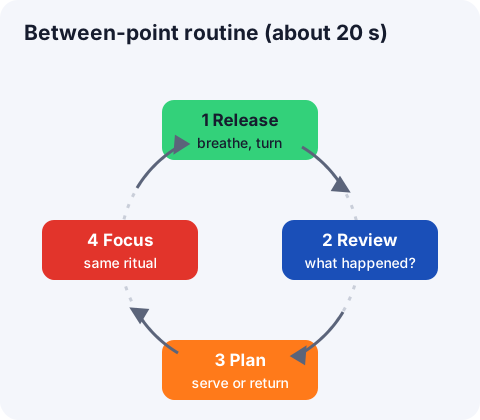
- Release: turn away from the table, take one deep breath and let the last point go, won or lost.
- Review: in one sentence, what happened? "I missed the loop because it had more backspin." No judgment.
- Plan: decide the next step. Which serve will I use? What return do I expect?
- Focus: do the same ritual before every point, like bouncing the ball twice or adjusting your paddle, then play.
Breathing to lower tension
When nerves rise, breathing gets shallow and your shoulders creep up. That stiffens your arm. Between points:
- Breathe in through your nose for a count of 4.
- Breathe out slowly through your mouth for a count of 6.
- Repeat once or twice, dropping your shoulders.
Breathing out more slowly than you breathe in helps many people calm down. Practice it off the table so it becomes automatic.
Process goals, not outcome goals
"I have to win this game" adds pressure. "I'll serve short and attack the third ball" gives you something concrete to do.
| Outcome goal (avoid) | Process goal (use) |
|---|---|
| I can't lose to this guy | I'll aim at his elbow |
| I have to win this point | Loop with margin, well over the net |
| I can't miss this serve | Low, short serve, same routine |
Tough moments
After a silly mistake
Accept that it will happen. Run your routine, say a cue word to yourself ("next," "loose") and go back to the plan. Dwelling on a mistake makes the next one more likely.
When you are winning easily
It is common to relax too much and let your opponent back in. Keep the same plan that was working until the last point.
At deuce (10-10)
From 10-10, the serve alternates every point and you need a 2-point lead to win. In those moments:
- Pick the serve you trust most, not the riskiest one.
- Play with margin: safe, well-placed balls.
- Run your routine calmly; do not rush it.
Against annoying opponents
Some players celebrate loudly or take a long time between points. Stick to your routine. If something crosses the line of the rules, that is the umpire's job.
Use the breaks the rules allow
Under ITTF rules:
- Each player (or pair) can call one timeout of up to 1 minute per match.
- There is an interval of up to 1 minute between games.
- You may towel off after every 6 points from the start of each game and at the change of ends in the deciding game.
Use your timeout when your opponent goes on a run or at a key moment, to break their rhythm and reset your plan. More in table tennis rules.
Mental training at practice
- Pressure games: start practice games down 7-9, or play "miss a serve, lose 2 points."
- Routine every time: use the 4 steps in practice points too.
- Short journal: after you play, write down one thing that worked and one to improve.
- Game plan: before a match, pick 2 or 3 simple tactics. These tips to win more points help you build one.
Frequently asked questions
How do I stop getting nervous in table tennis?
Use a short between-point routine, slow breathing and process goals like "serve short and attack" instead of thinking about the score.
What should I do after missing an easy ball?
Run your routine: release, review in one sentence, plan your next serve or return, and refocus. Do not dwell on it.
When should I call a timeout in table tennis?
When your opponent goes on a run or at a key moment. Each player gets one timeout of up to 1 minute per match.
How do you do table tennis mental training?
Play pressure games at practice, use the same routine between points every time and write down what worked after each match.
How do I play well at 10-10?
Pick the serve you trust most, play with margin and do not rush your routine.