What is backspin in table tennis (ping pong)?
Backspin is spin where the ball rotates backward, against the direction it travels. It floats in the air, slows down on the bounce and drops into the net off a square paddle. To return it, open your paddle and play under the ball, or loop it with a clearly upward swing.
In this article
Backspin (also called underspin) is spin where the ball rotates backward: the bottom of the ball moves forward and the top rotates back toward the player who hit it.
Backspin is the spin of defense, short serves and the push. It does not win points on its own as often as topspin, but it is essential for controlling the game and forcing errors.
How the ball rotates with backspin
Picture the ball traveling from you to your opponent. With backspin, the top rotates backward, toward you, and the bottom rotates forward. It is the opposite of a rolling wheel.
You create it by sliding an open paddle under the ball, high to low and forward, with a thin contact.
What backspin does to the ball
In the air: it floats
Backspin creates a small upward force (the Magnus effect, covered in the physics of spin). The ball seems to "hang" in the air and carries a little further than a no-spin ball hit the same way.
On the bounce: it slows down
When a backspin ball hits the table, the spin works against its motion and it loses forward speed. Short balls with heavy backspin can almost stop after the bounce, or even pull back toward the net.
On the opponent's paddle: it drops
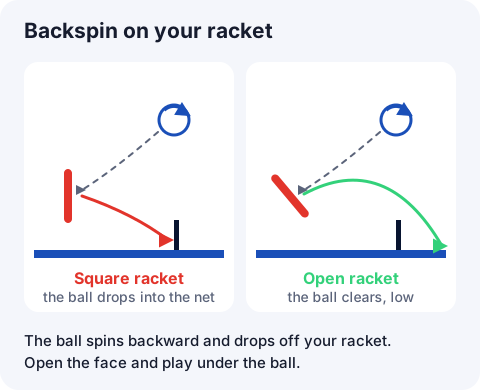
This is the key effect. When a backspin ball hits a square paddle, the spin sends it downward. That is why anyone who misses the backspin puts the ball in the net.
Where backspin shows up
| Situation | Stroke |
|---|---|
| Short or long backspin serve | Backspin serve |
| Short rallies near the net | Push |
| Defense away from the table | Chop |
| Block with the paddle moving down | Chop block |
How to do backspin in table tennis
- Open your paddle so the face points up.
- Bring the paddle slightly above the height of the ball.
- Slide the paddle under and behind the ball, forward and slightly down.
- Use a thin contact, brushing the ball instead of shoving it.
- Speed up at contact: spin comes from paddle speed, not from a big swing.
How to return backspin in ping pong
You have two main options:
- Push it back. Open your paddle and play under the ball. The more backspin, the more open the paddle. This is the safe answer to short balls.
- Loop it. Against long backspin, loop with a clearly upward swing and a nearly square paddle. Our forehand loop guide shows the stroke against backspin.
What you cannot do is hit it flat with a vertical paddle: the ball goes into the net.
Watch out for the no-spin ball
A serve or push can look like backspin and carry almost none. If you open your paddle expecting backspin, the ball pops up and your opponent attacks. That is the no-spin ball, a favorite weapon against players who read spin only from the arm motion.
Common mistakes against backspin
- A square paddle. The ball drops into the net.
- Looping without lifting. Against backspin, a loop needs upward motion.
- Opening too much against light backspin. The ball pops up and goes long.
- Hitting late. A backspin ball that has dropped low is even harder to lift.
Frequently asked questions
What is backspin in table tennis?
It is spin where the ball rotates backward. The ball floats, slows down on the bounce and drops when it hits a square paddle.
How do you counter backspin in ping pong?
Open your paddle and push under the ball, or loop it with a clearly upward swing and a nearly square paddle.
Why does a backspin ball go into the net?
The backward rotation sends the ball downward when it hits your paddle. Opening the face compensates for it.
Is underspin the same as backspin?
Yes. Underspin, backspin and "chop" are all used for a ball rotating backward.