The physics of spin: the Magnus effect in table tennis
The Magnus effect is the force that appears when a ball spins as it moves through the air: the spin deflects the air to one side and the ball is pushed the opposite way. In table tennis, topspin creates a downward force, backspin an upward force and sidespin a sideways force, which is why the ball curves.
In this article
Why does a topspin ball dive while a backspin ball seems to float? The answer is a piece of physics called the Magnus effect. It is the same effect that bends a soccer free kick, makes a baseball curveball break and helps a golf ball climb.
In table tennis it is especially strong, because the ball is very light and spins very fast. This guide explains it simply, with no equations.
What is the Magnus effect?
The Magnus effect is the sideways force on a ball (or cylinder) that spins while moving through a fluid such as air. It is named after the German physicist Heinrich Gustav Magnus, who studied it in the 19th century. Long before him, Isaac Newton had already remarked on how spinning tennis balls curve.
The core idea:
- A spinning ball drags a thin layer of air along with its surface.
- On one side, the ball's surface moves with the oncoming air; on the other, against it.
- As a result, the air flowing past the ball is deflected to one side.
- By Newton's third law (action and reaction), if the ball pushes the air one way, the air pushes the ball the opposite way.
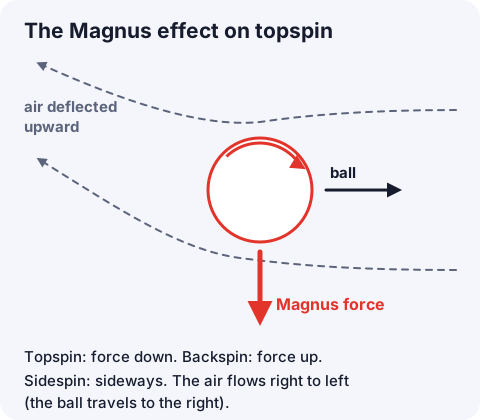
Another way to see it: on the side where the ball's surface moves with the air, the air flows faster and the pressure drops. On the other side the pressure is higher. The ball is pushed from high pressure toward low pressure.
The Magnus effect for each spin
| Spin | Direction of the Magnus force | What you see |
|---|---|---|
| Topspin | Down | The ball dives and lands sooner |
| Backspin | Up | The ball floats and carries further |
| Sidespin | Sideways | The ball curves left or right |
| No spin | None | Only gravity and air drag |
Topspin: the force that pulls down
On a topspin ball, the Magnus force points down and adds to gravity. That is why a heavy loop can clear the net with room to spare and still land on the table. Without it, hitting hard would be far riskier. See what is topspin.
Backspin: the force that holds the ball up
On a backspin ball, the Magnus force points up and partly holds the ball against gravity. In table tennis it does not make the ball rise on its own, but the ball drops more slowly and carries further than a no-spin ball.
Sidespin: the sideways curve
With sidespin, the force is sideways. The table is short, so the curve is small, but you can see it on slower serves and on loops with sidespin.
Why the effect is so strong in table tennis
- The ball is light. Under the rules it weighs 2.7 g (under a tenth of an ounce) and is 40 mm (about 1.6 in) across. With so little mass for its size, the same force bends its path far more than it would a heavy ball.
- The ball spins a lot. Modern rubbers grip the ball and allow very high spin for a ball that size.
- The force grows with spin and speed. The faster the ball spins and flies, the bigger the Magnus force.
Magnus is not the whole story: bounce and paddle
The Magnus effect acts in the air. But in table tennis, spin also changes the ball at two moments of contact, and those effects have nothing to do with air:
- On the bounce: friction with the table makes topspin kick forward and backspin slow down.
- On the paddle: friction with the rubber makes topspin jump up, backspin drop and sidespin deflect.
In practice, these contact effects often matter even more to a player than the curve in the air. Together, they explain everything described in table tennis spin.
Frequently asked questions
What is the Magnus effect?
It is the force on a ball that spins while it moves through the air. The spin deflects the air to one side and the ball is pushed the other way.
How does the Magnus effect work on a ping pong ball?
Topspin creates a downward force so the ball dives; backspin creates an upward force so it floats; sidespin creates a sideways force so it curves.
Is it the same effect as a curving soccer ball or baseball?
Yes. A bending free kick or a breaking curveball is the same physical effect on a bigger, heavier ball.
Why does a ping pong ball curve so much?
Because it is very light for its size and spins very fast, so the same force changes its path much more than it would for a heavy ball.