RealTT physics: spin, speed and timing
In RealTT the ball is simulated as a physical object, with gravity, air drag, the Magnus effect and friction on the bounce. That is why topspin dips, backspin holds up at the net and your opponent's spin pushes your return. Every shot depends on your timing, your position and your bat angle.
In this article
In a realistic table tennis game, the ball does not follow a canned path. In RealTT, the game works out the forces on the ball moment by moment, just like on a real table. That is what makes topspin dip, backspin hold up at the net, and an early swing come out different from one that is right on time.
This article explains, without equations, what RealTT physics simulates and how to use it in a match.
What RealTT simulates
The ball is calculated in very small steps, 300 per second, and each step uses the same forces as real ping pong physics:
| Force | What happens in the game |
|---|---|
| Gravity | The ball drops in an arc, and a slower ball has to rise higher to clear the net |
| Air drag | The light ball slows down in flight, and faster the harder it was hit |
| Magnus effect | Spin pushes the ball: topspin makes it drop sooner, backspin makes it float, sidespin makes it curve |
| Spin decay | Spin slowly fades during the flight |
| Bounce friction | Spin "grabs" the table: topspin kicks forward and low, backspin brakes |
| Net | A low ball hits the net and drops back; one that clips the tape can roll over |
The sizes are official too: a 2.74 m by 1.525 m table (9 ft by 5 ft), a 15.25 cm (6 in) net and a 40 mm ball. For the theory, read about the Magnus effect in table tennis.
Spin changes everything
In RealTT, every shot leaves your bat with some amount of spin, shown in revolutions per minute (rpm) right after contact. That spin acts at three moments, as we explain in table tennis spin:
- In the air: topspin curves down, which lets you hit hard and still land on the table. Backspin makes the ball float and arrive slower.
- On the bounce: topspin jumps forward; backspin brakes and stays low.
- On your bat: the incoming spin keeps acting on your return. Hit a topspin ball with a flat bat and it tends to fly long; hit a backspin ball flat and it tends to go into the net.
The game tells you when this happens, with messages like Spin pushed it long or Spin pulled it down, plus the fix: Open the bat more or Close the bat more.
To read spin before you hit, keep Show ball spin on in Settings. The game draws the spin around the ball, and its trail changes color with the type of spin: toward red for topspin, blue for backspin, green or purple for sidespin, and white when the ball barely spins. Your rubber matters too: pips and anti feel less of your opponent's spin, and long pips send it back reversed. More in how to build your racket in RealTT.
Speed: power with margin
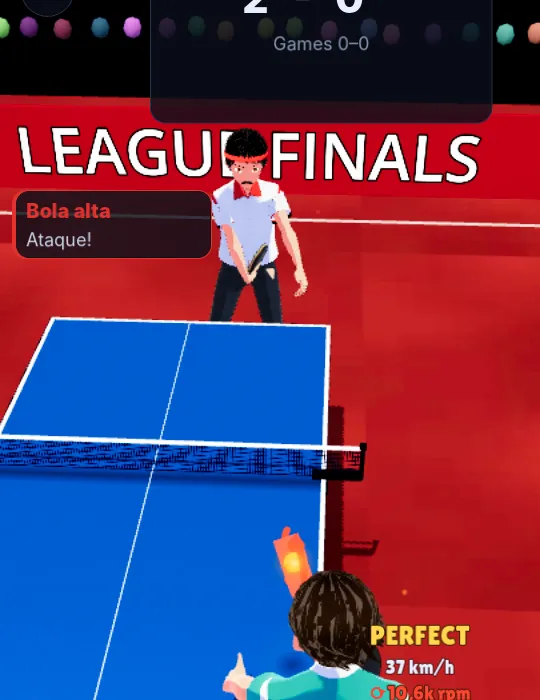
Shot power comes from how fast you swipe. A slow swipe gives a controlled ball; a fast one gives a hard ball, with its speed shown in km/h. But power without margin misses: on a low ball, hitting all out sends it off the table, and the game warns you with Too hard for that ball. When the ball sits up high, you get the opposite hint: High ball, Attack it!
Your game mode also caps your power. In Beginner your shots reach 50% of full power; in Intermediate, 65%; in Advanced, 100%.
Timing: the window for every shot
Timing is what separates a good shot from a bad one. The game works out the exact moment the ball passes closest to your bat and compares it with the moment of your swipe.
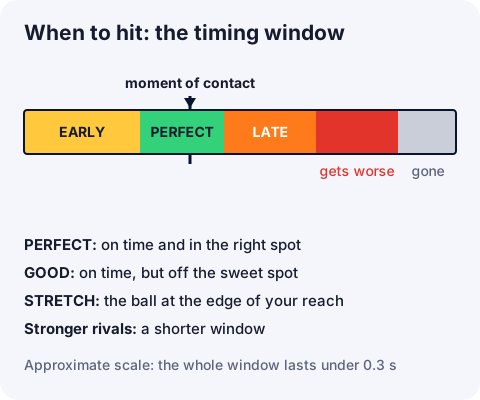
- Early: swipe a bit too soon and the bat waits for the ball and strikes when it arrives, with a penalty.
- On time: it is a PERFECT if you are also in the right spot, close to the ideal contact point. On time but farther away, it is a GOOD.
- Late: the shot still connects, but gets worse and worse until the ball is gone.
- Stretch: the ball went by at the edge of your reach; you still get it, but without quality.
A clean contact also helps against spin: on a PERFECT, part of the incoming spin loses its effect on your return, and on a GOOD, a smaller part. Against stronger rivals the window gets shorter. That is why getting to the ball early matters as much as fast fingers.
Venues with different physics
In Story mode, some venues change the conditions, and the game tells you before the match:
- Uncle Zé's garage: an old wooden table, with a lower bounce.
- Sunset beach and Rooftop at night: a crosswind. Slow balls drift; fast ones cut through.
- Mountain lodge: thin air makes the ball faster, plus snow and wind.
- Orbital station: low gravity, so the ball floats and drops where you least expect it.
Each rival is covered in the Story mode guide.
What about online matches?
In live matches, the game server referees the points. When the connection delays your opponent's ball, the game does not make it jump on screen: it leaves their bat and flies a little faster until it is back on time, before it bounces on your side. Before you join the Ranked queue, the game checks your connection and warns you if the signal is weak.
Frequently asked questions
Does RealTT have real table tennis physics?
Yes. The ball is simulated with gravity, air drag, the Magnus effect, spin decay and friction on the bounce, on a table with official dimensions.
What does PERFECT mean in RealTT?
It is a shot on time and in the right spot. If your timing is right but you are away from the ideal contact point, it becomes a GOOD.
Why does my ball go long in RealTT?
Usually it is your opponent's topspin meeting a bat that is too open. Touch higher in the square to close the bat, or swing softer.
Why does my ball go into the net?
Usually it is backspin returned with a flat bat. Touch lower in the square to open the bat, or lift the ball with an upward swipe.
What does rpm mean in RealTT?
Revolutions per minute: how fast the ball spins after your shot. The higher the rpm, the more spin bends the flight and changes the bounce.