Ping pong rules for beginners: the quick summary
Games go to 11 points and you must win by 2. Each player serves 2 points in a row, the serve bounces once on each side, and during a rally the ball may bounce only once on your side before you hit it back. Whoever makes the mistake loses the point, no matter who served.
In this article
Need to explain ping pong to a PE class, settle an argument in the basement, or just learn the basics before your first club night? This quick summary of the ping pong rules for beginners covers what you need in a few minutes. These are the official ITTF table tennis rules, in the order they come up in a game.
Want every detail, like racket specs and the expedite rule? Read the complete table tennis rules guide. Here we stick to what every beginner needs.
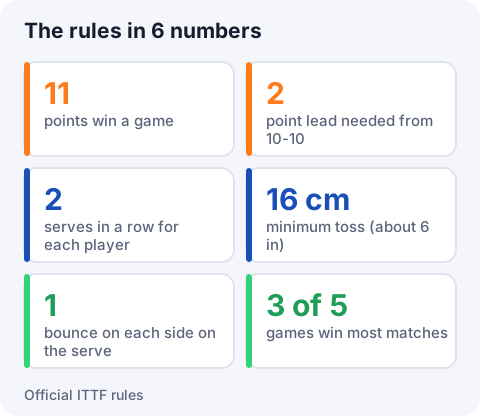
The basic rules in 10 points
- Each game goes to 11 points. At 10-10, you need a 2-point lead to win.
- A match is best of 3, 5 or 7 games. Casual and school events usually play best of 3 or 5.
- Every rally scores a point for the winner, no matter who served.
- Each player serves 2 points in a row. From 10-10, the serve switches every point.
- On the serve, the ball rests on your open palm, rises at least 16 cm (about 6 in) and is hit on the way down, from behind the end line.
- The serve bounces once on your side and once on your opponent's side.
- After the serve, the ball must bounce once on your side before you return it, and your return must land directly on the other side.
- If the serve clips the net and lands in, it is a let: replay it, no point.
- Your free hand cannot touch the table, and no one may move the table or touch the net.
- Players switch ends after each game, and in the last game when someone reaches 5 points.
How you lose a point
It is easier to remember the rules by thinking about what loses you a point:
- missing the serve (net and out, bouncing on one side only, an illegal toss);
- letting the ball bounce twice on your side;
- hitting the ball off the table or into the net;
- hitting the ball before it bounces on your side while it is still over the table or heading toward it;
- putting your free hand on the table, moving the table, or touching the net with your body, clothes or paddle;
- in doubles, hitting the ball out of turn.
What happens at 10-10 and how to call the score are covered in table tennis scoring explained.
Serving: the summary that ends arguments
Two serving rules cause more fights in casual games than all the others combined.
In singles, the serve does not have to go diagonal. It can land anywhere on your opponent's side. The white center line only matters in doubles.
There is no second serve. A missed serve is your opponent's point. Only a let (a serve that clips the net and lands in) is replayed, as many times as it happens.
To learn a legal serve step by step, see how to serve in table tennis.
Singles vs doubles
| Situation | Singles | Doubles |
|---|---|---|
| Where the serve lands | Anywhere on the other side | From your right half to their right half |
| Who hits the ball | The two players alternate | All four alternate: one from each pair in turn |
| Serving order | 2 serves each | A rotation among all four players |
The doubles serving order is the most confusing part. It is explained step by step in table tennis doubles rules.
House rules that are not real rules
Many people learned ping pong with rules that are not in the official rulebook:
- "The serve has to go cross-court": only in doubles.
- "Games go to 21": that was true until 2001. Now it is 11.
- "Whoever wins the point serves": no. The serve switches every 2 points, always.
- "Edge balls don't count": they do, if the ball touches the top edge of the table.
- "If the ball hits your hand, you lose the point": if it hits the hand holding the paddle, below the wrist, the shot is legal.
- "You can serve the ball out of a closed hand": not under the official rules; it must come off an open palm.
In a friendly game you can agree on whatever you like. But if the question is "what is the official rule", the answer is above.
Tips for teachers and beginners
For classes with lots of students and few tables, a few formats keep everyone playing:
- Short games: 1 game to 11 keeps the line moving.
- King of the table: the winner stays, the loser goes to the back of the line.
- Doubles early on: four players per table means twice as many students playing, and everyone practices alternating shots.
For beginners, the most important thing is a legal serve with a proper toss. The rest comes with practice.
Frequently asked questions
What are the basic rules of ping pong?
Games go to 11 with a 2-point lead, each player serves 2 in a row, the serve bounces once on each side, and during a rally the ball bounces only once on your side before you return it.
Does a ping pong serve have to go diagonal?
Only in doubles. In singles, the serve can land anywhere on your opponent's side.
Is ping pong played to 11 or 21?
Official games go to 11 points. Games to 21 were the rule until 2001 and survive only as a house rule.
Can you hit the ball before it bounces in ping pong?
No. If the ball is over the table or heading toward it and you touch it before it bounces, your opponent wins the point.
Is there a second serve in ping pong?
No. A missed serve is a point for your opponent. Only a let, when the ball clips the net and lands in, is replayed.